

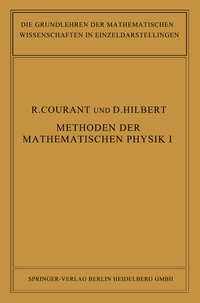
Methoden der Mathematischen Physik
Published on 1. January 1924
Book
Paperback/Softback
XIII, 454 pages
978-3-662-35615-9 (ISBN)
Description
Dieser Buchtitel ist Teil des Digitalisierungsprojekts Springer Book Archives mit Publikationen, die seit den Anfängen des Verlags von 1842 erschienen sind. Der Verlag stellt mit diesem Archiv Quellen für die historische wie auch die disziplingeschichtliche Forschung zur Verfügung, die jeweils im historischen Kontext betrachtet werden müssen. Dieser Titel erschien in der Zeit vor 1945 und wird daher in seiner zeittypischen politisch-ideologischen Ausrichtung vom Verlag nicht beworben.
More details
Series
Edition
Softcover reprint of the original 1st ed. 1924
Language
German
Place of publication
Berlin
Germany
Publishing group
Springer Berlin
Target group
Professional and scholarly
Research
Illustrations
1 s/w Abbildung
XIII, 454 S. 1 Abb.
Dimensions
Height: 235 mm
Width: 155 mm
Thickness: 26 mm
Weight
709 gr
ISBN-13
978-3-662-35615-9 (9783662356159)
DOI
10.1007/978-3-662-36445-1
Schweitzer Classification
Other editions
Additional editions
Richard Courant | David Hilbert
Methoden der Mathematischen Physik
E-Book
12/2013
1st Edition
Springer
€35.96
Available for download
Persons
Biography of Richard Courant
Richard Courant was born in 1888 in a small town of what is now Poland, and died in New Rochelle, N.Y. in 1972. He received his doctorate from the legendary David Hilbert in Göttingen, where later he founded and directed its famed mathematics Institute, a Mecca for mathematicians in the twenties. In 1933 the Nazi government dismissed Courant for being Jewish, and he emigrated to the United States. He found, in New York, what he called "a reservoir of talent" to be tapped. He built, at New York University, a new mathematical Sciences Institute that shares the philosophy of its illustrious predecessor and rivals it in worldwide influence.
For Courant mathematics was an adventure, with applications forming a vital part. This spirit is reflected in his books, in particular in his influential calculus text, revised in collaboration with his brilliant younger colleague, Fritz John.
(P.D. Lax)
Biography of Fritz John
Fritz John was born on June 14, 1910, in Berlin. After his school years in Danzig (now Gdansk, Poland), he studied in Göttingen and received his doctorate in 1933, just when the Nazi regime came to power. As he was half-Jewish and his bride Aryan, he had to flee Germany in 1934. After a year in Cambridge, UK, he accepted a position at the University of Kentucky, and in 1946 joined Courant, Friedrichs and Stoker in building up New York University the institute that later became the Courant Institute of Mathematical Sciences. He remained there until his death in New Rochelle on February 10, 1994.
John's research and the books he wrote had a strong impact on the development of many fields of mathematics, foremost in partial differential equations. He also worked on Radon transforms, illposed problems, convex geometry, numerical analysis, elasticity theory. In connection with his work in latter field, he and Nirenberg introduced the space of the BMO-functions (bounded mean oscillations). Fritz John's work exemplifies the unity of mathematics as well as its elegance and its beauty.
(J. Moser)