

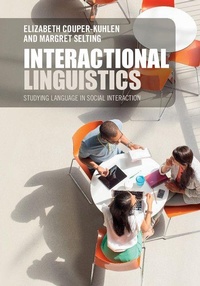
Interactional Linguistics
Studying Language in Social Interaction
Published on 21. December 2017
Book
Hardback
620 pages
978-1-107-03280-4 (ISBN)
Description
The first textbook dedicated to interactional linguistics, focusing on linguistic analyses of conversational phenomena, this introduction provides an overview of the theory and methodology of interactional linguistics. Reviewing recent findings on linguistic practices used in turn construction and turn taking, repair, action formation, ascription, and sequence and topic organization, the book examines the way that linguistic units of varying size - sentences, clauses, phrases, clause combinations, and particles - are mobilized for the implementation of specific actions in talk-in-interaction. A final chapter discusses the implications of an interactional perspective for our understanding of language as well as its variation, diversity, and universality. Supplementary online chapters explore additional topics such as the linguistic organization of preference, stance, footing, and storytelling, as well as the use of prosody and phonetics, and further practices with language. Featuring summary boxes and transcripts from recordings of everyday conversation, this is an essential resource for advanced undergraduate and postgraduate courses on language in social interaction.
Reviews / Votes
'... 'Interactional Linguistics. Studying Language in Social Interaction' is a monumental and well-executed effort, as well as a timely one.' Karolina Zofia Grzech, Linguist List (new.linguistlist.org) '... an impressive compilation of materials otherwise dispersed in journals, books and other academic publications. I envision this book as a primary text for introductory and advanced courses in linguistics for undergraduate and graduate students. ... a key resource for students, instructors and researchers alike.' Francesca A. Williamson, Discourse StudiesMore details
Language
English
Place of publication
Cambridge
United Kingdom
Target group
College/higher education
Professional and scholarly
Dimensions
Height: 250 mm
Width: 175 mm
Thickness: 38 mm
Weight
1253 gr
ISBN-13
978-1-107-03280-4 (9781107032804)
Copyright in bibliographic data and cover images is held by Nielsen Book Services Limited or by the publishers or by their respective licensors: all rights reserved.
Schweitzer Classification
Other editions
Additional editions

Elizabeth Couper-Kuhlen | Margret Selting
Interactional Linguistics
Studying Language in Social Interaction
E-Book
02/2018
Cambridge University Press
€41.49
Available for download
Elizabeth Couper-Kuhlen | Margret Selting
Interactional Linguistics
Studying Language in Social Interaction
Book
12/2017
Cambridge University Press
€58.00
Shipment within 15-20 days

E-Book
12/2017
Cambridge University Press
€35.49
Available for download
Persons
Elizabeth Couper-Kuhlen is Distinguished Professor (emerita) at the University of Helsinki, Finland. She has published widely on prosody and grammar in interaction; in addition to numerous journal articles, she has authored, co-authored and co-edited many volumes on interactional linguistics, including Prosody in Conversation (with Margret Selting, Cambridge, 1996) and Studies in Interactional Linguistics (with Margret Selting, Cambridge, 2001). Margret Selting is Professor of Linguistics and Communication Theory at Universitaet Potsdam, Germany. She has published extensively on prosody and grammar in interaction, including Prosody in Conversation (with Elizabeth Couper-Kuhlen, Cambridge, 1996), Studies in Interactional Linguistics (with Elizabeth Couper-Kuhlen, Cambridge, 2001) and Verstaendigungsprobleme (1987).
Content
Introduction: 1. What is interactional linguistics?; Part I. How Is Interaction Conducted with Linguistic Resources?: 2. Turn construction and turn taking; 3. Repair; 4. Action formation and ascription; 5. Topic and sequence; Part II. How are Linguistic Resources Deployed in Interaction?; 6. Sentences, clauses, and phrases; 7. Clause combinations; 8. One-word constructions: particles; Conclusion: 9. Implications for language theory.