


An Introduction to Forensic Linguistics
Language in Evidence
Published on 30. November 2007
Book
Hardback
240 pages
978-0-415-32024-5 (ISBN)
Description
From the accusation of plagiarism in The Da Vinci Code, to the infamous hoaxer in the Yorkshire Ripper case, the use of linguistic evidence in court and the number of linguists called to act as expert witnesses in court trials has increased rapidly in the past fifteen years. An Introduction to Forensic Linguistics: Language in Evidence provides a timely and accessible introduction to this rapidly expanding subject.
Using knowledge and experience gained in legal settings - Malcolm Coulthard in his work as an expert witness and Alison Johnson in her work as a West Midlands police officer - the two authors combine an array of perspectives into a distinctly unified textbook, focusing throughout on evidence from real and often high profile cases including serial killer Harold Shipman, the Bridgewater Four and the Birmingham Six.
Divided into two sections, 'The Language of the Legal Process' and 'Language as Evidence', the book covers the key topics of the field. The first section looks at legal language, the structures of legal genres and the collection and testing of evidence from the initial police interview through to examination and cross-examination in the courtroom. The second section focuses on the role of the forensic linguist, the forensic phonetician and the document examiner, as well as examining in detail the linguistic investigation of authorship and plagiarism.
With research tasks, suggested reading and website references provided at the end of each chapter, An Introduction to Forensic Linguistics: Language in Evidence is the essential textbook for courses in forensic linguistics and language of the law.
Using knowledge and experience gained in legal settings - Malcolm Coulthard in his work as an expert witness and Alison Johnson in her work as a West Midlands police officer - the two authors combine an array of perspectives into a distinctly unified textbook, focusing throughout on evidence from real and often high profile cases including serial killer Harold Shipman, the Bridgewater Four and the Birmingham Six.
Divided into two sections, 'The Language of the Legal Process' and 'Language as Evidence', the book covers the key topics of the field. The first section looks at legal language, the structures of legal genres and the collection and testing of evidence from the initial police interview through to examination and cross-examination in the courtroom. The second section focuses on the role of the forensic linguist, the forensic phonetician and the document examiner, as well as examining in detail the linguistic investigation of authorship and plagiarism.
With research tasks, suggested reading and website references provided at the end of each chapter, An Introduction to Forensic Linguistics: Language in Evidence is the essential textbook for courses in forensic linguistics and language of the law.
More details
Language
English
Place of publication
London
United Kingdom
Publishing group
Taylor & Francis Ltd
Target group
College/higher education
Illustrations
2 s/w Tabellen
2 Tables, black and white
Dimensions
Height: 229 mm
Width: 152 mm
Weight
476 gr
ISBN-13
978-0-415-32024-5 (9780415320245)
Copyright in bibliographic data is held by Nielsen Book Services Limited or its licensors: all rights reserved.
Schweitzer Classification
Other editions
New editions
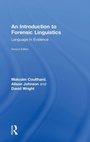
Malcolm Coulthard | Alison Johnson | David Wright
An Introduction to Forensic Linguistics
Language in Evidence
Book
07/2016
2nd Edition
Routledge
€261.30
Shipment within 10-20 days
Additional editions
Book
10/2014
1st Edition
Routledge
€64.56
Article exhausted; check for reprint
Content
Chapter 1. Approaching a Forensic Text Chapter 2. The Language of the Law Chapter 3. Legal genres Chapter 4. Collecting Evidence Chapter 5. Order in Court Chapter 6. The Work of the Forensic Linguist Chapter 7. The Work of the Forensic Phonetician and the Document Examiner Chapter 8. Idiolect and uniqueness of encoding Chapter 9. On Textual Borrowing Chapter 10. The Linguist as Expert Witness