

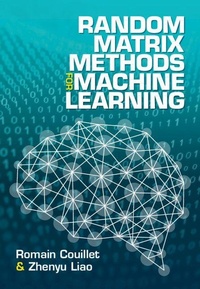
Random Matrix Methods for Machine Learning
Published on 21. July 2022
Book
Hardback
408 pages
978-1-009-12323-5 (ISBN)
Description
This book presents a unified theory of random matrices for applications in machine learning, offering a large-dimensional data vision that exploits concentration and universality phenomena. This enables a precise understanding, and possible improvements, of the core mechanisms at play in real-world machine learning algorithms. The book opens with a thorough introduction to the theoretical basics of random matrices, which serves as a support to a wide scope of applications ranging from SVMs, through semi-supervised learning, unsupervised spectral clustering, and graph methods, to neural networks and deep learning. For each application, the authors discuss small- versus large-dimensional intuitions of the problem, followed by a systematic random matrix analysis of the resulting performance and possible improvements. All concepts, applications, and variations are illustrated numerically on synthetic as well as real-world data, with MATLAB and Python code provided on the accompanying website.
Reviews / Votes
'Roman Couillet's book is unique among books on random matrix theory in that it provides a solid yet accessible introduction to the theory and its transformative potential in applications. After presenting a coherent and uncluttered introduction of the theory, several chapters illustrate how it applies to important problems, including, high dimensional statistical inference, neural networks, random graphs, and convex optimization. Written in a self-contained and exceptionally clear style this book will be of great utility to researchers in machine learning, statistics and signal processing who want to learn about how random matrix theory can be applied.' Alfred Hero, University of Michigan 'This book is a reference for all engineers and researchers interested in the recent mathematical advances in Machine Learning. It's a real 'tour de force' that fruitfully combines the mathematical elegance of random matrix theory methods with an impressive range of real-world applications.' Merouane Debbah, Huawei France Research Center 'This is a very timely and important book. Romain Couillet and Zhenyu Liao provide a great entry point into active, recent research on the applications of Random Matrix Theory as it pertains to high-dimensional statistics and analysis of machine learning algorithms. RMT was born in statistics with Wishart and later became, via Wigner, a great pillar of quantum and statistical before being recently pushed by mathematicians to deeper universality results. It is quite fitting that it now comes back to the modern problems and methods of statistics with this very well-organized and carefully written book by two leading experts.' Gerard Ben Arous, Courant Institute of Mathematical Sciences, New York UniversityMore details
Language
English
Place of publication
Cambridge
United Kingdom
Target group
Professional and scholarly
Edition type
New edition
Product notice
sewn/stitched
Cloth over boards
Illustrations
Worked examples or Exercises
Dimensions
Height: 247 mm
Width: 173 mm
Thickness: 24 mm
Weight
890 gr
ISBN-13
978-1-009-12323-5 (9781009123235)
Copyright in bibliographic data and cover images is held by Nielsen Book Services Limited or by the publishers or by their respective licensors: all rights reserved.
Schweitzer Classification
Other editions
Additional editions
Romain Couillet | Zhenyu Liao
Random Matrix Methods for Machine Learning
E-Book
07/2022
Cambridge University Press
€68.49
Available for download
Persons
Romain Couillet is a Full Professor at Grenoble-Alpes University, France. Prior to that, he was a Full Professor at CentraleSupélec, University of Paris-Saclay. His research topics are in random matrix theory applied to statistics, machine learning, and signal processing. He is the recipient of the 2021 IEEE/SEE Glavieux prize, of the 2013 CNRS Bronze Medal, and of the 2013 IEEE ComSoc Outstanding Young Researcher Award.
Content
Preface; 1. Introduction; 2. Random matrix theory; 3. Statistical inference in Linear Models; 4. Kernel methods; 5. Large neural networks; 6. Large dimensional convex optimization; 7. Community detection on graphs; 8. Universality and real data; Bibliography; Index.