

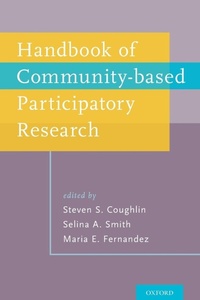
Handbook of Community-Based Participatory Research
Published on 2. March 2017
Book
Paperback/Softback
304 pages
978-0-19-065223-4 (ISBN)
Description
Community-based participatory research (CBPR) emerged in response to the longstanding tradition of "top-down" research-studies in which social scientists observe social phenomena and community problems as outsiders, separate from the participants' daily lives. CBPR is more immersive, fostering partnerships between academic and community organizations that increase the value and consequence of the research for all partners. The current perspectives gleaned from this school of research have been wildly well-received, in no small part because they address the complexity of the human experience in their conclusions.
HANDBOOK OF COMMUNITY-BASED PARTICIPATORY RESEARCH codifies the methods and theories of this research approach and articulates an expansive vision of health that includes gender equality, safe and adequate housing, and freedom from violence. Topic-based chapters apply the theory and methods of CBPR to real world problems affecting women, ethnic and racial minorities, and immigrant communities such as sexual violence, exposure to environmental toxins, and lack of access to preventive care as well as suggesting future directions for effective, culturally sensitive research.
HANDBOOK OF COMMUNITY-BASED PARTICIPATORY RESEARCH is required reading for academics, policy makers, and students seeking meaningful social change through scholarship.
HANDBOOK OF COMMUNITY-BASED PARTICIPATORY RESEARCH codifies the methods and theories of this research approach and articulates an expansive vision of health that includes gender equality, safe and adequate housing, and freedom from violence. Topic-based chapters apply the theory and methods of CBPR to real world problems affecting women, ethnic and racial minorities, and immigrant communities such as sexual violence, exposure to environmental toxins, and lack of access to preventive care as well as suggesting future directions for effective, culturally sensitive research.
HANDBOOK OF COMMUNITY-BASED PARTICIPATORY RESEARCH is required reading for academics, policy makers, and students seeking meaningful social change through scholarship.
Reviews / Votes
An invaluable guide for readers, including students, practitioners, researchers, and community members, towards understanding the strengths and challenges of this methodology through practical examples, and a great resource for the application of proven CBPR methods to public health challenges. * American Journal of Clinical Nutrition *More details
Language
English
Place of publication
New York
United States
Target group
Professional and scholarly
Product notice
Paperback (trade)
Unsewn / adhesive bound
Dimensions
Height: 231 mm
Width: 155 mm
Thickness: 20 mm
Weight
431 gr
ISBN-13
978-0-19-065223-4 (9780190652234)
Copyright in bibliographic data and cover images is held by Nielsen Book Services Limited or by the publishers or by their respective licensors: all rights reserved.
Schweitzer Classification
Other editions
Additional editions
Steven S. Coughlin | Selina A. Smith | Maria E. Fernandez
Handbook of Community-Based Participatory Research
E-Book
01/2017
1st Edition
OUP eBook
€65.99
Available for download
Steven S. Coughlin | Selina A. Smith | Maria E. Fernandez
Handbook of Community-Based Participatory Research
E-Book
01/2017
1st Edition
OUP eBook
€65.99
Available for download
Persons
Steven S. Coughlin, Ph.D, is Associate Professor at Augusta University and Adjunct Professor of Epidemiology at Emory University. Until recently, he was a Visiting Professor in the College of Health Sciences at the University of Massachusetts, Lowell. Until 2014, he was Professor of Preventive Medicine at the University of Tennessee College of Medicine in Memphis and Director of the Research Core for the Research Center on Health Disparities, Equity, and the Exposome. Previously, he was a senior epidemiologist in the Division of Cancer Prevention and Control at CDC in Atlanta.
Maria E. Fernandez, Ph.D, is Professor of Health Promotion and Behavioral Sciences at the University of Texas, School of Public Health (SPH) and Director of the Center for Health Promotion and Prevention Research (CHPPR).
Selina A. Smith, Ph.D, MDiv, is the Director of the Augusta University (AU) Institute of Public and Preventive Health (IPPH). The IPPH is AU's first public health institute (established in 2012). Dr. Smith holds appointments as Professor and Curtis G. Hames, MD Distinguished Chair, Department of Family Medicine, Medical College of Georgia (MCG) and Member, Population Sciences, Cancer Center.
Maria E. Fernandez, Ph.D, is Professor of Health Promotion and Behavioral Sciences at the University of Texas, School of Public Health (SPH) and Director of the Center for Health Promotion and Prevention Research (CHPPR).
Selina A. Smith, Ph.D, MDiv, is the Director of the Augusta University (AU) Institute of Public and Preventive Health (IPPH). The IPPH is AU's first public health institute (established in 2012). Dr. Smith holds appointments as Professor and Curtis G. Hames, MD Distinguished Chair, Department of Family Medicine, Medical College of Georgia (MCG) and Member, Population Sciences, Cancer Center.
Editor
Associate ProfessorAssociate Professor, College of Allied Health Sciences, Augusta University
DirectorDirector, Institute of Public and Preventative Health, Augusta University
DirectorDirector, Department of Health Promotion and Behavioral Sciences, University of Texas School of Public Health
Content
Contributors
Preface
1. Overview of Community-based Participatory Research
2. Community-based Participatory Research Study Approaches along a Continuum of Community-Engaged Research
3. Research Methods and Community-based Participatory Research: Challenges and Opportunities
4. The use of GIS and Spatial Analyses in Community-based Participatory Research
5. Ethical Issues in Community-based Participatory Research Studies
6. Participatory Research Studies in Faith-based Settings
7. Special Issues in Conducting Community-based Participatory Research Studies with Ethnic and Racial Minorities
8. Community-based Participatory Research Studies Involving Immigrants
9. Applying a Community-based Participatory Research Approach to Address Determinants of Cardiovascular Disease and Diabetes Mellitus in an Urban Setting
10. Community-based Participatory Research Addressing Infant Mortality
11. Community-based Participatory Research Studies on Colorectal Cancer Screening
12. Community-based Participatory Research Studies on Breast and Cervical Cancer Screening
13. Community-based Participatory Research Studies on Environmental Health
14. Community-based Participatory Research Studies on Interpersonal Violence: Ending the Cycle of Poverty and Violence
15. Using Community-based Participatory Research Approaches in HIV: Three Case Studies
16. Engaging Communities in Translational Research
17. Summary and Conclusions
Index
Preface
1. Overview of Community-based Participatory Research
2. Community-based Participatory Research Study Approaches along a Continuum of Community-Engaged Research
3. Research Methods and Community-based Participatory Research: Challenges and Opportunities
4. The use of GIS and Spatial Analyses in Community-based Participatory Research
5. Ethical Issues in Community-based Participatory Research Studies
6. Participatory Research Studies in Faith-based Settings
7. Special Issues in Conducting Community-based Participatory Research Studies with Ethnic and Racial Minorities
8. Community-based Participatory Research Studies Involving Immigrants
9. Applying a Community-based Participatory Research Approach to Address Determinants of Cardiovascular Disease and Diabetes Mellitus in an Urban Setting
10. Community-based Participatory Research Addressing Infant Mortality
11. Community-based Participatory Research Studies on Colorectal Cancer Screening
12. Community-based Participatory Research Studies on Breast and Cervical Cancer Screening
13. Community-based Participatory Research Studies on Environmental Health
14. Community-based Participatory Research Studies on Interpersonal Violence: Ending the Cycle of Poverty and Violence
15. Using Community-based Participatory Research Approaches in HIV: Three Case Studies
16. Engaging Communities in Translational Research
17. Summary and Conclusions
Index