

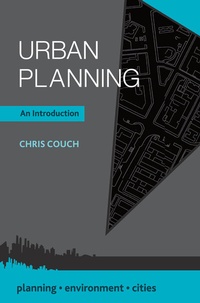
Urban Planning
An Introduction
Published on 8. January 2016
Book
Paperback/Softback
340 pages
978-1-137-42756-4 (ISBN)
Description
This is a wide-ranging and internationally-focussed introduction to planning for the urban landscape. It provides an up-to-date account of planning, reflecting throughout on the need for sustainable, efficient and equitable solutions to planning problems. Taking account of the sometimes conflicting expectations of markets, citizens, public organizations and planners, it demonstrates the similarities of challenges faced in different national planning systems.
The author traces the historical evolution of planning and urban governance, and explores the range of urban problems and policies likely to be found in almost any city in the developed world. Combining the latest theory in the field with practical insight and numerous illustrative case studies, the author comprehensively addresses issues of economic change and development; retailing and the role of urban centres; housing provision and neighbourhood renewal; urban design and conservation; green and blue infrastructure; and mobility and accessibility.
Assuming no prior knowledge of the subject, this text is the ideal accessible introduction to the planning field, giving equal focus to both theory and practice. Whilst celebrating the work of planners, it also provides essential critical analysis of how key decisions are made and implemented, the benefits and limitations of planning, and ultimately its potential in achieving 'good city form'.
The author traces the historical evolution of planning and urban governance, and explores the range of urban problems and policies likely to be found in almost any city in the developed world. Combining the latest theory in the field with practical insight and numerous illustrative case studies, the author comprehensively addresses issues of economic change and development; retailing and the role of urban centres; housing provision and neighbourhood renewal; urban design and conservation; green and blue infrastructure; and mobility and accessibility.
Assuming no prior knowledge of the subject, this text is the ideal accessible introduction to the planning field, giving equal focus to both theory and practice. Whilst celebrating the work of planners, it also provides essential critical analysis of how key decisions are made and implemented, the benefits and limitations of planning, and ultimately its potential in achieving 'good city form'.
Reviews / Votes
'A clear and up-to-date account of the principles on which towns and cities around the world have responded to change and sought to shape their futures.' - Michael Hebbert, University College London, UK 'Drawing on international comparisons and weaving together theory and practice, this important book provides a magisterial overview of planning and the challenges it faces.' - Greg Lloyd, Ulster University, UKMore details
Series
Edition
1st ed. 2016
Language
English
Place of publication
London
United Kingdom
Publishing group
Bloomsbury Publishing PLC
Target group
College/higher education
Dimensions
Height: 234 mm
Width: 156 mm
Thickness: 19 mm
Weight
524 gr
ISBN-13
978-1-137-42756-4 (9781137427564)
DOI
10.1007/978-1-137-42758-8
Schweitzer Classification
Other editions
Additional editions
Book
01/2016
Red Globe Press
€163.80
Shipment within 10-20 days
Person
Chris Couch is Emeritus Professor of Urban Planning at Liverpool John Moores University and teaches at the University of Liverpool, UK. He has published widely on matters of urban planning and regeneration.
Content
Introduction.- 1. The Evolution of Urban Change and Planning.- 2. Governance and the Implementation in Planning.- 3. Sustainable Development and the Goals of Planning.- 4. Economic Change, Development and Urban Planning.- 5. Retailing, Central Areas and Urban Planning.- 6. Housing and Neighbourhood Issues in Urban Planning.- 7. Placemaking: Urban Design and Conservation in Urban Planning.- 8. Mobility, Accessibility and Urban Planning.- 9. Conclusions.