

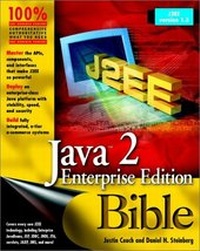
Java 2 Enterprise Edition Bible
Published on 15. April 2002
Book
Paperback/Softback
XXIV, 936 pages
978-0-7645-0882-0 (ISBN)
Description
Sun Microsystems' Java 2 Platform, Enterprise Edition (J2EE) defines the standard for developing multitier enterprise applications - and the "Java 2 Enterprise Edition Bible" defines the standard for comprehensive coverage of this exciting development tool! This book covers all the primary technologies of J2EE, including: Enterprise JavaBeans, Java Server Pages, servlets, the Java Naming and Directory Interface (JNDI), the Java Transaction API (JTA), CORBA, and the JDBC data access API. It also explains how XML works with Java. Developers can rely on this book to provide detail on developing and deploying a complete, stable, secure, fast Java platform to the enterprise level.
More details
Persons
Justin Couch spends most of his time in Australia but travels extensively in the United States and England as a trainer and consultant. He is the author of Java 2 Bible (Hungry Minds) and Java 2 Networking (McGraw--Hill). Daniel H. Steinberg is from Oberlin, Ohio where he is a Mathematics Professor at Oberlin College. He is coauthor of Java 2 Bible and editor of IBM's developerWorks JavaZone.
Content
Preface. Acknowledgments. Part I: Getting Started. Chapter 1: Defining the Enterprise. Chapter 2: Introducing Enterprise Applications. Part II: Delivering Content. Chapter 3: Creating Dynamic Content with Servlets. Chapter 4: Using Java Server Pages. Chapter 5: Sending and Receiving Mail With JavaMail. Part III: Finding Things with Databases and Searches. Chapter 6: Interacting with Relational Databases. Chapter 7: Using JDBC to Interact with SQL Databases. Chapter 8: Working with Directory Services and LDAP. Chapter 9: Accessing Directory Services with JNDI. Part IV: Communicating Between Systems With XML. Chapter 10: Building an XML Foundation. Chapter 11: Describing Documents with DTDs and Schemas. Chapter 12: Parsing Documents with JAXP. Chapter 13: Interacting with XML Using JDOM. Chapter 14: Transforming and Binding Your XML Documents. Part V: Abstracting the System. Chapter 15: Exploring the RMI Mechanism. Chapter 16: Introducing Enterprise JavaBeans. Chapter 17: Using Advanced EJB Techniques. Chapter 18: Introducing CORBA. Chapter 19: CORBA Applications in the Enterprise. Chapter 20: Why Dream of Jini? Part VI: Building Big Systems. Chapter 21: Implementing Web Services. Chapter 22: JMS. Chapter 23: Managing Transactions with JTA/JTS. Chapter 24: System Architecture Issues. Chapter 25: J2EE Design Patterns. Appendix A: Installing the J2EE Reference Implementation. Appendix B: J2EE API Version Requirements. Appendix C: J2EE Vendors and Systems. Glossary. Index.