

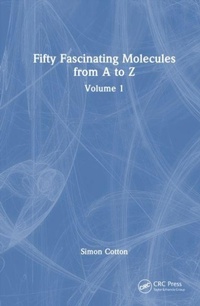
Fifty Fascinating Molecules from A to Z
Description
Fifty Fascinating Molecules From A to Z, Volume 1 follows on from the author's earlier Every Molecule Tells a Story and Every Molecule Matters, and also relate the stories of a wide range of molecules.
They encompass familiar names - medicines including aspirin, cisplatin and morphine; flavourings such as menthol and vanilla; and substances of abuse like cocaine and methamphetamine. But there are the unexpected, like the poisons that crop in the stories of James Bond and Dr Crippen; the molecules that give chillies and mustard their particular charm; the polymers that the 20th century made a part of everyday life - polythene, nylon and terylene; and other everyday molecules, such as hexenal, with a role in the smell of a summer's day; dimethyl sulphide, which will takes you to the seaside, and water, a substance that so many take for granted. It is not just about molecules. Chemicals like the medicines that we rely on were brought to use by scientists. Read about these molecules and their creators here.
Key Features
-
Many important medicinal molecules are featured, including Artemisinin; Aspirin; Atropine; Cisplatin; Codeine; Ivermectin; Mefloquine; Morphine; Paracetamol; Penicillin; Quinine; Streptomycin; Sulfanilamide; Taxol; Tetracycline; and Thalidomide.
-
Numerous abused drugs of importance are featured, including Cathinones & Khat; Cocaine; Desomorphine; Fentanyl; Heroin (Morphine); LSD; Methamphetamine; and Oxycodone; 'Spice'.
-
Several important polymers are discussed, including Nylon; Polythene; and Terylene.
-
Several molecules important in the environment are included, such as Dichlorodifluoromethae (CF2Cl2); Chloromethane; Dimethylsulfide; Octane (and isooctane); Water.
-
The text also covers a number of molecules with particular smells and/or flavours, such as 2-acetylpyrroline; Capsaicin; Chanel No. 5; Cinnamaldehyde; Limonene; Menthol; and Vanillin.
-
The book is complemented by a widely encompassing bibliography of approaching 1000 references from the original literature, which supply all the background you could reasonably expect for each one of the molecules detailed in all the chapters.
More details
Other editions
Additional editions
Person
Simon Cotton obtained his BSc and PhD in the Chemistry department of Imperial College London, followed by research and teaching appointments at Queen Mary College, London, and the University of East Anglia. He subsequently taught chemistry in both state and independent schools for over 30 years, then in 2011 he became an honorary senior lecturer in Chemistry at the University of Birmingham, where for five years he taught inorganic and organic chemistry. He has published research on the chemistry of iron, cobalt, scandium, yttrium and the lanthanide elements in particular.
His "Soundbite Molecules" feature ran as a regular column in the magazine
Education in Chemistry from 1996 to 2012, reaching every secondary school in the UK. He has written over 100 "Molecules of the Month" articles, which are featured online at
http://www.chm.bris.ac.uk/motm/motm.htm and recognised globally. Additionally, he has delivered over forty "Chemistry in Its Element" podcasts for the Royal Society of Chemistry's Chemistry World website at http://www.rsc.org/chemistryworld/.
In 2005 he shared the Royal Society of Chemistry Schools Education Award and in 2014 was awarded the British Empire Medal for his work in chemistry and education.
He was editor of "Lanthanide and Actinide Compounds" for the Dictionary of
Organometallic Compounds and the Dictionary of Inorganic Compounds (Chapman and Hall) between 1984 and 1997. He wrote the account of lanthanide coordination chemistry for the second edition of Comprehensive Coordination Chemistry the accounts of lanthanide inorganic and coordination chemistry for the first and second editions of the Encyclopedia of Inorganic Chemistry.
This is his tenth book; his previous books are
D. J. Cardin, S. A. Cotton, M. Green, and J. A. Labinger, Organometallic Compounds of the Lanthanides, Actinides and Early Transition Metals, 1985.
S. A. Cotton, Building The Late Mediaeval Suffolk Parish Church, 2019.
S. A. Cotton, Chemistry of Precious Metals, 1997.
S. A. Cotton, Every Molecule Tells a Story, 2012: second edition 2026.
S. A. Cotton, Every Molecule Matters
S. A. Cotton, Lanthanide and Actinide Chemistry, 2006; second edition 2024.
S. A. Cotton, Lanthanides and Actinides, 1991.
S. A. Cotton and F. A. Hart, The Heavy Transition Elements, 1975.
P. W. May and S. A. Cotton, Molecules That Amaze Us, 2015.
Content
Preface. Acknowledgments. Chapter 1 2-acetyl-1-pyrroline. Chapter 2 A-234 and the Novichok agents. Chapter 3 Allyl isothiocyanate. Chapter 4 Artemisinin. Chapter 5 Aspirin. Chapter 6 Atropine. Chapter 7 Capsaicin. Chapter 8 Cathinones + Khat. Chapter 9 CF2Cl2 and chlorofluorocarbons. Chapter 10 Chanel no 5 and 2-methylundecanal. Chapter 11 Chloromethane. Chapter 12 Cinnamaldehyde. Chapter 13 Cisplatin and other platinum anticancer drugs. Chapter 14 Cocaine. Chapter 15 Codeine, oxycodone and desomorphine. Chapter 16 Dimethylmercury. Chapter 17 Dimethylsulfide. Chapter 18 Fentanyl and its homologues. Chapter 19 Hexenal and green grass. Chapter 20 Ivermectin. Chapter 21 Limonene. Chapter 22 LSD. Chapter 23 Mefloquine and some other synthetic antimalarial drugs. Chapter 24 Menthol. Chapter 25 Methamphetamine. Chapter 26 Morphine (and heroin). Chapter 27 Muscone and synthetic musks. Chapter 28 Nylon. Chapter 29 Octanal. Chapter 30 Octane and its isomers. Chapter 31 Paracetamol, Tylenol and other coal-tar derived painkillers. Chapter 32 Penicillin. Chapter 33 Polythene. Chapter 34 Quinine. Chapter 35 Scopolamine. Chapter 36 "Spice". Chapter 37 Streptomycin. Chapter 38 Sulfanilamide. Chapter 39 Taxol. Chapter 40 Terylene. Chapter 41 Tetracycline and other members of the family. Chapter 42 Tetraethyl lead. Chapter 43 Tetrodotoxin. Chapter 44 Thalidomide. Chapter 45 Vanillin. Chapter 46 Vaska's compound. Chapter 47 VX, sarin and other early nerve agents. Chapter 48 Water. Chapter 49 Wilkinson's catalyst. Chapter 50 Zingerone. Bibliography. Index