

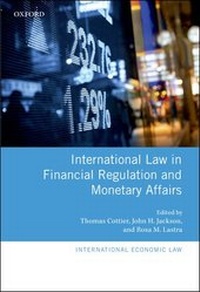
International Law in Financial Regulation and Monetary Affairs
Published on 4. October 2012
Book
Hardback
470 pages
978-0-19-966819-9 (ISBN)
Description
The early twenty-first century has seen a conspicuous absence of formal international law concerning money and finance. This book argues that this lack of formal international regulation was a significant contributing factor to the global financial crisis that began in 2007. It focuses on this lack of global substantive principles and 'hard law' rules in the field of financial regulation and monetary affairs, and analyses the emerging framework within international law that aims to govern financial institutions and markets. The global financial crisis has demonstrated the essential need for financial and monetary regulatory reform, and for the establishment of appropriate mechanisms for the settlement of financial disputes and for the regulation of cross-border financial institutions. This book therefore presents the foundations of solutions that could fill these critical gaps in international financial law. It addresses cross-border issues, financial regulation, and provides detailed analyses of monetary policies and regulation.
This book is an updated collection of papers first published in the Special Edition of the Journal of International Economic Law on 'The Quest for International Law in Financial Regulation and Monetary Affairs' (Volume 12, Number 3, September 2010), which also show that the regulatory hands-off approach was not replicated in other areas of international economic law. International trade regulation witnessed an increased number of international rules and the reinforcement of a rule-oriented, if not rule-based, approach. Judicial dispute settlement and retaliation, exclusively based upon international ruling and authorization, was reinforced. Given the importance of trade regulation and WTO law, which has an established institutional and legal framework, the book therefore provides a much-needed comparative approach.
This book is an updated collection of papers first published in the Special Edition of the Journal of International Economic Law on 'The Quest for International Law in Financial Regulation and Monetary Affairs' (Volume 12, Number 3, September 2010), which also show that the regulatory hands-off approach was not replicated in other areas of international economic law. International trade regulation witnessed an increased number of international rules and the reinforcement of a rule-oriented, if not rule-based, approach. Judicial dispute settlement and retaliation, exclusively based upon international ruling and authorization, was reinforced. Given the importance of trade regulation and WTO law, which has an established institutional and legal framework, the book therefore provides a much-needed comparative approach.
More details
Series
Language
English
Place of publication
Oxford
United Kingdom
Target group
Professional and scholarly
Dimensions
Height: 240 mm
Width: 170 mm
Thickness: 32 mm
Weight
860 gr
ISBN-13
978-0-19-966819-9 (9780199668199)
Copyright in bibliographic data and cover images is held by Nielsen Book Services Limited or by the publishers or by their respective licensors: all rights reserved.
Schweitzer Classification
Other editions
Additional editions
John H. Jackson Rosa M. Lastra Thomas Cottier
International Law in Financial Regulation and Monetary Affairs
E-Book
10/2012
1st Edition
OUP Oxford
€138.89
Available for download
John H. Jackson Rosa M. Lastra Thomas Cottier
International Law in Financial Regulation and Monetary Affairs
E-Book
10/2012
1st Edition
OUP Oxford
€123.49
Available for download
Persons
John H. Jackson is University Professor at the Georgetown University Law Center in Washington, D.C.. He has served as Associate Vice President for Academic Affairs at the University of Michigan and as General Counsel for the Office of the President's Special Representative for Trade in the U.S. Executive Office of the President in Washington, D.C. He is a member of the editorial board for The World Economy and a past member of the editorial boards for the International Bar Association and the Journal of World Trade Law. In 1992 he received the Wolfgang Friedmann Memorial Award for lifelong contribution to the field of international law from the Columbia University Journal of Transnational Law. He has published numerous books, articles, and chapters. He is founding Editor-in-Chief of the Journal of International Economic Law (JIEL), published by Oxford University Press.
Thomas Cottier, Managing Director of the World Trade Institute and the Institute of European and International Economic Law, is Professor of European and International Economic Law at the University of Bern. He directs the national research programme on trade law and policy (NCCR Trade Regulation: From Fragmentation to Coherence) located at the WTI. He is an associate editor of several journals. He was a visiting professor at the Graduate Institute, Geneva and also currently teaches at the Europa Institut Saarbruecken, Germany and at Wuhan University, China. He was a member of the Swiss National Research Council from 1997 to 2004 and served on the board of the International Plant Genetic Resources Institute (IPGRI) Rome during the same period. He served the Baker & McKenzie law firm as Of Counsel from 1998 to 2005. Prof. Cottier has a long-standing involvement in GATT/WTO activities. He served on the Swiss negotiating team of the Uruguay Round from 1986 to 1993 and as Chief negotiator on TRIPs.
Dr. Rosa Maria Lastra is Professor in International Financial and Monetary Law at the Centre for Commercial Law Studies (CCLS), Queen Mary, University of London. She is a member of Monetary Committee of the International Law Association (MOCOMILA), a founding member of the European Shadow Financial Regulatory Committee (ESFRC), an associate of the Financial Markets Group of the London School of Economics and Political Science, and an affiliated scholar of the Centre for the Study of Central Banks at New York University School of Law. From 2008 to 2010 she is also Visiting Professor of the University of Stockholm. She has served as a consultant to the International Monetary Fund, the European Central Bank, the World Bank, the Asian Development Bank and the Federal Reserve Bank of New York. From November 2008 to June 2009 she acted as Specialist Adviser to the European Union Committee [Sub-Committee A] of the House of Lords regarding its Inquiry into EU Financial Regulation.
Thomas Cottier, Managing Director of the World Trade Institute and the Institute of European and International Economic Law, is Professor of European and International Economic Law at the University of Bern. He directs the national research programme on trade law and policy (NCCR Trade Regulation: From Fragmentation to Coherence) located at the WTI. He is an associate editor of several journals. He was a visiting professor at the Graduate Institute, Geneva and also currently teaches at the Europa Institut Saarbruecken, Germany and at Wuhan University, China. He was a member of the Swiss National Research Council from 1997 to 2004 and served on the board of the International Plant Genetic Resources Institute (IPGRI) Rome during the same period. He served the Baker & McKenzie law firm as Of Counsel from 1998 to 2005. Prof. Cottier has a long-standing involvement in GATT/WTO activities. He served on the Swiss negotiating team of the Uruguay Round from 1986 to 1993 and as Chief negotiator on TRIPs.
Dr. Rosa Maria Lastra is Professor in International Financial and Monetary Law at the Centre for Commercial Law Studies (CCLS), Queen Mary, University of London. She is a member of Monetary Committee of the International Law Association (MOCOMILA), a founding member of the European Shadow Financial Regulatory Committee (ESFRC), an associate of the Financial Markets Group of the London School of Economics and Political Science, and an affiliated scholar of the Centre for the Study of Central Banks at New York University School of Law. From 2008 to 2010 she is also Visiting Professor of the University of Stockholm. She has served as a consultant to the International Monetary Fund, the European Central Bank, the World Bank, the Asian Development Bank and the Federal Reserve Bank of New York. From November 2008 to June 2009 she acted as Specialist Adviser to the European Union Committee [Sub-Committee A] of the House of Lords regarding its Inquiry into EU Financial Regulation.
Editor
Managing Director, World Trade Institute; Professor for European and International Economic Law, University of Bern; Director, Institute of European and International Economic Law
Professor of Law at Georgetown University, Director of the Institute of International Economic Law, Georgetown University Law Center
Professor of International Financial and Monetary Law, Centre for Commercial Law Studies, Queen Mary University of London
Content
Introduction ; I. THE CRISIS OF 2007-2009: NATURE, CAUSES, AND REACTIONS ; 1. The Crisis Of 2007-09: Nature, Causes, and Reactions ; II. ARCHITECTURE AND CONCEPTUAL ISSUES ; 2. Systemic Regulation Of Global Trade and Finance: A Tale of Two Systems ; 3. The International Monetary System: A Look Back Over Seven Decades ; 4. Towards a New Architecture for Financial Stability: Seven Principles ; 5. Why Soft Law Dominates International Finance - and Not Trade ; 6. The 'Santiago Principles' for Sovereign Wealth Funds: A Case Study on International Financial Standard-Setting Processes ; III. FINANCIAL MARKET REGULATION ; 7. The Role and Prospects of International Law in Financial Regulation and Supervision ; 8. Multilayered Governance in International Financial Regulation and Supervision ; 9. Border Problems ; 10. The International Law of Financial Crisis: Spillovers, Subsidiarity, Fragmentation, and Cooperation ; 11. Addressing Government Failure Through International Financial Law ; 12. Reducing Systemic Risk Through The Reform of Capital Regulation ; 13. The Role of Transparency in Financial Regulation ; 14. Global Securities Regulation After The Financial Crisis ; IV. TRADE, COMPETITION, AND TAX RELATED ASPECTS ; 15. What Role for Non-Discrimination and Prudential Standards in International Financial Law? ; 16. Financial Services Trade After The Crisis: Policy and Legal Conjectures ; 17. WTO Subsidies Discipline During and After The Crisis ; 18. The Role of Competition and State Aid Policy in Financial and Monetary Law ; 19. International Regulatory Reform and Financial Taxes ; V. MONETARY REGULATION ; 20. The Role of International Law in Monetary Affairs ; 21. Financial Stability and Monetary Policy: Need for International Surveillance ; 22. Enhancing The IMF's Regulatory Authority ; Conclusion