

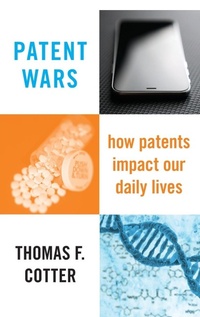
Patent Wars
How Patents Impact Our Daily Lives
Published on 12. July 2018
Book
Hardback
360 pages
978-0-19-024443-9 (ISBN)
Description
Patents are ubiquitous in contemporary life. Practically everything we use incorporates one or more patented inventions, and recent years have witnessed epic disputes over such matters as the patenting of human genes, the control of smartphone design and technology, the marketing of patented drugs, and the conduct of "patent trolls" accused of generating revenue from nuisance litigation. But what exactly is a patent? Why do governments grant them? Can patents simultaneously encourage new invention, while limiting monopoly and other abuses?
In Patent Wars, Thomas Cotter, one of America's leading patent law scholars, offers an accessible, lively, and up-to-date examination of the current state of patent law, showing how patents affect everything from the food we eat to the cars we drive to the devices that entertain and inform us. Beginning with a general overview of patent law and litigation, the book addresses such issues as the patentability of genes, medical procedures, software, and business methods; the impact of drug patents and international treaties on the price of health care; trolls; and the smartphone wars. Taking into account both the benefits and costs that patents impose on society, Cotter highlights the key issues in current debates and explores what still remains unknown about the effect of patents on innovation.
An essential one-volume analysis of the topic, Patent Wars explains why patent laws exist in the first place and how we can make the system better.
In Patent Wars, Thomas Cotter, one of America's leading patent law scholars, offers an accessible, lively, and up-to-date examination of the current state of patent law, showing how patents affect everything from the food we eat to the cars we drive to the devices that entertain and inform us. Beginning with a general overview of patent law and litigation, the book addresses such issues as the patentability of genes, medical procedures, software, and business methods; the impact of drug patents and international treaties on the price of health care; trolls; and the smartphone wars. Taking into account both the benefits and costs that patents impose on society, Cotter highlights the key issues in current debates and explores what still remains unknown about the effect of patents on innovation.
An essential one-volume analysis of the topic, Patent Wars explains why patent laws exist in the first place and how we can make the system better.
Reviews / Votes
Patent Wars is a big-picture look at how patents impact the cost and speed of technological innovationand thus our everyday liveswritten by a legal scholar who understands the patent regime down to its nitty-gritty details. Thomas Cotter weaves together compelling stories and sound economic reasoning for an enlightening introduction to some of patent laws most contentious and high-profile controversies. * Kevin Emerson Collins, Professor of Law, Washington University Law School * Patent disputes increasingly dominate the news and affect our daily lives, from access to life saving drugs and diagnostic tests to battles over mobile phones and other vital platform technologies. Professor Thomas Cotter provides a sophisticated, balanced, and readable survey of the patent system that will illuminate patent specialists, scientists, engineers, students, and the general public alike. By demystifying the most salient patent controversies, Patent Wars offers valuable insights into the important roles that patents play in the Information Age. * Peter S. Menell, Koret Professor of Law and Director, Berkeley Center for Law & Technology, University of California-Berkeley * The patent system touches almost every life in innumerable ways, yet it remains opaque and mysterious. Written by a renowned specialist in the intellectual property field, this book explains, in crystal clear language, both the basics of this system and the way it continues to impact crucial contemporary technologies, from DNA to cell phones. Thomas Edison famously invented (and patented) the light bulb, but after you have learned from the entertaining and deeply knowledgeable Professor Cotter, you will never again be in the dark when it comes to this most interesting and important part of the law. * Rob Merges, Professor of Law, University of California-Berkeley *More details
Language
English
Place of publication
New York
United States
Target group
Professional and scholarly
Illustrations
5 line drawings
Dimensions
Height: 240 mm
Width: 161 mm
Thickness: 24 mm
Weight
702 gr
ISBN-13
978-0-19-024443-9 (9780190244439)
Copyright in bibliographic data and cover images is held by Nielsen Book Services Limited or by the publishers or by their respective licensors: all rights reserved.
Schweitzer Classification
Other editions
Additional editions
E-Book
06/2018
1st Edition
OUP eBook
€19.49
Available for download
E-Book
06/2018
1st Edition
OUP eBook
€14.99
Available for download
Person
Thomas F. Cotter is the Briggs and Morgan Professor of Law at the University of Minnesota Law School. He previously served on law faculties at the University of Florida and at Washington and Lee University. Professor Cotter's principal teaching and research interests are in the fields of intellectual property, antitrust, and law and economics. He has authored or coauthored six books and over sixty other scholarly works, and publishes the "Comparative Patent Remedies" blog.
Content
Prologue
Chapter 1: What Exactly Is a Patent?
Chapter 2: Why Patents?
Chapter 3: Genes
Chapter 4: Diagnostic Methods and Personalized Medicine
Chapter 5: Software and Business Methods
Chapter 6: Drugs
Chapter 7: Developing Countries
Chapter 8: Trolls
Chapter 9: Smartphones and Other Complex Devices
Conclusion
Chapter 1: What Exactly Is a Patent?
Chapter 2: Why Patents?
Chapter 3: Genes
Chapter 4: Diagnostic Methods and Personalized Medicine
Chapter 5: Software and Business Methods
Chapter 6: Drugs
Chapter 7: Developing Countries
Chapter 8: Trolls
Chapter 9: Smartphones and Other Complex Devices
Conclusion