

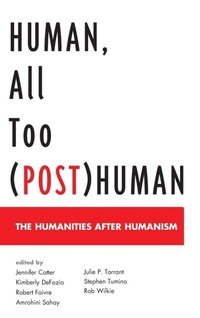
Human, All Too (Post)Human
The Humanities after Humanism
Published on 2. June 2016
Book
Hardback
252 pages
978-1-4985-0573-4 (ISBN)
Description
The contemporary has marked itself off from modernity by questioning its humanism that centers the world around the human as the moral subject of free will and self-determination, the bearer of universal essence that is the basis of human rights. Modernism normalizes humanism through language as referential, a set of interrelated signs that correspond to the empirical reality outside it. Humanist modernity, in other words, is seen in the contemporary as a regime that, by separating the human from the non-human and insisting on language as correspondence, not only fails to engage the emerging forms of social relations in which the boundaries of human and machine are fading but is also indifferent to the difference between the "other"'s life and other lives. Human, All Too (Post)Human: The Humanities after Humanism argues that the Nietzschean tendencies that provide the philosophical boundaries of post-humanism do not undo humanism but reform it, constructing a parallel discourse that saves humanism from itself.
Grounded in materialist analysis of social life, Human, All Too (Post)Human argues that humanism and post-humanism are cultural discourses that normalize different stages of capitalism-analog and digital capitalism. They are different orders of property relations. The question, the writers argue, is not humanism or post-humanism, namely cultural representations, but the material relations of production that are centered on wage labor. Language, free will, or human rights are not the issues since "Right can never be higher than the economic structure of society and its cultural development conditioned thereby." The question that shapes all questions, in Human, All Too (Post)Human is freedom from (wage) labor.
Grounded in materialist analysis of social life, Human, All Too (Post)Human argues that humanism and post-humanism are cultural discourses that normalize different stages of capitalism-analog and digital capitalism. They are different orders of property relations. The question, the writers argue, is not humanism or post-humanism, namely cultural representations, but the material relations of production that are centered on wage labor. Language, free will, or human rights are not the issues since "Right can never be higher than the economic structure of society and its cultural development conditioned thereby." The question that shapes all questions, in Human, All Too (Post)Human is freedom from (wage) labor.
Reviews / Votes
Human, All Too (Post)Human is the culmination of some extraordinary and necessary work produced over the last 20 years. . . . The authors argue convincingly that the recent theory emerging from neoliberalism obscures history, materiality, and class relations. * Science & Society * Human, All Too (Post)Human is an uncommon book; it is a philosophically insightful and erudite analysis of the contemporary situation with deep political commitment to social change. It is a piercing root critique of governing ideas and the social conditions that produce them at a time when critique itself has become the target of accommodationist thinkers such as Bruno Latour in order to sideline such un-assembling of the social. Written against the horizon of Marx's Critique of the Gotha Program, Human, All Too (Post)Human, breaks the silence on what has become unspeakable in contemporary cultural critique and argues not for freedom from humanism or post-humanism, which have haunted bourgeois thought, but for a future free from wage labor. -- Peter McLaren, Emeritus Professor, the University of California, Los AngelesMore details
Language
English
Place of publication
United States
Publishing group
Bloomsbury Publishing Plc
Target group
Professional and scholarly
Dimensions
Height: 235 mm
Width: 157 mm
Thickness: 20 mm
Weight
568 gr
ISBN-13
978-1-4985-0573-4 (9781498505734)
Copyright in bibliographic data and cover images is held by Nielsen Book Services Limited or by the publishers or by their respective licensors: all rights reserved.
Schweitzer Classification
Other editions
Additional editions
Jennifer Cotter | Kimberly DeFazio | Robert Faivre
Human, All Too (Post)Human
The Humanities After Humanism
E-Book
06/2016
1st Edition
Lexington Books
€108.99
Available for download
Jennifer Cotter | Kimberly DeFazio | Robert Faivre
Human, All Too (Post)Human
The Humanities After Humanism
E-Book
06/2016
1st Edition
Lexington Books
€108.99
Available for download
Persons
Jennifer Cotter is associate professor of English at William Jewell College.
Kimberly DeFazio is associate professor of English at the University of Wisconsin, La Crosse.
Robert Faivreis professor of English at SUNY Adirondack.
Amrohini Sahay is assistant professor of English at Hofstra University.
Julie P. Torrant is assistant professor of English at Kingsborough Community College.
Stephen Tumino is adjunct assistant professor of English at the Borough of Manhattan Community College (CUNY).
Rob Wilkie is associate professor of English at the University of Wisconsin, La Crosse.
Kimberly DeFazio is associate professor of English at the University of Wisconsin, La Crosse.
Robert Faivreis professor of English at SUNY Adirondack.
Amrohini Sahay is assistant professor of English at Hofstra University.
Julie P. Torrant is assistant professor of English at Kingsborough Community College.
Stephen Tumino is adjunct assistant professor of English at the Borough of Manhattan Community College (CUNY).
Rob Wilkie is associate professor of English at the University of Wisconsin, La Crosse.
Content
Introduction: Posthumanism and the Evacuation of Critique - Jennifer Cotter, Kimberly DeFazio, Robert Faivre, Amrohini Sahay, Julie P. Torrant, Stephen Tumino, and Rob Wilkie
I: "Natural" Life and "Species" Life
1 The New Class Common-Sense: Biopolitics, Posthumanism, and Love - Jennifer Cotter
2 Loving Transnationalism: Spiritualizing Class in House of Sand and Fog - Amrohini Sahay
II: New Materialisms, Object Ontologies, and Class Totalities
3 "Theory Too Becomes a Material Force": Militant Materialism or Messianic Matterism? - Stephen Tumino
4 Mind over Matter and Other Posthumanist Feminist Tales - Julie P. Torrant
5 Ghostly Objectivity: Commodity Fetishism, Animated Monsters, and the Posthuman Object - Rob Wilkie
III: Theory in the Common, Theory in the Commune
6 The Commune, NOT the Common - Kimberly DeFazio
7 Posthumanist Metaphysics and the Necessity of Dialectics - Robert Faivre
IV: Disaster Theory
8 The "Event-al" Logic of Disaster: On "Left" Exinctionism - Jennifer Cotter, Kimberly DeFazio, Robert Faivre, Amrohini Sahay, Julie P. Torrant, Stephen Tumino, and Rob Wilkie
I: "Natural" Life and "Species" Life
1 The New Class Common-Sense: Biopolitics, Posthumanism, and Love - Jennifer Cotter
2 Loving Transnationalism: Spiritualizing Class in House of Sand and Fog - Amrohini Sahay
II: New Materialisms, Object Ontologies, and Class Totalities
3 "Theory Too Becomes a Material Force": Militant Materialism or Messianic Matterism? - Stephen Tumino
4 Mind over Matter and Other Posthumanist Feminist Tales - Julie P. Torrant
5 Ghostly Objectivity: Commodity Fetishism, Animated Monsters, and the Posthuman Object - Rob Wilkie
III: Theory in the Common, Theory in the Commune
6 The Commune, NOT the Common - Kimberly DeFazio
7 Posthumanist Metaphysics and the Necessity of Dialectics - Robert Faivre
IV: Disaster Theory
8 The "Event-al" Logic of Disaster: On "Left" Exinctionism - Jennifer Cotter, Kimberly DeFazio, Robert Faivre, Amrohini Sahay, Julie P. Torrant, Stephen Tumino, and Rob Wilkie