

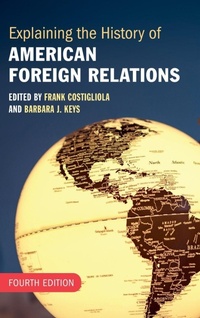
Explaining the History of American Foreign Relations
4th Edition
Published on 13. November 2025
Book
Hardback
436 pages
978-1-009-44797-3 (ISBN)
Description
The fourth edition of Explaining the History of American Foreign Relations reconceptualizes this long-established classic to focus squarely on methods: not what we do, but how we do what we do. It presents revised, sharply focused essays on methods for researching national security, development, political economy, gender, religion, race, emotion, and nongovernmental organizations, alongside entirely new contributions on digital resources, spatial analysis, technology, materials, the natural world, the interaction of race and empire, US-Indigenous relations, ideology, and culture. The chapters are bracketed with an essay that assesses changes in the conception of US foreign relations history, and with an overview of how US foreign relations history is practiced in China. The essays, by scholars who have made a significant contribution in their areas of specialization, highlight conceptual approaches and methods that, taken together, offer an innovative and practical 'how-to' manual for both experienced scholars and newcomers to the field.
Reviews / Votes
'Costigliola and Keys' impressive volume offers an invigorating look under the hood of historical practice in the study of US foreign relations. Its contributors present the reader with a gleaming toolkit for assembling scholarship at once solid and fluid, grounded and cutting-edge. Current and future historians interested in how the United States fits into a wider world would do well to keep this new how-to manual within reach.' Megan A. Black, Massachusetts Institute of Technology 'These marvelous essays by a dream team of the field's leading senior scholars and early-career rising stars cultivate a critical awareness of the innovative methods that are transforming how American foreign relations history is written today. Deeply reflective and written in an accessible hands-on style, they take up approaches drawn from studies of science and technology, the environment, material culture, and Indigeneity along with histories of capitalism, race, empire, and grand strategy to collectively offer an indispensable primer on how to remake our understanding of America in the world.' Mark Philip Bradley, University of Chicago 'Costigliola and Keys have done something I thought impossible: improving something that already seemed perfect. Moving beyond the first edition's goal of reminding students and scholars that studying foreign affairs still mattered, their new edition of Explaining the History of American Foreign Relations displays the field's originality, vibrancy, and most of all necessity, offering a one-stop introduction to the contours of America's path to global primacy from the nineteenth to the twentieth centuries, and the questions raised by wondering if it will retain that position in the twenty-first.' Jeffrey A. Engel, David Gergen Director, Center for Presidential History, SMUMore details
Edition
4th Revised edition
Language
English
Place of publication
Cambridge
United Kingdom
Edition type
Revised edition
Illustrations
Worked examples or Exercises
Dimensions
Height: 235 mm
Width: 157 mm
Thickness: 28 mm
Weight
778 gr
ISBN-13
978-1-009-44797-3 (9781009447973)
Copyright in bibliographic data and cover images is held by Nielsen Book Services Limited or by the publishers or by their respective licensors: all rights reserved.
Schweitzer Classification
Other editions
Additional editions
Frank Costigliola | Barbara J. Keys
Explaining the History of American Foreign Relations
Book
11/2025
4th Edition
Cambridge University Press
€43.50
Shipment within 15-20 days
Previous edition
Frank Costigliola | Michael J. Hogan
Explaining the History of American Foreign Relations
Book
03/2016
3rd Edition
Cambridge University Press
€126.50
Article exhausted; check for reprint
Persons
Content
Introduction Frank Costigliola and Barbara J. Keys; 1. Three left turns Ryan M. Irwin; 2. Digital resources David Langbart; 3. Materials Gretchen Heefner; 4. Development and growth Stephen Macekura; 5. Capitalism Alex Beasley; 6. Ecological footprints and other forms of spatial analysis Kristin Hoganson; 7. Medicine, science, and the environment Julia F. Irwin; 8. Technology and national security Katherine C. Epstein; 9. National security Melvyn Leffler; 10. Ideology Christopher McKnight Nichols; 11. Race Kaysha Corinealdi; 12. Race and empire Kristin Oberiano; 13. US-Indigenous relations Elspeth Martini; 14. Religion Emily Conroy-Krutz; 15. Gender Megan Threlkeld; 16. Culture Andrew Rotter; 17. Meaning and emotion Frank Costigliola; 18. Nongovernmental organizations Barbara J. Keys; 19. The view from China Niu Ke; Index.