

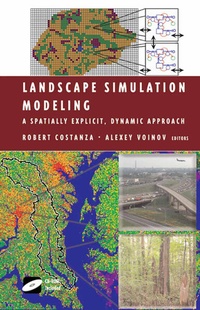
Landscape Simulation Modeling
A Spatially Explicit, Dynamic Approach
Published on 31. October 2003
Book
Hardback
XIII, 330 pages
978-0-387-00835-6 (ISBN)
Description
The world consists of many complex systems, ranging from our own bodies to ecosystems to economic systems. Despite their diversity, complex systems have many structural and functional features in common that can be effectively si- lated using powerful, user-friendly software. As a result, virtually anyone can - plore the nature of complex systems and their dynamical behavior under a range of assumptions and conditions. This ability to model dynamic systems is already having a powerful influence on teaching and studying complexity. The books in this series will promote this revolution in "systems thinking" by integrating computational skills of numeracy and techniques of dynamic mod- ing into a variety of disciplines. The unifying theme across the series will be the power and simplicity of the model-building process, and all books are designed to engage the reader in developing their own models for exploration of the dyn- ics of systems that are of interest to them. Modeling Dynamic Systems does not endorse any particular modeling paradigm or software. Rather, the volumes in the series will emphasize simplicity of lea- ing, expressive power, and the speed of execution as priorities that will facilitate deeper system understanding.
Reviews / Votes
From the reviews:"This book is a much-needed addition to the geospatial modeling literature, providing theoretical and practical information . . this is a valuable contribution to the literature on dynamic spatial modeling in particular, and integrated land-change research in general. . The clearly articulated unifying theme . and the fact that all the case studies utilize the same software, make for a well-constructed, compelling, informative, and interesting read. I will certainly evaluate this approach and program for my own work." (Maggi Kelly, Environment and Planning, Vol. 32 (2), 2005)"Landscape Simulation Modeling . makes a significant contribution by directly incorporating space into existing simulation modeling approaches for a greater understanding of landscape systems. . this is an excellent book. The content is comprehensive and the text written in a simple and clear style . . the book will also appeal to many multidisciplinary practitioners . . This book should be a required reading for anyone interested either casually or deeply in the design and implementation of spatial simulation models . ." (Shivanand Balram, Suzana Dragicevic, Ecological Economics, Vol. 52 (1), 2005)More details
Series
Edition
2004 ed.
Language
English
Place of publication
New York
United States
Target group
Professional and scholarly
Research
Product notice
sewn/stitched
Cloth over boards
Illustrations
XIII, 330 p. With online files/update.
Dimensions
Height: 241 mm
Width: 163 mm
Thickness: 23 mm
Weight
644 gr
ISBN-13
978-0-387-00835-6 (9780387008356)
DOI
10.1007/b97268
Schweitzer Classification
Other editions
Additional editions
Book
04/2013
Springer
€53.49
Shipment within 15-20 days
E-Book
06/2006
Springer
€53.49
Available for download
Content
Theory and Methods.- Introduction: Spatially Explicit Landscape Simulation Models.- Spatial Simulation Using the SME.- Modular Ecosystem Modeling.- Calibration of Large Spatial Models: A Multistage, Multiobjective Optimization Technique.- Case Studies.- Habitat Changes in the Mississippi Delta: Future Scenarios and Alternatives.- Development and Application of the Everglades Landscape Model.- Spatial Modeling of Eelgrass Distribution in Great Bay, New Hampshire.- Patuxent Landscape Model: Integrated Modeling of a Watershed.- The Fort Hood Avian Simulation Model-V: A Spatially Explicit Population Viability Model for Two Endangered Species.- Simulating Land Use Alternatives and Their Impacts on a Desert Tortoise Population in the Mojave Desert, California.- A Dynamic Model of the Spatial Spread of an Infectious Disease: The Case of Fox Rabies in Illinois.- Landscape Optimization: Applications of a Spatial Ecosystem Model.