

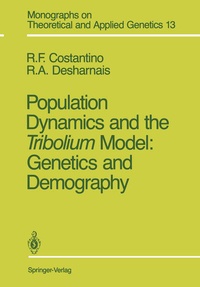
Population Dynamics and the Tribolium Model: Genetics and Demography
Published on 17. September 2011
Book
Paperback/Softback
XII, 258 pages
978-1-4612-7823-8 (ISBN)
Description
The study of populations is becoming increasingly focused on dynamics. We believe there are two reasons for this trend. The ftrst is the impactof nonlinear dynamics with its exciting ideas and colorful language: bifurcations, domains of attraction, chaos, fractals, strange attractors. Complexity, which is so very much a part of biology, now seems to be also a part of mathematics. A second trend is the accessibility of the new concepts. Thebarriers tocommunicationbetween theoristandexperimentalistseemless impenetrable. The active participationofthe experimentalist means that the theory will obtain substance. Our role is the application of the theory of dynamics to the analysis ofbiological populations. We began our work early in 1979 by writing an ordinary differential equation for the rateofchange in adult numbers which was based on an equilibrium model proposed adecadeearlier. Duringthenextfewmonths weftlledournotebookswithstraightforward deductions from the model and its associated biological implications. Slowly, some of the biological observations were explained and papers followed on a variety of topics: genetic and demographic stability, stationary probability distributions for population size,population growth asabirth-deathprocess, natural selectionanddensity-dependent population growth, genetic disequilibrium, and the stationary stochastic dynamics of adult numbers.
More details
Series
Edition
Softcover reprint of the original 1st ed. 1991
Language
English
Place of publication
New York
United States
Target group
Professional and scholarly
Research
Illustrations
XII, 258 p.
Dimensions
Height: 244 mm
Width: 170 mm
Thickness: 16 mm
Weight
482 gr
ISBN-13
978-1-4612-7823-8 (9781461278238)
DOI
10.1007/978-1-4612-3170-7
Schweitzer Classification
Other editions
Additional editions
Robert F. Costantino | Robert A. Desharnais
Population Dynamics and the Tribolium Model: Genetics and Demography
E-Book
12/2012
Springer
€96.29
Available for download

Robert F. Costantino | Robert A. Desharnais
Population Dynamics and the Tribolium Model: Genetics and Demography
Genetics and Demography
Book
08/1991
Springer
€85.55
Article exhausted; check different version
Content
1 Introduction.- 1.1 A Brief History of the Mathematics of Tribolium.- 2 Biology and Dynamics of Age Structure.- 2.1 Models for Age-Structured Populations.- 2.2 Life Stage Interactions.- 2.3 Parameterization.- 2.4 Experimental Data and Computer Simulations.- 2.5 Summary and Conclusions.- 2.6 Appendix.- 3 Demographic Oscillations.- 3.1 Egg-Larval Submodel.- 3.2 Analytical Results.- 3.3 Numerical Results.- 3.4 Biological Relevance.- 3.5 Summary and Conclusions.- 3.6 Appendix.- 4 Continuous Stochastic Models.- 4.1 Deterministic Model for Adult Numbers.- 4.2 Stochastic Model for Adult Numbers.- 4.3 Statistical Procedures.- 4.4 Applications.- 4.5 Stationary Time Series.- 4.6 Time-Dependent Gamma Distribution.- 4.7 Summary and Conclusions.- 5 Discrete Stochastic Models.- 5.1 Population Growth as a Birth-Death Process.- 5.2 Nonlinear Birth-Death Process for Tribolium.- 5.3 Linear Birth-Death Approximation.- 5.4 Application to Tribolium brevicornis.- 5.5 Summary and Conclusions.- 5.6 Appendix.- 6 Natural Selection.- 6.1 Ecological-Genetic Perspective.- 6.2 Density-Regulated Natural Selection.- 6.3 Experimental Results on the Corn Oil Sensitive Mutant.- 6.4 Summary and Conclusions.- 7 Genetic Disequilibrium.- 7.1 An Entropy Measure of Genetic Disequilibrium.- 7.2 Rate of Genetic Adaptation.- 7.3 Density-Independent Population Growth.- 7.4 Density-Dependent Population Growth.- 7.5 Extensions to the Theory.- 7.6 Summary and Conclusions.- 8 Two Interacting Species.- 8.1 Competition as an Adult-Immature Interaction.- 8.2 Two Cannibalistic Species.- 8.3 An Inhibiting Species with a Cannibalistic Species.- 8.4 Two Inhibiting Species.- 8.5 Summary and Conclusions.- 9 Dynamics and the Tribolium Model.- 9.1 Demography.- 9.2 Stochasticity.- 9.3 Natural Selection.- 9.3.1 Natural Selection and Age Structure.- 9.4 Species Interactions.- 9.5 Summary and Conclusions.- References.- Author Index.