

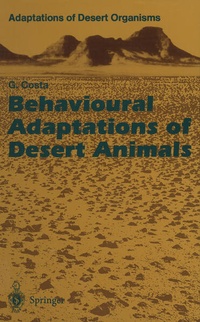
Behavioural Adaptations of Desert Animals
Published on 19. January 2012
Book
Paperback/Softback
XI, 198 pages
978-3-642-79358-5 (ISBN)
Description
After a brief survey of biotopic and vegetational features and an account of the main groups of desert animals, the most unusual patterns of the behaviour of the xerophilous fauna are examined. The importance of the thermohygric regulation and self-protective and locomotor mechanisms to the survival of arid-adapted animals is emphasized and various adaptations in the alimentary, reproductive and social spheres are analyzed.
The clear and fluent treatment will awaken the interest of the reading public, from the amateur naturalists to research scientists.
The clear and fluent treatment will awaken the interest of the reading public, from the amateur naturalists to research scientists.
More details
Series
Edition
Softcover reprint of the original 1st ed. 1995
Language
English
Place of publication
Berlin
Germany
Publishing group
Springer Berlin
Target group
Professional and scholarly
Research
Illustrations
XI, 198 p.
Dimensions
Height: 235 mm
Width: 155 mm
Thickness: 12 mm
Weight
335 gr
ISBN-13
978-3-642-79358-5 (9783642793585)
DOI
10.1007/978-3-642-79356-1
Schweitzer Classification
Other editions
Additional editions
Giovanni Costa
Behavioural Adaptations of Desert Animals
E-Book
12/2012
Springer
€96.29
Available for download

Giovanni Costa
Behavioural Adaptations of Desert Animals
Book
07/1995
Springer
€85.55
Article exhausted; check different version
Content
1 Introduction.- 2 Biotope and Vegetation Features.- 2.1 Definition of Desert.- 2.2 Factors of Aridity.- 2.3 Classifications of Deserts.- 2.4 Biotope Features.- 2.5 Characteristics of Desert Vegetation.- 3 Desert Zoocoenosis.- 3.1 General Characteristics.- 3.2 Main Animal Groups.- 4 Thermohygric Regulation.- 4.1 Timing of Activity Rhythms.- 4.2 Modulation of Activity Rhythms.- 4.3 Exploitation of Substratum Resources.- 4.4 Exploitation of Body Resources.- 4.5 Exploitation of Social Resources.- 5 Self-Protective Mechanisms.- 5.1 Primary Self-Protection.- 5.2 Secondary Self-Protection.- 6 Patterns of Movement.- 6.1 Locomotor Patterns.- 6.2 Orientation Mechanisms.- 7 Exploitation of Food Resources.- 7.1 Herbivores.- 7.2 Carnivores.- 7.3 Detritivores.- 8 Reproductive Regulation.- 8.1 Timing of Reproduction.- 8.2 Partner Location.- 8.3 Courtship and Mating.- 8.4 Pair Stabilization; Sexual Groups.- 8.5 Parental Care and Developmental Regulation.- 9 Social Behaviour.- 9.1 Sociality in Desert Environments.- 9.2 Territorial Phenomena.- 9.3 Learning and Culture.- References.