

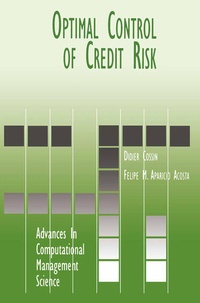
Optimal Control of Credit Risk
Published on 31. October 2012
Book
Paperback/Softback
VII, 102 pages
978-1-4613-5531-1 (ISBN)
Description
Optimal Control of Credit Risk
presents an alternative methodology to deal with a financial problem that has not been well analyzed yet: the control of credit risk. Credit risk has become recently the center of interest of the financial community, with new instruments (such as Credit Risk Derivatives) and new methodologies (such as Credit Metrics) being developed. The recent literature has focused on the pricing of credit risk. On the other hand, practitioners tend to eliminate credit risk rather than price it. They do so via collateralization. The authors propose here a methodological basis for an optimal collateralization.
The monograph is organized as follows: Chapter 1 reviews the main avenues of literature related to our problem; Chapter 2 provides a brief overview of the main optimal control principles; and Chapter 3 presents the models and their setting.
In the remaining chapters, the authors propose two sets of programs. One set of programs will apply in cases where the information on the assets=value is readily available ( full observation case), while the other applies when costly audits are needed in order to assess this value ( partial observation case).
In either case, the modeling stage leads to a set of quasi-variational inequalities which the authors attempt to solve numerically in the simpler case of full observations. This is done in Chapter 6. Finally a simulation analysis is carried out in Chapter 7, in which the authors study the influence on the control process of changes in the different model parameters. This precedes a discussion on possible extensions in Chapter 8 and some concluding remarks in Section 9.
The monograph is organized as follows: Chapter 1 reviews the main avenues of literature related to our problem; Chapter 2 provides a brief overview of the main optimal control principles; and Chapter 3 presents the models and their setting.
In the remaining chapters, the authors propose two sets of programs. One set of programs will apply in cases where the information on the assets=value is readily available ( full observation case), while the other applies when costly audits are needed in order to assess this value ( partial observation case).
In either case, the modeling stage leads to a set of quasi-variational inequalities which the authors attempt to solve numerically in the simpler case of full observations. This is done in Chapter 6. Finally a simulation analysis is carried out in Chapter 7, in which the authors study the influence on the control process of changes in the different model parameters. This precedes a discussion on possible extensions in Chapter 8 and some concluding remarks in Section 9.
More details
Series
Edition
Softcover reprint of the original 1st ed. 2001
Language
English
Place of publication
New York
United States
Target group
Professional and scholarly
Research
Illustrations
VII, 102 p.
Dimensions
Height: 235 mm
Width: 155 mm
Thickness: 7 mm
Weight
189 gr
ISBN-13
978-1-4613-5531-1 (9781461355311)
DOI
10.1007/978-1-4615-1393-3
Schweitzer Classification
Other editions
Additional editions
Didier Cossin | Felipe M. Aparicio Acosta
Optimal Control of Credit Risk
E-Book
11/2012
Springer
€96.29
Available for download
Didier Cossin | Felipe M. Aparicio Acosta
Optimal Control of Credit Risk
Book
04/2001
Kluwer Academic Publishers
€106.99
Shipment within 15-20 days
Content
1. Introduction.- 2. Literature Review.- 1. Guarantee valuation.- 2. Deposit insurance valuation.- 3. Control of guarantees.- 4. Other applications.- 3. Elements of Optimal Control.- 1. Optimal deterministic control.- 2. Optimal stochastic control.- 3. Stochastic impulse control.- 4. The Model.- 1. The underlying process behavior.- 2. Cost of credit risk.- 3. Cost of information.- 4. Forms of control.- 5. Solution Approaches.- 5. Full-Observation Case.- 1. The decision process.- 2. "Single jump" operator approach.- 3. QVI approach.- 6. Partial Observation Case.- 1. The decision process.- 2. QVI approach.- 7. Numerical Approaches.- 8. Simulation Experiments.- 1. Changes in parameters.- 2. Changes in the cost function.- 10. Appendix: Practical Cases.- 1. Guarantees in a private setting.- 2. Guarantees in a public setting.