


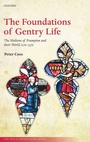
The Foundations of Gentry Life
The Multons of Frampton and their World 1270-1370
Published on 2. September 2021
Book
Paperback/Softback
336 pages
978-0-19-886716-6 (ISBN)
Description
In The Foundations of Gentry Life, Peter Coss examines the formative years of the English gentry. In doing so, he explains their lasting characteristics during a long history as a social elite, including adaptability to change and openness to upward mobility from below.
Revolving around the rich archive left by the Multons of Frampton in South Lincolnshire, the book explores the material culture of the gentry, their concern with fashion and their obsession with display. It pays close attention to the visitors to their homes, and to the social relationships between men and women. Coss shows that the gentry household was a literate community, within a literate local world, and he studies closely the consumption of literature, paying particular attention to household entertainment.
Beyond their households, then gentry could assert their pre-eminence in the local community through involvement with the Church and the management of their estates. Treating the relationship between gentry and Church in both devotional and institutional terms, Coss shows how religious practice was a means for the gentry to assert social dominance, and they increasingly treated the Church as a career path for their kin. Protecting their estates was of similar importance, and legal expertise was highly prized-it consequently provided a major means of entry into the gentry, as well as offering further opportunities for younger sons.
Overall, Coss reveals that the cultural horizons of the gentry were essentially local. Nevertheless there were wider dimensions, and the book concludes with observations on how national and chivalric concerns interacted with the rhythms of regional life.
Revolving around the rich archive left by the Multons of Frampton in South Lincolnshire, the book explores the material culture of the gentry, their concern with fashion and their obsession with display. It pays close attention to the visitors to their homes, and to the social relationships between men and women. Coss shows that the gentry household was a literate community, within a literate local world, and he studies closely the consumption of literature, paying particular attention to household entertainment.
Beyond their households, then gentry could assert their pre-eminence in the local community through involvement with the Church and the management of their estates. Treating the relationship between gentry and Church in both devotional and institutional terms, Coss shows how religious practice was a means for the gentry to assert social dominance, and they increasingly treated the Church as a career path for their kin. Protecting their estates was of similar importance, and legal expertise was highly prized-it consequently provided a major means of entry into the gentry, as well as offering further opportunities for younger sons.
Overall, Coss reveals that the cultural horizons of the gentry were essentially local. Nevertheless there were wider dimensions, and the book concludes with observations on how national and chivalric concerns interacted with the rhythms of regional life.
Reviews / Votes
a masterful book * Philip Morgan, English Historical Review * this handsomely presented volume stimulates questions ... The book works as a cache of data gathered from detailed research to build up a complex picture of a largely midland group. ... Students and scholars will find the material rich and illuminating and packed with interest. Any medievalist will find the sources fascinating. * Carole Hill, Medieval Prosopography * this is an important work * Professor Stephen H. Rigby, Society for Lincolnshire History and Archaeology *More details
Series
Language
English
Place of publication
Oxford
United Kingdom
Target group
Adult education
Product notice
Paperback (trade)
Unsewn / adhesive bound
Illustrations
24 b/w halftones, 4 maps
Dimensions
Height: 239 mm
Width: 160 mm
Thickness: 18 mm
Weight
590 gr
ISBN-13
978-0-19-886716-6 (9780198867166)
Copyright in bibliographic data and cover images is held by Nielsen Book Services Limited or by the publishers or by their respective licensors: all rights reserved.
Schweitzer Classification
Other editions
Additional editions
Book
03/2010
Oxford University Press
€145.40
Shipment within 15-20 days
Person
Peter Coss is Emeritus Professor in Medieval History at the University of Cardiff
Content
1: Introduction
2: The Multons and Frampton
3: Gentry Household: The Locus of Consumption
4: Household, Locality and Social Interaction
5: The Gentry Estate: The Locus of Production
6: Commercialisation and Estate Management
7: Human Resources: The Lord and his Tenants
8: The Church as Cultural Space
9: The Gentry and the Parish
10: The Culture of the Cartulary: The Gentry Family and the Protection of Estates
11: Lawyers and Literacy
12: Literature and Household Entertainment
13: The Urban Dimension: The Gentry, Towns and Merchants
14: Conclusion: Cultural Horizons
2: The Multons and Frampton
3: Gentry Household: The Locus of Consumption
4: Household, Locality and Social Interaction
5: The Gentry Estate: The Locus of Production
6: Commercialisation and Estate Management
7: Human Resources: The Lord and his Tenants
8: The Church as Cultural Space
9: The Gentry and the Parish
10: The Culture of the Cartulary: The Gentry Family and the Protection of Estates
11: Lawyers and Literacy
12: Literature and Household Entertainment
13: The Urban Dimension: The Gentry, Towns and Merchants
14: Conclusion: Cultural Horizons