

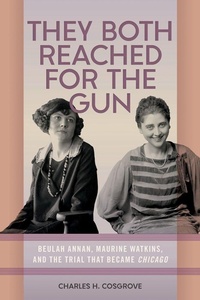
They Both Reached for the Gun
Beulah Annan, Maurine Watkins, and the Trial That Became Chicago
Published on 8. July 2024
Book
Paperback/Softback
240 pages
978-0-8093-3938-9 (ISBN)
Description
Examining the case that inspired a pop culture phenomenon
In 1924 Beulah Annan was arrested and incarcerated for killing her lover, Harry Kalsted. Six weeks later, a jury acquitted her of murder. Inspired by the sordid event, trial, and acquittal, Maurine Watkins, a reporter at the time, wrote the play Chicago, a Broadway hit that was adapted several times. Through a fresh retelling of the story of Annan and of Watkins's play, Charles H. Cosgrove provides the first critical examination of the criminal case, and an initial exploration of the era's social assumptions that made the message of the play so plausible in its own time. His careful historical research challenges the received portrait of Annan as a killer who got away with murder, and of Watkins as a savvy cub reporter and precocious playwright.
In They Both Reached for the Gun, Charles H. Cosgrove expertly combines inquest and police records, and interviews with Annan's relatives, to analyze the participants, the trial, and the subsequent play. Although no one will ever know what really happened in the Kenwood apartment on Chicago's south side one hundred years ago, Cosgrove's interrogation shows how sensationalized Watkins's writing was. Her reporting on the Annan case perpetuated falsehoods about Annan's so-called "confession," and her play gave an inaccurate portrayal of Chicago's criminal justice system. Despite Watkins's insistence that her drama revealed the truth about its subjects without any exaggeration, her play depicted police, prosecutors, and judges as the only "good guys" in the story, ignoring those who lied, misled, and used brutal methods to obtain forced confessions.
In 1924 Beulah Annan was arrested and incarcerated for killing her lover, Harry Kalsted. Six weeks later, a jury acquitted her of murder. Inspired by the sordid event, trial, and acquittal, Maurine Watkins, a reporter at the time, wrote the play Chicago, a Broadway hit that was adapted several times. Through a fresh retelling of the story of Annan and of Watkins's play, Charles H. Cosgrove provides the first critical examination of the criminal case, and an initial exploration of the era's social assumptions that made the message of the play so plausible in its own time. His careful historical research challenges the received portrait of Annan as a killer who got away with murder, and of Watkins as a savvy cub reporter and precocious playwright.
In They Both Reached for the Gun, Charles H. Cosgrove expertly combines inquest and police records, and interviews with Annan's relatives, to analyze the participants, the trial, and the subsequent play. Although no one will ever know what really happened in the Kenwood apartment on Chicago's south side one hundred years ago, Cosgrove's interrogation shows how sensationalized Watkins's writing was. Her reporting on the Annan case perpetuated falsehoods about Annan's so-called "confession," and her play gave an inaccurate portrayal of Chicago's criminal justice system. Despite Watkins's insistence that her drama revealed the truth about its subjects without any exaggeration, her play depicted police, prosecutors, and judges as the only "good guys" in the story, ignoring those who lied, misled, and used brutal methods to obtain forced confessions.
Reviews / Votes
"Cosgrove shines a dazzling spotlight on the historical distortions behind the musical Chicago and its source material. With authority and clarity, he argues there never was a Jazz Age Chicago where beautiful women routinely got away with murder. On trial here: the pushback against American women's social progress." - Marcia Biederman, author of The Disquieting Death of Emma Gill: Abortion, Death, and Concealment in Victorian New England"They Both Reached for the Gun is a fascinating exploration of the history behind Chicago, the musical based loosely on the 1924 conviction of Beulah Annan for her lover's murder. Through a careful reexamination of the case, the sensational press coverage, and the transformation of the actual events into entertainment, Cosgrove investigates the sometimes-unhealthy relationship between crime news and entertainment." - Ann Durkin Keating, North Central College
"In a smooth and flowing style, Cosgrove's rich insight into a troubled woman's existence culminating in a questionable indictment and 'trial-by-press' presumption of guilt, provides readers with a sobering reassessment of the case, with a glimpse into the era and tabloid culture of the Roaring Twenties." - Richard C. Lindberg, author of Tales of Forgotten Chicago
More details
Language
English
Place of publication
Carbondale
United States
Target group
Professional and scholarly
Product notice
Paperback (trade)
Unsewn / adhesive bound
Illustrations
39 illustrations
Dimensions
Height: 229 mm
Width: 152 mm
Thickness: 20 mm
Weight
386 gr
ISBN-13
978-0-8093-3938-9 (9780809339389)
Copyright in bibliographic data and cover images is held by Nielsen Book Services Limited or by the publishers or by their respective licensors: all rights reserved.
Schweitzer Classification
Other editions
Additional editions

Charles H. Cosgrove
They Both Reached for the Gun
Beulah Annan, Maurine Watkins, and the Trial That Became Chicago
E-Book
06/2024
1st Edition
Southern Illinois University Press
€36.99
Available for download
Person
Charles H. Cosgrove is emeritus professor of early Christian literature at Garrett Seminary in Evanston, Illinois. He is the author of numerous books, most recently Fortune and Faith in Old Chicago: A Dual Biography of Mayor Augustus Garrett and Seminary Founder Eliza Clark Garrett, and Music at Social Meals in Greek and Roman Antiquity. A lifelong native of the Chicago area, he is an aficionado of the city's history and makes occasional appearances in the area's music venues as a jazz trombonist.
Content
List of Figures
Preface
A Note on Names
Acknowledgments
Introduction
1. Beulah Mae
2. A Shooting
3. An Alleged Confession
4. Police and Prosecutors Shape the Narrative
5. Inquest into the Death of Harry Kalsted
6. Finding Beulah behind the Press's Tropes and Paraquotations
7. Maurine Watkins's News with Wit
8. Back in Owensboro
9. Popular Opinions about Jury Bias in Favor of Women
10. Beulah Annan Goes to Trial
11. Watkins's Tendentious Reporting on the Annan Trial
12. A Play Is Born
13. The Truth about Chicago's Criminal Justice System
14. The Short Unhappy Finish to Beulah's Life
15. Beulah Remembered as Roxie
16. Bob Fosse's Musical Remake of Maurine Watkins's Play
Postscript
Abbreviations
Notes
Bibliography
Preface
A Note on Names
Acknowledgments
Introduction
1. Beulah Mae
2. A Shooting
3. An Alleged Confession
4. Police and Prosecutors Shape the Narrative
5. Inquest into the Death of Harry Kalsted
6. Finding Beulah behind the Press's Tropes and Paraquotations
7. Maurine Watkins's News with Wit
8. Back in Owensboro
9. Popular Opinions about Jury Bias in Favor of Women
10. Beulah Annan Goes to Trial
11. Watkins's Tendentious Reporting on the Annan Trial
12. A Play Is Born
13. The Truth about Chicago's Criminal Justice System
14. The Short Unhappy Finish to Beulah's Life
15. Beulah Remembered as Roxie
16. Bob Fosse's Musical Remake of Maurine Watkins's Play
Postscript
Abbreviations
Notes
Bibliography