

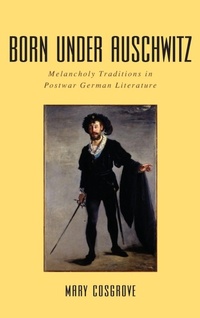
Born under Auschwitz
Melancholy Traditions in Postwar German Literature
Published on 1. April 2014
Book
Hardback
244 pages
978-1-57113-556-8 (ISBN)
Description
Uncovers the literary traditions of melancholy that inform major works of postwar and contemporary German literature dealing with the Holocaust and the Nazi period.
In German Studies the literary phenomenon of melancholy, which has a longstanding and diverse history in European letters, has typically been associated with the Early Modern and Baroque periods, Romanticism, and the crisis of modernity. This association, alongside the dominant psychoanalytical view of melancholy in German memory discourses since the 1960s, has led to its neglect as an important literary mode in postwar German literature, a situation the present book seeks to redress by identifying and analyzing epochal postwar works that use melancholy traditions to comment on German history in the aftermath of the Holocaust. It focuses on five writers - Guenter Grass, Wolfgang Hildesheimer, Peter Weiss, W. G. Sebald, and Iris Hanika - who reflect on the legacy of Auschwitz as intellectuals trying to negotiate a relationship to the past based on the stigma of belonging to a perpetrator collective (Grass, Sebald, Hanika) or, broadly speaking, to the victim collective (Weiss, Hildesheimer), in order to develop a melancholy ethics of memory for the Holocaust and the Nazi past. It will appeal to scholars and students of German Studies,Comparative Literature, Cultural Studies, Cultural Memory, and Holocaust Studies.
Mary Cosgrove is Reader in German at the University of Edinburgh.
In German Studies the literary phenomenon of melancholy, which has a longstanding and diverse history in European letters, has typically been associated with the Early Modern and Baroque periods, Romanticism, and the crisis of modernity. This association, alongside the dominant psychoanalytical view of melancholy in German memory discourses since the 1960s, has led to its neglect as an important literary mode in postwar German literature, a situation the present book seeks to redress by identifying and analyzing epochal postwar works that use melancholy traditions to comment on German history in the aftermath of the Holocaust. It focuses on five writers - Guenter Grass, Wolfgang Hildesheimer, Peter Weiss, W. G. Sebald, and Iris Hanika - who reflect on the legacy of Auschwitz as intellectuals trying to negotiate a relationship to the past based on the stigma of belonging to a perpetrator collective (Grass, Sebald, Hanika) or, broadly speaking, to the victim collective (Weiss, Hildesheimer), in order to develop a melancholy ethics of memory for the Holocaust and the Nazi past. It will appeal to scholars and students of German Studies,Comparative Literature, Cultural Studies, Cultural Memory, and Holocaust Studies.
Mary Cosgrove is Reader in German at the University of Edinburgh.
Reviews / Votes
[D]etailed and cogent . . . . Throughout the study, textual analysis is enhanced by careful attention to the literary, political, and cultural context, and by details drawn from archival material about the writers' knowledge and discussion of melancholy traditions. Cosgrove's strident engagement with earlier critical reception is particularly noteworthy, not least as her study responds to a lack of scholarly interest in post-war Holocaust memory and melancholy, an association that she shows to be worthy of further attention. . . . The monograph is an original and serious work which provides a highly detailed perspective on post-war writing about the poetics of remembrance after the Holocaust. As such, it makes an important contribution to the extensive body of recent criticism on post-war German memory culture. * MODERN LANGUAGE REVIEW * [The book's] greatest contribution is to emphasize the variety of traditions at play, in particular Christian, Greek, and Renaissance modes of melancholy discourse beyond the better-known psychological and medical definition of the term, most notably as derived from Freud. . . . Recommended. * CHOICE * The [book's] greatest strength . . . is its careful and erudite analysis of a range of thematic intricacies, such as the distinctive treatments of melancholy depending on whether the narrator (or author) speaks from the perspective of the perpetrator or the victim, as a man or a woman, as an individual or a collective, etc. Clearly, Cosgrove's analysis goes along with a keen analytical grasp of the theoretical and conceptual issues involved in the problem of melancholy. . . . The book is an important, precise, and thorough study that breaks new ground and advances our understanding of a set of major German novels in the social and cultural context of memory studies. Overall this is a graceful work of remarkable erudition that will be greatly appreciated as a landmark study about both postwar German literary history and theory, and memory discourse in the humanities. * MONATSHEFTE * Cosgrove compels her readers to identify contemporary literary works that, through engagement in subversive melancholy traditions, are able to stave o? inauthentic and indi?erent means of mourning and remembrance of the Holocaust . . . . Scholars of environmental, gender, German, and Holocaust Studies will ?nd this volume . . . to be a catalyst for renewed close readings and an engaging impulse for future research. * SYMPOSIUM *More details
Series
Language
English
Place of publication
Columbia, MD
United States
Publishing group
Boydell & Brewer Ltd
Target group
College/higher education
Product notice
Cloth over boards
Dimensions
Height: 241 mm
Width: 159 mm
Thickness: 25 mm
Weight
517 gr
ISBN-13
978-1-57113-556-8 (9781571135568)
Copyright in bibliographic data and cover images is held by Nielsen Book Services Limited or by the publishers or by their respective licensors: all rights reserved.
Schweitzer Classification
Other editions
Additional editions
E-Book
04/2014
1st Edition
De Gruyter
€48.99
Available for download
Person
Mary Cosgrove is Professor in German at Trinity College Dublin. Her research and teaching foci include Holocaust memory and representation in literature and culture; German Jewish writing; the cultural history and theory of melancholia and boredom in European letters; and literary
and narrative economics. Key publications include Born under Auschwitz: Melancholy Traditions in Postwar German Literature (Camden House,
2014); German Memory Contests: The Quest for Identity in Literature, Film, and Discourse since 1990 (Camden House, 2006; paperback 2010).
and narrative economics. Key publications include Born under Auschwitz: Melancholy Traditions in Postwar German Literature (Camden House,
2014); German Memory Contests: The Quest for Identity in Literature, Film, and Discourse since 1990 (Camden House, 2006; paperback 2010).
Content
Introduction: In Defense of Melancholy
The Diseased Imagination: Perpetrator Melancholy in Guenter Grass's Aus dem Tagebuch einer Schnecke and Beim Haeuten der Zwiebel
The Disenchanted Mind: Victim Melancholy in Wolfgang Hildesheimer's Tynset and Masante
The Feminine Holocaust: Gender, Melancholy, and Memory in Peter Weiss's Die AEsthetik des Widerstands
From the Weltschmerz of the Postwar Penitent to Capitalism and the "Racial Century": Melancholy Diversity in W. G. Sebald's Work
Epilogue: Death of the Male Melancholy Genius: From Vergangenheitsbewaeltigung to Vergangenheitsbewirtschaftung in Iris Hanika's Das Eigentliche
Bibliography
Index
The Diseased Imagination: Perpetrator Melancholy in Guenter Grass's Aus dem Tagebuch einer Schnecke and Beim Haeuten der Zwiebel
The Disenchanted Mind: Victim Melancholy in Wolfgang Hildesheimer's Tynset and Masante
The Feminine Holocaust: Gender, Melancholy, and Memory in Peter Weiss's Die AEsthetik des Widerstands
From the Weltschmerz of the Postwar Penitent to Capitalism and the "Racial Century": Melancholy Diversity in W. G. Sebald's Work
Epilogue: Death of the Male Melancholy Genius: From Vergangenheitsbewaeltigung to Vergangenheitsbewirtschaftung in Iris Hanika's Das Eigentliche
Bibliography
Index