

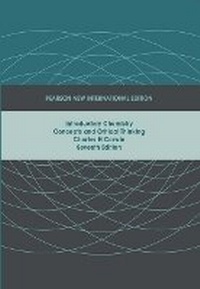
Introductory Chemistry: Concepts and Critical Thinking
Pearson New International Edition
7th Edition
Published on 2. August 2013
Book
Paperback/Softback
654 pages
978-1-292-02060-0 (ISBN)
Description
Were you looking for the book with access to MasteringChemistry? This product is the book alone and does NOT come with access to MasteringChemistry. Buy the book and access card package to save money on this resource. With an expanded focus on critical thinking and problem solving, the new Seventh Edition of Introductory Chemistry: Concepts and Critical Thinking prepares students for success in Introductory Chemistry courses. Unlike other introductory chemistry texts, all materials -the textbook, student solutions manual, laboratory manual, instructor's manual and test item file - are written by the author and tightly integrated to work together most effectively. Math and problem solving are covered early in the text; Corwin builds student confidence and ability through innovative pedagogy and technology formulated to meet the needs of today's learners. By presenting chemistry in a clear and interesting way, students to leave their first chemistry course with a positive impression, a set of new skills, and the desire to learn more.
More details
Edition
7th edition
Language
English
Place of publication
Harlow
United Kingdom
Target group
College/higher education
Dimensions
Height: 277 mm
Width: 217 mm
Thickness: 25 mm
Weight
1370 gr
ISBN-13
978-1-292-02060-0 (9781292020600)
Copyright in bibliographic data and cover images is held by Nielsen Book Services Limited or by the publishers or by their respective licensors: all rights reserved.
Schweitzer Classification
Other editions
Additional editions
Charles Corwin
Introductory Chemistry: Concepts and Critical Thinking
Pearson New International Edition
E-Book
08/2013
7th Edition
Pearson Education Limited
€49.22
Available for download
Previous edition
Book
01/2013
7th Edition
Pearson
€195.29
Article exhausted; check for reprint
Content
1 Introduction to Chemistry
1.1 Evolution of Chemistry
1.2 Modern Chemistry
CHEMISTRY CONNECTION "Worth Your Salt?"
1.3 Learning Chemistry
CHEMISTRY CONNECTION A Student Success Story
Summary * Key Terms * Exercises
Chapter Self-Test
Prerequisite Science Skills
PSS.1 Measurements
PSS.2 Significant Digits
PSS.3 Rounding Off Nonsignificant Digits
PSS.4 Adding and Subtracting Measurements
PSS.5 Multiplying and Dividing Measurements
PSS.6 Exponential Numbers
PSS.7 Scientific Notation
2 The Metric System
2.1 Basic Units and Symbols
CRITICAL THINKING The International System of Measurement (SI)
2.2 Metric Conversion Factors
2.3 Metric-Metric Conversions
2.4 Metric-English Conversions
CHEMISTRY CONNECTION The Olympics
CRITICAL THINKING World Trade Center
2.5 The Percent Concept
2.6 Volume by Calculation
2.7 Volume by Displacement
2.8 The Density Concept
2.9 Temperature
2.10 The Heat Concept
Summary * Problem-Solving Organizer
Key Terms * Exercises
Chapter Self-Test
3 Matter and Energy
3.1 Physical States of Matter
3.2 Elements, Compounds, and Mixtures
3.3 Names and Symbols of the Elements
CRITICAL THINKING Aluminum or Aluminium?
3.4 Metals, Nonmetals, and Semimetals
CHEMISTRY CONNECTION Elements 104 and Beyond
3.5 Compounds and Chemical Formulas
3.6 Physical and Chemical Properties
3.7 Physical and Chemical Changes
3.8 Conservation of Mass
3.9 Potential and Kinetic Energy
3.10 Conservation of Energy
CHEMISTRY CONNECTION Recycling Aluminum
Summary * Key Terms * Exercises
Chapter Self-Test
4 Models of the Atom
4.1 Dalton Model of the Atom
CHEMISTRY CONNECTION John Dalton
4.2 Thomson Model of the Atom
4.3 Rutherford Model of the Atom
4.4 Atomic Notation
4.5 Atomic Mass
CHEMISTRY CONNECTION Heavy Water
4.6 The Wave Nature of Light
4.7 The Quantum Concept
4.8 Bohr Model of the Atom
CRITICAL THINKING Neon Lights
4.9 Energy Levels and Sublevels
4.10 Electron Configuration
4.11 Quantum Mechanical Model of the Atom
Summmary * Key Terms * Exercises
Chapter Self-Test
5 The Periodic Table
5.1 Classification of Elements
CHEMISTRY CONNECTION Dmitri Mendeleev
5.2 The Periodic Law Concept
5.3 Groups and Periods of El
1.1 Evolution of Chemistry
1.2 Modern Chemistry
CHEMISTRY CONNECTION "Worth Your Salt?"
1.3 Learning Chemistry
CHEMISTRY CONNECTION A Student Success Story
Summary * Key Terms * Exercises
Chapter Self-Test
Prerequisite Science Skills
PSS.1 Measurements
PSS.2 Significant Digits
PSS.3 Rounding Off Nonsignificant Digits
PSS.4 Adding and Subtracting Measurements
PSS.5 Multiplying and Dividing Measurements
PSS.6 Exponential Numbers
PSS.7 Scientific Notation
2 The Metric System
2.1 Basic Units and Symbols
CRITICAL THINKING The International System of Measurement (SI)
2.2 Metric Conversion Factors
2.3 Metric-Metric Conversions
2.4 Metric-English Conversions
CHEMISTRY CONNECTION The Olympics
CRITICAL THINKING World Trade Center
2.5 The Percent Concept
2.6 Volume by Calculation
2.7 Volume by Displacement
2.8 The Density Concept
2.9 Temperature
2.10 The Heat Concept
Summary * Problem-Solving Organizer
Key Terms * Exercises
Chapter Self-Test
3 Matter and Energy
3.1 Physical States of Matter
3.2 Elements, Compounds, and Mixtures
3.3 Names and Symbols of the Elements
CRITICAL THINKING Aluminum or Aluminium?
3.4 Metals, Nonmetals, and Semimetals
CHEMISTRY CONNECTION Elements 104 and Beyond
3.5 Compounds and Chemical Formulas
3.6 Physical and Chemical Properties
3.7 Physical and Chemical Changes
3.8 Conservation of Mass
3.9 Potential and Kinetic Energy
3.10 Conservation of Energy
CHEMISTRY CONNECTION Recycling Aluminum
Summary * Key Terms * Exercises
Chapter Self-Test
4 Models of the Atom
4.1 Dalton Model of the Atom
CHEMISTRY CONNECTION John Dalton
4.2 Thomson Model of the Atom
4.3 Rutherford Model of the Atom
4.4 Atomic Notation
4.5 Atomic Mass
CHEMISTRY CONNECTION Heavy Water
4.6 The Wave Nature of Light
4.7 The Quantum Concept
4.8 Bohr Model of the Atom
CRITICAL THINKING Neon Lights
4.9 Energy Levels and Sublevels
4.10 Electron Configuration
4.11 Quantum Mechanical Model of the Atom
Summmary * Key Terms * Exercises
Chapter Self-Test
5 The Periodic Table
5.1 Classification of Elements
CHEMISTRY CONNECTION Dmitri Mendeleev
5.2 The Periodic Law Concept
5.3 Groups and Periods of El