

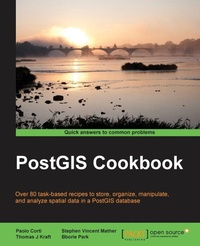
PostGIS Cookbook
For web developers and software architects this book will provide a vital guide to the tools and capabilities available to PostGIS spatial databases. Packed with hands-on recipes and powerful concepts
Published on 24. January 2014
Book
Paperback/Softback
484 pages
978-1-84951-866-6 (ISBN)
Description
Key Features
Book DescriptionAn easy-to-use guide, full of hands-on recipes for manipulating spatial data in a PostGIS database. Each topic is explained and placed in context, and for the more inquisitive, there are more details of the concepts used. If you are a web developer or a software architect, especially in location-based companies, and want to expand the range of techniques you are using with PostGIS, then this book is for you. You should have some prior experience with PostgreSQL database and spatial concepts.What you will learn
Import and export geographic data from the PostGIS database using the available tools
Structure spatial data using the functionality provided by the combination of PostgreSQL and PostGIS
Work with a set of PostGIS functions to perform basic and advanced vector analyses
Connect PostGIS with Python
Learn to use programming frameworks around PostGIS
Maintain, optimize, and finetune spatial data for longterm viability
Explore the 3D capabilities of PostGIS, including LiDAR point clouds and point clouds derived from Structure from Motion (SfM) techniques
Distribute 3D models through the Web using the X3D standard
Use PostGIS to develop powerful GIS web applications using Open Geospatial Consortium web standards
Master PostGIS Raster
Who this book is for
Book DescriptionAn easy-to-use guide, full of hands-on recipes for manipulating spatial data in a PostGIS database. Each topic is explained and placed in context, and for the more inquisitive, there are more details of the concepts used. If you are a web developer or a software architect, especially in location-based companies, and want to expand the range of techniques you are using with PostGIS, then this book is for you. You should have some prior experience with PostgreSQL database and spatial concepts.What you will learn
Import and export geographic data from the PostGIS database using the available tools
Structure spatial data using the functionality provided by the combination of PostgreSQL and PostGIS
Work with a set of PostGIS functions to perform basic and advanced vector analyses
Connect PostGIS with Python
Learn to use programming frameworks around PostGIS
Maintain, optimize, and finetune spatial data for longterm viability
Explore the 3D capabilities of PostGIS, including LiDAR point clouds and point clouds derived from Structure from Motion (SfM) techniques
Distribute 3D models through the Web using the X3D standard
Use PostGIS to develop powerful GIS web applications using Open Geospatial Consortium web standards
Master PostGIS Raster
Who this book is for
More details
Language
English
Place of publication
Birmingham
United Kingdom
Dimensions
Height: 235 mm
Width: 191 mm
Thickness: 27 mm
Weight
895 gr
ISBN-13
978-1-84951-866-6 (9781849518666)
Copyright in bibliographic data and cover images is held by Nielsen Book Services Limited or by the publishers or by their respective licensors: all rights reserved.
Schweitzer Classification
Other editions
Additional editions
Paolo Corti | Bborie Park
PostGIS Cookbook
For web developers and software architects this book will provide a vital guide to the tools and capabilities available to PostGIS spatial databases. Packed with hands-on recipes and powerful concepts
E-Book
01/2025
Packt Publishing
from
€41.99
Available for download
Persons
Paolo Corti is an environmental engineer with 20 years of experience in the GIS field, currently working as a Geospatial Engineer Fellow at the Center for Geographic Analysis at Harvard University. He is an advocate of open source geospatial technologies and Python, an OSGeo Charter member, and a member of the pycsw and GeoNode Project Steering Committees. He is a coauthor of the first edition of this book and the reviewer for the first and second editions of the Mastering QGIS book by Packt. Bborie Park has been breaking (and subsequently fixing) computers for most of his life. His primary interests involve developing end-to-end pipelines for spatial datasets. He is an active contributor to the PostGIS project and is a member of the PostGIS Steering Committee. He happily resides with his wife Nicole in the San Francisco Bay Area.
Content
Table of Contents