

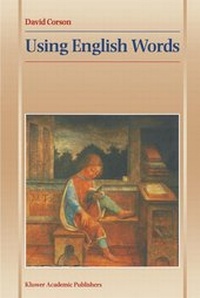
Using English Words
1st Edition
Published on 31. August 1995
Book
Hardback
VIII, 226 pages
978-0-7923-3710-2 (ISBN)
Description
Using English Words examines the impact that the life histories of people can have on their vocabulary. The book shows how discursive relations outside education position people through their vocabularies. Some are prepared for easy entry into life-long prospects of privilege and educational success, while others are denied entry. It argues that education fails to take account of the fact that many children's discursive relations, before and outside schools, are inconsistent with the kinds of lexicosemantic demands that present-day schools and their high-status culture of literacy place upon them: often unnecessarily. Partly as a result of this, many students - both native speakers and those whose second language is English - are almost guaranteed to fail in the middle levels of contemporary education before they have a chance to show that they can succeed.
The book draws on theory and research from discursive psychology and the sociology of language, but this rigorous interdisciplinary study also integrates a wide range of international work from linguistics, psycholinguistics, foreign language studies, history, philosophy, anthropology, classics, first language education, and ESL/EFL education.
More details
Edition
1., 995
Language
English
Place of publication
Dordrecht
United States
Target group
College/higher education
Professional and scholarly
Research
Illustrations
VIII, 226 p.
references, index
Dimensions
Height: 24 cm
Width: 16 cm
Weight
578 gr
ISBN-13
978-0-7923-3710-2 (9780792337102)
DOI
10.1007/978-94-011-0425-8
Schweitzer Classification
Other editions
Additional editions
P. Corson
Using English Words
Book
03/1996
Kluwer Academic Publishers
€74.89
Shipment within 15-20 days
Content
Introduction. 1. The place of words in discourse and in education. 2. A multidisciplinary review: words, culture, education, and society. 3. The historical development of the lexical bar. 4. Factors reinforcing the bar in the present day. 5. The research studies. 6. Using words in educational performance and for sociocultural reproduction. 7. Morphology and the mental lexicon. 8. Difficulty in lexical access: the lexical bar. 9. Changing practices: further research, equity matters, and other lexical bars. References. Index.