

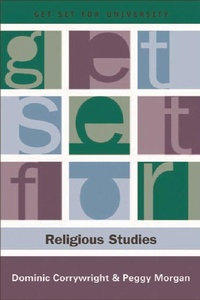
Get Set for Religious Studies
Published on 13. April 2006
Book
Paperback/Softback
160 pages
978-0-7486-2032-6 (ISBN)
Description
The transition from RE A level, or from entirely alternate roots (many RS students have not taken previous RS related courses), to Religious Studies at university requires some careful shepherding. The field is huge. This introductory book will provide a clear map for the key features of the terrain. The two main strands shaping the book define what religions are and explain how Religious Studies approaches the religions. The language is clear at the same time as introducing some of the key terminology used in the study of religions.This book would therefore appeal to school/college Religious Studies students as well as those completely new to the subject who seek a short introduction to the range of approaches to Religious Studies that they are likely to encounter at university.The study of religions and the academic discipline of Religious Studies are growing areas in tertiary education in the UK. The continued interest in RE AS and A level as well as the growth in cognate humanities and social sciences, such as Psychology, Sociology, Philosophy, at AS/A level and GNVQ level indicates the significant interest amongst students on matters that pertain to culture and humanity in general. Students realise that religion is a driving force in contemporary culture and the study of it is central to understanding the contemporary world. The statistics on religious belief bear out their interest: four billion out of the six billion people who inhabit the world profess religious belief; even in the 'secular' societies of the Western world religiosity is growing and changing - a recent BBC poll stated that 70% of people in the UK believe in a 'higher being' or spiritual force.Key features1. Concise descriptions of religions2. Clear explanations of key Approaches3. Detailed explanation of study skills4. Glossary of key terms
More details
Series
Language
English
Place of publication
Edinburgh
United Kingdom
Target group
Professional and scholarly
Product notice
Paperback (trade)
Unsewn / adhesive bound
Dimensions
Height: 216 mm
Width: 136 mm
Thickness: 17 mm
Weight
261 gr
ISBN-13
978-0-7486-2032-6 (9780748620326)
Copyright in bibliographic data and cover images is held by Nielsen Book Services Limited or by the publishers or by their respective licensors: all rights reserved.
Schweitzer Classification
Other editions
Additional editions
Dominic Corrywright | Peggy Morgan
Get Set for Religious Studies
E-Book
04/2006
1st Edition
Edinburgh University Press
€0.00
Available for download
Persons
Dominic Corrywright is Senior Lecturer and Field Chair in the Study of Religions at Oxford Brookes University. Before coming to Oxford Brookes he taught in secondary education for ten years. He was also an examiner for GCSE and A level in Religious Studies and History. His key research interests and publications are related to New Age and Alternative spiritualities, and New Religious Movements. Peggy Morgan is Lecturer in Study of Religions At Mansfield College, Oxford and a member of the University of Oxford Faculty of Theology. From 2000-2003 she was Honorary President of the British Association for the Study of Religions. Her key research areas are Contemporary Buddhism. She has written widely about ethics in religious traditions and religions in the modern world.
Content
Part One Religion and the Study of Religions; 1. Describing and Defining Religion; 2. Grouping Religions; Part Two Perspectives in the Study of Religions; 3. Study of Religions and Theology; 4. Study of Religions and Phenomenology; 5. Study of Religions and Philosophy; 6. Study of Religions and Anthropology; 7. Study of Religions and Sociology; 8. Study of Religions and Psychology; 9. Study of Religions and Identity; Part Three Study Skills in Religious Studies; 10. Getting Started; 11. Learning, Reading and Assessment; 12. Making the Most of Assessments; 13. Writing with Confidence; 14. Glossary.