

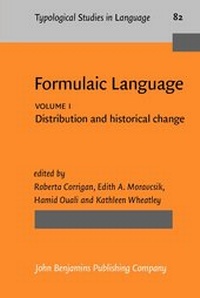
Formulaic Language
Volume 1. Distribution and historical change
Published on 20. May 2009
Book
Hardback
315 pages
978-90-272-2995-3 (ISBN)
Description
This book is the first of the two-volume collection of papers on formulaic language. The collection is among the first ones in the field. The book draws attention to the ritualized, repetitive side of language, which to some estimates make up over 50% of spoken and written text. While in the linguistic literature, the creative and innovative aspects of language have been amply highlighted, conventionalized, pre-fabricated, "off-the-shelf" expressions have been paid less attention - an imbalance that this book attempts to remedy. The first of the two volumes addresses the very concept of formulaic language and provides studies that explore the grammatical and semantic properties of formulae, their stylistic distribution within languages, and their evolution in the course of language history. Since most of the papers are readily accessible to readers with only basic familiarity with linguistics, besides being a resource in linguistic research, the book may be used in courses on discourse structure, pragmatics, semantics, language acquisition, and syntax, as well as being a resource in linguistic research.
Reviews / Votes
The volume provides a rich read. [...]The label 'formulaic' allows volumes such as the present one to illustrate the pervasiveness of lexcically restricted sequences and to explore them in all their glorious detail. -- Regina Weinert, University of the Basque Country/University of Sheffield, in Folia Linguistica, Vol.44:1 (2010)More details
Series
Language
English
Place of publication
Amsterdam
Netherlands
Target group
Professional and scholarly
Dimensions
Height: 245 mm
Width: 164 mm
Weight
770 gr
ISBN-13
978-90-272-2995-3 (9789027229953)
Copyright in bibliographic data and cover images is held by Nielsen Book Services Limited or by the publishers or by their respective licensors: all rights reserved.
Schweitzer Classification
Other editions
Additional editions
Roberta Corrigan | Edith A. Moravcsik | Hamid Ouali
Formulaic Language
Volume 1. Distribution and historical change
E-Book
05/2009
1st Edition
John Benjamins Publishing Company
€130.99
Available for download
Persons
Content
1. Preface; 2. Introduction. Approaches to the study of formulae (by Corrigan, Roberta); 3. Part I. What is Formulaic Language; 4. Grammarians' languages versus humanists' languages and the place of speech act formulas in models of linguistic competence (by Pawley, Andrew); 5. Identifying formulaic language: Persistent challenges and new opportunities (by Wray, Alison); 6. Part II. Structure and distribution; 7. Formulaic tendencies of demonstrative clefts in spoken English (by Calude, Andreea S.); 8. Formulaic language and the relater category - the case of about (by Hudson, Jean); 9. The aim is to analyze NP: The function of prefabricated chunks in academic texts (by Kerz, Elma); 10. Fixedness in Japanese adjectives in conversation: Toward a new understanding of a lexical ('part-of-speech') category (by Ono, Tsuyoshi); 11. Genre-controlled constructions in written language quotatives: A case study of English quotatives from two major genres (by Sams, Jessie); 12. Some remarks on the evaluative connotations of toponymic idioms in a contrastive perspective (by Szerszunowicz, Joanna); 13. Part III. Historical change; 14. The role of prefabs in grammaticization: How the particular and the general interact in language change (by Bybee, Joan L.); 15. Formulaic models and formulaicity in Classical and Modern Standard Arabic (by Lancioni, Giuliano); 16. A corpus study of lexicalized formulaic sequences with preposition + hand (by Lindquist, Hans); 17. The embodiment/culture continuum: A historical study of conceptual metaphor (by Mischler, III, James J.); 18. From 'remaining' to 'becoming' in Spanish: The role of prefabs in the development of the construction quedar(se) + ADJECTIVE (by Wilson, Damian Vergara); 19. Author index; 20. Subject index