

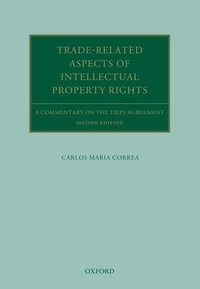
Trade Related Aspects of Intellectual Property Rights
A Commentary on the TRIPS Agreement
2nd Edition
Published on 23. July 2020
Book
Hardback
592 pages
978-0-19-870721-9 (ISBN)
Description
The TRIPS Agreement is the most comprehensive and influential international treaty on intellectual property rights. It brings intellectual property rules into the framework of the World Trade Organization, obliging all WTO Member States to meet minimum standards of intellectual property protection and enforcement. This has required massive changes in some national laws, particularly in developing countries. This volume provides a detailed legal analysis of the provisions of the TRIPS Agreement, as well as elements to consider their economic implications in different legal and socio-economic contexts.
This book provides an in depth analysis of the principles and of the substantive and enforcement provisions of the TRIPS Agreement, the most influential international treaty on intellectual property currently in force. It discusses the legal context in which the Agreement was negotiated, the objectives of their proponents and the nature of the obligations it created for the members of the World Trade Organization. In particular, it examines the minimum standards that must be implemented with regard to patents, trademarks, industrial designs, geographical indications, copyright and related rights, integrated circuits, trade-secrets and test data for pharmaceutical and agrochemical products.
Trade Related Aspects of Intellectual Property Rights: A Commentary on the TRIPS Agreement elaborates on the interpretation of provisions contained in said Agreement, in the light of the customary principles for the interpretation of international law. The analysis -which is supported by a review of the relevant GATT and WTO jurisprudence- identifies the policy space left to such members to implement their obligations in accordance with their own legal systems and public policy objectives, including in respect of complex issues such as patentability criteria, compulsory licenses, exceptions and limitations to copyright, border measures, injunctive relief and the protection of test data under the discipline of unfair competition.
This book provides an in depth analysis of the principles and of the substantive and enforcement provisions of the TRIPS Agreement, the most influential international treaty on intellectual property currently in force. It discusses the legal context in which the Agreement was negotiated, the objectives of their proponents and the nature of the obligations it created for the members of the World Trade Organization. In particular, it examines the minimum standards that must be implemented with regard to patents, trademarks, industrial designs, geographical indications, copyright and related rights, integrated circuits, trade-secrets and test data for pharmaceutical and agrochemical products.
Trade Related Aspects of Intellectual Property Rights: A Commentary on the TRIPS Agreement elaborates on the interpretation of provisions contained in said Agreement, in the light of the customary principles for the interpretation of international law. The analysis -which is supported by a review of the relevant GATT and WTO jurisprudence- identifies the policy space left to such members to implement their obligations in accordance with their own legal systems and public policy objectives, including in respect of complex issues such as patentability criteria, compulsory licenses, exceptions and limitations to copyright, border measures, injunctive relief and the protection of test data under the discipline of unfair competition.
Reviews / Votes
Ultimately, does the book stand out among other commentaries of the TRIPS Agreement, such as the series by Nuno Pires de Carvalho or Daniel Gervais' book, now in its fifth edition? In my view, it clearly does: it is more compact than most of the other works, yet packs the same punch -- if not more -- because of Correa's authoritative and succinct writing style. Thus, Correa finds balance not just in his interpretation of the TRIPS Agreement, but also in how he expresses it: accessible, clear, and to-the-point. As such, I expect that it will be a valuable reference for practitioners and students. * Leon Dijkman, European Intellectual Property Review * Review from previous edition provides much valuable material to read and consider..a comprehensive and accessible analysis of TRIPs, taking in (i) examination of the rights and duties of WTO members in implementing it, (ii) a forward-looking analysis of the developments in digital copyright as well as (iii) discussion of TRIPs' crucial enforcement provisions well-written and helpfully-referenced work.. * Jeremy Phillips, www.ipkat.com *More details
Series
Edition
2nd Revised edition
Language
English
Place of publication
Oxford
United Kingdom
Target group
Professional and scholarly
Edition type
Revised edition
Product notice
sewn/stitched
Cloth over boards
Dimensions
Height: 249 mm
Width: 170 mm
Thickness: 38 mm
Weight
1202 gr
ISBN-13
978-0-19-870721-9 (9780198707219)
Copyright in bibliographic data and cover images is held by Nielsen Book Services Limited or by the publishers or by their respective licensors: all rights reserved.
Schweitzer Classification
Other editions
Additional editions
Carlos Correa
Trade Related Aspects of Intellectual Property Rights
A Commentary on the TRIPS Agreement
E-Book
07/2020
2nd Edition
OUP eBook
€98.99
Available for download
Carlos Correa
Trade Related Aspects of Intellectual Property Rights
A Commentary on the TRIPS Agreement
E-Book
07/2020
2nd Edition
OUP eBook
€98.99
Available for download
Previous edition
Carlos Correa | Correa
Trade Related Aspects of Intellectual Property Rights
A Commentary on the TRIPS Agreement
Book
2007
Oxford University Press Inc
€213.56
Article exhausted; check for reprint
Person
Prof. Carlos Maria Correa is the Executive Director of the South Centre, an intergovernmental organization established in Geneva. He has been Director of the Center for Interdisciplinary Studies on Industrial Property and Economics (University of Buenos Aires), a visiting professor in post-graduate courses of several universities and consultant to UNCTAD, UNIDO, UNDP, WHO, FAO, IDB, INTAL, World Bank, SELA, ECLA, and other regional and international organizations.