

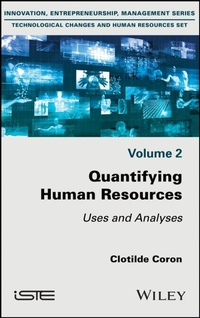
Quantifying Human Resources
Uses and Analyses
1st Edition
Published on 20. March 2020
Book
Hardback
238 pages
978-1-78630-446-9 (ISBN)
Description
Since the late 20th Century, Human Resources (HR) has had a legal obligation to produce reports for management in most firms. However, these have long been considered restrictive and are seldom used to improve decision-making. More recently, the emergence of analytics, Big Data and algorithms has enabled a reconfiguration of the uses of quantification in HR. Accompanied by empirical examples, this book presents and defines the different tools and uses of quantification in HR. It studies the effect of these tools on decision-making and ? without subscribing to the myth of objective and rational quantification ? presents the contributions and limits of the use of data in HR, and analyzes the potential risks of excessive quantification. It also discusses the appropriation of these tools by the various players in a company and examines their effects on the position of HR.
More details
Language
English
Place of publication
London
United Kingdom
Target group
Professional and scholarly
Product notice
sewn/stitched
Cloth over boards
Dimensions
Height: 240 mm
Width: 166 mm
Thickness: 20 mm
Weight
495 gr
ISBN-13
978-1-78630-446-9 (9781786304469)
Copyright in bibliographic data and cover images is held by Nielsen Book Services Limited or by the publishers or by their respective licensors: all rights reserved.
Schweitzer Classification
Other editions
Additional editions
E-Book
04/2020
1st Edition
Jossey-Bass
€139.99
Available for download
E-Book
03/2020
1st Edition
Jossey-Bass
€139.99
Available for download
Person
Clotilde Coron is an Associate Professor at the IAE Paris ? Sorbonne Business School, France, where she co-directs the Human Resources and Corporate Social Responsibility Master?s degree. Her research focuses on the use of figures and data in Human Resources.
Content
1. The Human and Social Sciences in the Face of Technological Change. 2. Technological Change and Society. 3. Technological Change and Organization. 4. Technological Change and the Individual. 5. Experiencing Technological Change.