

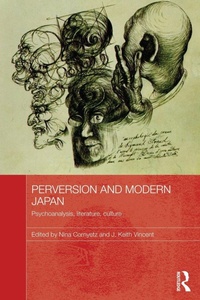
Perversion and Modern Japan
Psychoanalysis, Literature, Culture
1st Edition
Published on 12. October 2011
Book
Paperback/Softback
352 pages
978-0-415-69143-7 (ISBN)
Description
How did nerves and neuroses take the place of ghosts and spirits in Meiji Japan? How does Natsume Soseki's canonical novel Kokoro pervert the Freudian teleology of sexual development? What do we make of Jacques Lacan's infamous claim that because of the nature of their language the Japanese people were unanalyzable? And how are we to understand the re-awakening of collective memory occasioned by the sudden appearance of a Japanese Imperial soldier stumbling out of the jungle in Guam in 1972?
In addressing these and other questions, the essays collected here theorize the relation of unconscious fantasy and perversion to discourses of nation, identity, and history in Japan. Against a tradition that claims that Freud's method, as a Western discourse, makes a bad 'fit'with Japan, this volume argues that psychoanalytic reading offers valuable insights into the ways in which 'Japan' itself continues to function as a psychic object.
By reading a variety of cultural productions as symptomatic elaborations of unconscious and symbolic processes rather than as indexes to cultural truths, the authors combat the truisms of modernization theory and the seductive pull of culturalism. This volume also offers a much needed psychoanalytic alternative to the area studies convention that reads narratives of all sorts as "windows" offering insights into a fetishized Japanese culture. As such, it will be of huge interest to students and scholars of Japanese literature, history, culture, and psychoanalysis more generally.
In addressing these and other questions, the essays collected here theorize the relation of unconscious fantasy and perversion to discourses of nation, identity, and history in Japan. Against a tradition that claims that Freud's method, as a Western discourse, makes a bad 'fit'with Japan, this volume argues that psychoanalytic reading offers valuable insights into the ways in which 'Japan' itself continues to function as a psychic object.
By reading a variety of cultural productions as symptomatic elaborations of unconscious and symbolic processes rather than as indexes to cultural truths, the authors combat the truisms of modernization theory and the seductive pull of culturalism. This volume also offers a much needed psychoanalytic alternative to the area studies convention that reads narratives of all sorts as "windows" offering insights into a fetishized Japanese culture. As such, it will be of huge interest to students and scholars of Japanese literature, history, culture, and psychoanalysis more generally.
More details
Series
Language
English
Place of publication
London
United Kingdom
Publishing group
Taylor & Francis Ltd
Target group
College/higher education
Illustrations
23 s/w Abbildungen, 23 s/w Photographien bzw. Rasterbilder
23 Halftones, black and white; 23 Illustrations, black and white
Dimensions
Height: 234 mm
Width: 156 mm
Thickness: 19 mm
Weight
538 gr
ISBN-13
978-0-415-69143-7 (9780415691437)
Copyright in bibliographic data and cover images is held by Nielsen Book Services Limited or by the publishers or by their respective licensors: all rights reserved.
Schweitzer Classification
Other editions
Additional editions
E-Book
01/2010
Routledge
€64.49
Available for download
E-Book
01/2010
Routledge
€64.49
Available for download
Book
12/2009
1st Edition
Routledge
€232.50
Shipment within 15-20 days
Persons
Nina Cornyetz is Associate Professor of Interdisciplinary Studies at New York University, USA.
J. Keith Vincent is Assistant Professor of Japanese and Comparative Literature at Boston University, USA.
J. Keith Vincent is Assistant Professor of Japanese and Comparative Literature at Boston University, USA.
Content
Introduction: Japan as Screen Memory: Psychoanalysis and History Nina Cornyetz 1. Speculations of Murder: Ghostly Dreams, Poisonous Frogs, and the Return of Yokoi Shoichi Bruce Suttmeier 2. Japan's Lost Decade and Its Two Recoveries: On Sawaragi Noi, Japanese Neo-Pop and Anti-War Activism Carl Cassegard 3. The Corporeal Principle of the National Polity: The Rhetoric of the National Polity, or, the Nation as Memory Machine Yutaka Nagahara 4. Penuses/ Phallises: The Multiplication, Displacement and Appropriations of the Phallus Ayelet Zohar 5. Penisular Cartography: Topology in Nakagami Kenji's "Kishu" Nina Cornyetz 6. Two Ways to Play Fort-Da: With Freud and Tanizaki in Yoshino Margherita Long 7. The Double Scission of Mishima Yukio: Limits and Anxieties in the Autofictional Machine Gavin Walker 8. Navigating the Inner Sea: Utsumi Bunzo's Affects in Ukigumo Dawn Lawson 9. In the Flesh: The Historical Unconscious of Ishikawa Jun's "Fugen" Irena Hayter 10. Sexuality and Narrative in Soseki's "Kokoro" Keith Vincent 11. Exhausted by their Battles with the World: Neuraesthenia and Civilization Critique in Early Twentieth Century Japan Christopher Hill 12. Freud, Lacan and Japan Kazushige Shingu