

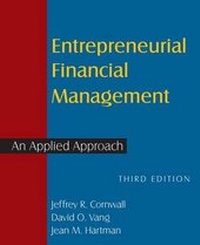
Entrepreneurial Financial Management
An Applied Approach
3rd Edition
Published on 1. October 2015
Book
Hardback
312 pages
978-1-138-13009-8 (ISBN)
Description
This new edition of Entrepreneurial Financial Management presents an applied, realistic view of finance for today's entrepreneurs. The book provides an integrated set of concepts and applications, drawn from entrepreneurship, finance, and accounting, that will prepare aspiring entrepreneurs for the world they are likely to face as they start their new businesses.
The book's contents are designed to follow the life cycle of a new business venture. Topics are covered in the order that entrepreneurs can expect to encounter them as they begin the process of business start-up and move into growing the business.
A comprehensive financial spreadsheet template is included with the book. This tool allows for the application of many of the concepts to actual businesses, and can be a valuable supplement to the process of developing a full business plan. The financial spreadsheet templates are available for unlimited free downloads at Professor Cornwall's blog site: www.drjeffcornwall.com.
Key Changes in the Third Edition
* The authors have added material on how the book's financial templates align with business modeling.
* The financial templates have been updated and now include more up-to-date assumptions on benefit costs.
* There is updated coverage of debt and equity financing due to new regulations and evolving investor expectations.
* The bootstrapping chapter has been revised to reflect the explosion of social media and its impact on bootstrap marketing.
The book's contents are designed to follow the life cycle of a new business venture. Topics are covered in the order that entrepreneurs can expect to encounter them as they begin the process of business start-up and move into growing the business.
A comprehensive financial spreadsheet template is included with the book. This tool allows for the application of many of the concepts to actual businesses, and can be a valuable supplement to the process of developing a full business plan. The financial spreadsheet templates are available for unlimited free downloads at Professor Cornwall's blog site: www.drjeffcornwall.com.
Key Changes in the Third Edition
* The authors have added material on how the book's financial templates align with business modeling.
* The financial templates have been updated and now include more up-to-date assumptions on benefit costs.
* There is updated coverage of debt and equity financing due to new regulations and evolving investor expectations.
* The bootstrapping chapter has been revised to reflect the explosion of social media and its impact on bootstrap marketing.
More details
Series
Edition
3rd New edition
Language
English
Place of publication
London
United Kingdom
Publishing group
Taylor & Francis Ltd
Target group
College/higher education
Edition type
New edition
Illustrations
Illustrations
Dimensions
Height: 229 mm
Width: 152 mm
Weight
454 gr
ISBN-13
978-1-138-13009-8 (9781138130098)
Copyright in bibliographic data and cover images is held by Nielsen Book Services Limited or by the publishers or by their respective licensors: all rights reserved.
Schweitzer Classification
Other editions
Additional editions

Jeffrey R. Cornwall | David O. Vang | Jean M. Hartman
Entrepreneurial Financial Management
An Applied Approach
Book
10/2012
3rd Edition
M.E. Sharpe
€71.98
Article exhausted; check different version
Persons
Jeffrey R. Cornwall is the inaugural recipient of the Jack C. Massey Chair in Entrepreneurship at Belmont University, USA. He also serves as the director of the Center for Entrepreneurship. He has published five other books on entrepreneurship. He does research in various areas of entrepreneurship and in business ethics. His blog, The Entrepreneurial Mind (www.drjeffcornwall.com), is one of the most popular small business blogs on the web.
David O. Vang is a professor of finance in the Opus College of Business at the University of St. Thomas, USA. He teaches and researches in the areas of finance, economics, and real estate. Dave has served as the CFO for a high-technology start-up company and has performed over seventy different consulting assignments for several organizations in areas such as derivatives, acquisitions, leveraged buyouts, product and service costing, and corporate finance.
Jean M. Hartman currently provides financial guidance working for a nonprofit organization that serves the chronically homeless. Her areas of interest include working with entrepreneurs and nonprofits to develop their understanding of financial statements and the critical importance of cash flow while applying ethical business practices. She is a certified public accountant.
David O. Vang is a professor of finance in the Opus College of Business at the University of St. Thomas, USA. He teaches and researches in the areas of finance, economics, and real estate. Dave has served as the CFO for a high-technology start-up company and has performed over seventy different consulting assignments for several organizations in areas such as derivatives, acquisitions, leveraged buyouts, product and service costing, and corporate finance.
Jean M. Hartman currently provides financial guidance working for a nonprofit organization that serves the chronically homeless. Her areas of interest include working with entrepreneurs and nonprofits to develop their understanding of financial statements and the critical importance of cash flow while applying ethical business practices. She is a certified public accountant.
Content
1. Introduction Part I: Building a Financial Forecast 2. Setting Financial Goals 3. Understanding Financial Statements 4. Revenue Forecasting 5. Expense Forecasting 6. Integrated Financial Model Part II: Managing the Financial Resources of a Venture 7. Monitoring Financial Performance 8. Day-to-Day Cash Flow Management and Forecasting Part III: Sources of Financing 9. Financing Over the Life of a Venture 10. Start-Up Financing from the Entrepreneur, Friends, and Family 11. Bootstrapping 12. External Sources of Funds: Equity 13. External Sources of Funds: Debt 14. Financing the High-Growth Business Part IV: Planning for the Entrepreneur's Transition 15. Business Valuation 16. Exit Planning