

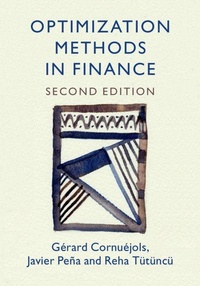
Optimization Methods in Finance
2nd Edition
Published on 9. August 2018
Book
Hardback
348 pages
978-1-107-05674-9 (ISBN)
Description
Optimization methods play a central role in financial modeling. This textbook is devoted to explaining how state-of-the-art optimization theory, algorithms, and software can be used to efficiently solve problems in computational finance. It discusses some classical mean-variance portfolio optimization models as well as more modern developments such as models for optimal trade execution and dynamic portfolio allocation with transaction costs and taxes. Chapters discussing the theory and efficient solution methods for the main classes of optimization problems alternate with chapters discussing their use in the modeling and solution of central problems in mathematical finance. This book will be interesting and useful for students, academics, and practitioners with a background in mathematics, operations research, or financial engineering. The second edition includes new examples and exercises as well as a more detailed discussion of mean-variance optimization, multi-period models, and additional material to highlight the relevance to finance.
Reviews / Votes
Review of first edition: 'This book will be useful as a textbook for students in financial engineering at the MS level. ... The book will also be of interest to researchers and graduate students in optimization who are interested in applications of optimization to financial problems.' Brian Borchers, Journal of Online Mathematics and its Applications Review of first edition: 'This book would certainly appeal to someone with a mathematical background, perhaps in operations research, wishing to update and apply their knowledge to the financial world.' Mathematics TODAY Review of first edition: 'Until now, there has been no comprehensive optimization book aimed at quantitative analysts in the financial industry. The book by Cornuejols and Tutuncu fills this void ... an excellent source for quantitative financial analysts and graduate students to learn about basic optimization theory, computational methods, and available software. At the same time, it can be used by academic researchers and students in optimization as an introduction to various interesting problems in financial applications.' International Review of Economics & FinanceMore details
Edition
2nd Revised edition
Language
English
Place of publication
Cambridge
United Kingdom
Target group
College/higher education
Professional and scholarly
Edition type
Revised edition
Illustrations
Worked examples or Exercises; 13 Halftones, black and white; 21 Line drawings, black and white
Dimensions
Height: 250 mm
Width: 175 mm
Thickness: 23 mm
Weight
784 gr
ISBN-13
978-1-107-05674-9 (9781107056749)
Copyright in bibliographic data and cover images is held by Nielsen Book Services Limited or by the publishers or by their respective licensors: all rights reserved.
Schweitzer Classification
Other editions
Additional editions
Gerard Cornuejols | Javier Pena | Reha Tuetuencue
Optimization Methods in Finance
E-Book
07/2018
2nd Edition
Cambridge University Press
€55.99
Available for download

Gerard Cornuejols | Javier Pena | Reha Tuetuencue
Optimization Methods in Finance
Book
2nd Edition
Cambridge University Press
Unfortunately, price unknown
The article will not be published
Previous edition
Gerard Cornuejols | Reha Tuetuencue
Optimization Methods in Finance
Book
12/2006
Cambridge University Press
€76.75
Article exhausted; check for reprint
Persons
Gerard Cornuejols is a Professor of Operations Research at the Tepper School of Business, Carnegie Mellon University, Pennsylvania. He is a member of the National Academy of Engineering and has received numerous prizes for his research contributions in integer programming and combinatorial optimization, including the Lanchester Prize, the Fulkerson Prize, the Dantzig Prize, and the von Neumann Theory Prize. Javier Pena is a Professor of Operations Research at the Tepper School of Business, Carnegie Mellon University, Pennsylvania. His research explores the myriad of challenges associated with large-scale optimization models and he has published numerous articles on optimization, machine learning, financial engineering, and computational game theory. His research has been supported by grants from the National Science Foundation, including a prestigious CAREER award. Reha Tuetuencue is the Chief Risk Officer at SECOR Asset Management and an adjunct professor at Carnegie Mellon University, Pennsylvania. He has previously held senior positions at Goldman Sachs Asset Management and AQR Capital Management focusing on quantitative portfolio construction, equity portfolio management, and risk management.
Content
Part I. Introduction: 1. Overview of optimization models; 2. Linear programming: theory and algorithms; 3. Linear programming models: asset-liability management; 4. Linear programming models: arbitrage and asset pricing; Part II. Single-Period Models: 5. Quadratic programming: theory and algorithms; 6. Quadratic programming models: mean-variance optimization; 7. Sensitivity of mean-variance models to input estimation; 8. Mixed integer programming: theory and algorithms; 9. Mixed integer programming models: portfolios with combinatorial constraints; 10. Stochastic programming: theory and algorithms; 11. Stochastic programming models: risk measures; Part III. Multi-Period Models: 12. Multi-period models: simple examples; 13. Dynamic programming: theory and algorithms; 14. Dynamic programming models: multi-period portfolio optimization; 15. Dynamic programming models: the binomial pricing model; 16. Multi-stage stochastic programming; 17. Stochastic programming models: asset-liability management; Part IV. Other Optimization Techniques: 18. Conic programming: theory and algorithms; 19. Robust optimization; 20. Nonlinear programming: theory and algorithms; Appendix; References; Index.