

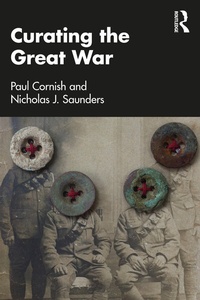
Curating the Great War
1st Edition
Published on 31. August 2022
Book
Paperback/Softback
366 pages
978-1-032-20269-3 (ISBN)
Description
Curating the Great War explores the inception and subsequent development of museums of the Great War and the animating spirit which lay behind them.
The book approaches museums of the Great War as political entities, some more overtly than others, but all unable to escape from the politics of the war, its profound legacies and its enduring memory. Their changing configurations and content are explored as reflections of the social and political context in which they exist. Curating of the Great War has expanded beyond the walls of museum buildings, seeking public engagement, both direct and digital, and taking in whole landscapes. Recognizing this fact, the book examines these museums as standing at the nexus of historiography, museology, anthropology, archaeology, sociology and politics as well as being a lieux de memoire. Their multi-vocal nature makes them a compelling subject for research and above all the book highlights that it is in these museums that we see the most complete fusion of the material culture of conflict with its historical, political and experiential context.
This book is an essential read for researchers of the reception of the Great War through material culture and museums.
The book approaches museums of the Great War as political entities, some more overtly than others, but all unable to escape from the politics of the war, its profound legacies and its enduring memory. Their changing configurations and content are explored as reflections of the social and political context in which they exist. Curating of the Great War has expanded beyond the walls of museum buildings, seeking public engagement, both direct and digital, and taking in whole landscapes. Recognizing this fact, the book examines these museums as standing at the nexus of historiography, museology, anthropology, archaeology, sociology and politics as well as being a lieux de memoire. Their multi-vocal nature makes them a compelling subject for research and above all the book highlights that it is in these museums that we see the most complete fusion of the material culture of conflict with its historical, political and experiential context.
This book is an essential read for researchers of the reception of the Great War through material culture and museums.
More details
Language
English
Place of publication
London
United Kingdom
Publishing group
Taylor & Francis Ltd
Target group
College/higher education
Illustrations
111 s/w Abbildungen, 111 s/w Photographien bzw. Rasterbilder
111 Halftones, black and white; 111 Illustrations, black and white
Dimensions
Height: 234 mm
Width: 156 mm
Weight
660 gr
ISBN-13
978-1-032-20269-3 (9781032202693)
Copyright in bibliographic data and cover images is held by Nielsen Book Services Limited or by the publishers or by their respective licensors: all rights reserved.
Schweitzer Classification
Other editions
Additional editions
Paul Cornish | Nicholas J. Saunders
Curating the Great War
E-Book
08/2022
1st Edition
Routledge
€53.99
Available for download
Paul Cornish | Nicholas J. Saunders
Curating the Great War
E-Book
08/2022
1st Edition
Routledge
€53.99
Available for download
Paul Cornish | Nicholas J. Saunders
Curating the Great War
Book
08/2022
1st Edition
Routledge
€206.50
Shipment within 10-20 days
Persons
Paul Cornish was, for 32 years, a curator at Imperial War Museums. He is co-editor of the Routledge series Material Culture and Modern Conflict.
Nicholas J. Saunders is Professor of Material Culture at Bristol University, UK, and co-director of the 'Great Arab Revolt Project'.
Nicholas J. Saunders is Professor of Material Culture at Bristol University, UK, and co-director of the 'Great Arab Revolt Project'.
Content
Introduction: Challenging perspectives on museums and the Great War; PART I: Museums, Identities and the Politics of Memory: Chapter 1: From one war to another: German army museums and exhibitions on the First World War, 1914-1940; Chapter 2: The Great War in French Museums 1914-2018; Chapter 3: Curating on the frontier: The Museum of the Great War in Gorizia, Italy; Chapter 4: Curating Dominion Narratives of the Great War; Chapter 5: Curating the Great War at the Imperial War Museum During the Second World War; PART II: Museums and Materialities: Chapter 6: East of the Jordan: Curating and forgetting the First World War and the Arab Revolt along the Hejaz Railway; Chapter 7: Conflict Landscape as Museum and Memorial: The Walk of Peace from the Alps to the Adriatic; Chapter 8: Digging a trench in an upstairs gallery: Commemorating the Great War in rural Dorset; Chapter 9. Curating the Great War in Poland: The prisoner-of-war camp at Czersk; Chapter 10: Curating the Macedonian Campaign; Chapter 11: 'Oh! What a Lovely Exhibition!': Exploring the Imperial War Museum's First World War 50th anniversary displays, 1964-1968; Chapter 12: Te Papa's Gallipoli: The scale of our war: Curating innovation; PART III: Audiences and Engagement: Chapter 13: Curating the Sensory War, 1914-2014: emotions, sensations and the violence of modern war; Chapter 14: Forgotten War? Coping with First World War trauma, and strategies for centenary commemoration in the Federal State of Tyrol, Austria; Chapter 15: Curating the Masonic Peace Memorial, London; Chapter 16: What Need of Tears?: Collaborative memorial-making in the centenary of The Great War; Chapter 17: Contested memories: Exhibiting the Great War in the Ulster Museum, Belfast; Chapter 18: The predicament of material culture: In situ legacies of the Isonzo Front after the First World War centenary (2014-2018); Afterword: Commemorating the First World today: The In Flanders Fields Museum, Ypres, Belgium; Index.