

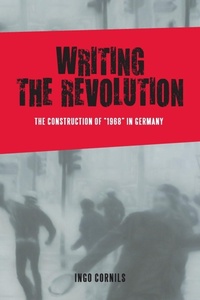
Writing the Revolution
The Construction of "1968" in Germany
Published on 17. February 2020
Book
Paperback/Softback
328 pages
978-1-64014-071-4 (ISBN)
Description
An extensive look at historical, literary, and media representations of '68 in Germany, challenging the way it has been instrumentalized.
In Germany, the concept of "1968" is enduring and synonymous with the German Student Movement, and is viewed, variously, as a fundamental liberalization, a myth, a second foundation, or an irritation. The movement's aims - radicalre-imagination of the political and economic order and social hierarchy - have been understood as requiring a "long march." While the movement has been judged at best a "successful failure," cultural elites continue to engage inthe construction of 1968. Ingo Cornils's book argues that writing about 1968 in Germany is no longer about the historical events or the specific objectives of a bygone counterculture, but is instead a moral touchstone, a marker ofsocial group identity meant to keep alive (or at bay) a utopian agenda that continues to fire the imagination. The book demonstrates that the representation of 1968 as a "foundational myth" suits the needs of a number of surprisingly heterogeneous groups, and that even attempts to deconstruct the myth strengthen it. Cornils brings together for the first time the historical, literary, and media representations of the movement, showing the motivation behindand effect of almost five decades of writing about 1968. In so doing, Cornils challenges the way 1968 has been instrumentalized: as a powerful imaginary that has colonized every aspect of life in Germany, and as symbolic capitalin cultural and political debates.
Ingo Cornils is Professor of German Studies at the University of Leeds.
In Germany, the concept of "1968" is enduring and synonymous with the German Student Movement, and is viewed, variously, as a fundamental liberalization, a myth, a second foundation, or an irritation. The movement's aims - radicalre-imagination of the political and economic order and social hierarchy - have been understood as requiring a "long march." While the movement has been judged at best a "successful failure," cultural elites continue to engage inthe construction of 1968. Ingo Cornils's book argues that writing about 1968 in Germany is no longer about the historical events or the specific objectives of a bygone counterculture, but is instead a moral touchstone, a marker ofsocial group identity meant to keep alive (or at bay) a utopian agenda that continues to fire the imagination. The book demonstrates that the representation of 1968 as a "foundational myth" suits the needs of a number of surprisingly heterogeneous groups, and that even attempts to deconstruct the myth strengthen it. Cornils brings together for the first time the historical, literary, and media representations of the movement, showing the motivation behindand effect of almost five decades of writing about 1968. In so doing, Cornils challenges the way 1968 has been instrumentalized: as a powerful imaginary that has colonized every aspect of life in Germany, and as symbolic capitalin cultural and political debates.
Ingo Cornils is Professor of German Studies at the University of Leeds.
Reviews / Votes
[V]ery important and useful . . . . Cornils analyses the 'successful failure' of the student revolt in Germany and the cultural construction of its myth in . . . all its components. -- Mauro Ponzi * LINKS * [A]n illuminating meta-history, not so much about 1968 as about the representation and mythologization of it. -- Hans Kundnani * TIMES LITERARY SUPPLEMENT * [I]ndispensable to anyone seeking to understand why '1968' is still written about and why it still matters so much in Germany. -- Joachim Whaley * JOURNAL OF EUROPEAN STUDIES * [M]eticulously researched and captivatingly narrated. . . . It is especially in the[] discursive shifts [that he describes and analyzes] -[which] concur with the shifts in German politics of memory in general - that the decisive benefit of Cornils' analysis appears. -- Ivana Perica * THEORY & EVENT * [A] meticulously researched and well executed analysis of the never-ending story of 1968, which draws on memory studies and expands on it. [Cornils's] comprehensive study is indispensable to everyone interested in understanding the meaning of the student movement in and for Germany . . . . -- Sabine von Dirke * GERMAN STUDIES REVIEW * The author has mastered the extensive literature and produced an engaging account of one of West Germany's most critical postwar periods. Highly recommended. * CHOICE * Cornils's impressive collection of materials that engage with 1968 mirrors the breathlessness of the events and the wide range of their interpretations and appropriations. * GERMAN QUARTERLY * [E]xcellent . . . . The significance of Cornils's work is . . . its releasing '1968' from history, handing it over to the present. . . . [F]ills a major gap . . . . * MODERN LANGUAGE REVIEW * [T]his volume . . . confirms the status of the author as a leading British-based expert in the area. . . . Cornils [writes] with infectious enthusiasm on a subject close to his heart. . . . [A] knowledgeable and readable book . . . . * JOURNAL OF CONTEMPORARY EUROPEAN STUDIES *More details
Series
Language
English
Place of publication
Columbia, MD
United States
Publishing group
Boydell & Brewer Ltd
Target group
Professional and scholarly
Product notice
Paperback (trade)
Illustrations
1 s/w Abbildung
1 b/w illus.
Dimensions
Height: 229 mm
Width: 152 mm
Thickness: 18 mm
Weight
477 gr
ISBN-13
978-1-64014-071-4 (9781640140714)
Copyright in bibliographic data and cover images is held by Nielsen Book Services Limited or by the publishers or by their respective licensors: all rights reserved.
Schweitzer Classification
Other editions
Additional editions
E-Book
09/2016
1st Edition
De Gruyter
€48.99
Available for download
E-Book
09/2016
1st Edition
Boydell & Brewer
€48.99
Available for download
Book
09/2016
Camden House Inc
€120.20
Shipment within 15-20 days
Person
INGO CORNILS is Professor of German Studies at the University of Leeds.
Content
Introduction
Heroes and Martyrs
Chroniclers and Interpreters
Critics and Renegades
Talespinners and Poets
Women of the Revolution
"1968" and the Media
"1968" and the Arts
Zaungaeste
Not Dark Yet: The 68ers at 70
Romantic Relapse or Modern Myth?
Conclusion
Notes
Bibliography
Heroes and Martyrs
Chroniclers and Interpreters
Critics and Renegades
Talespinners and Poets
Women of the Revolution
"1968" and the Media
"1968" and the Arts
Zaungaeste
Not Dark Yet: The 68ers at 70
Romantic Relapse or Modern Myth?
Conclusion
Notes
Bibliography