

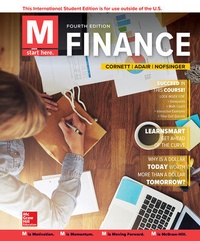
ISE M: Finance
4th Edition
Published on 8. August 2018
Book
Paperback/Softback
464 pages
978-1-260-09192-2 (ISBN)
Description
M: Finance incorporates the newest technology to facilitate the learning process, saving valuable time for you and your students. Cornett M's unmatched pedagogy and additional resources within Connect help students solve financial problems, understand the relevance, and apply what they've learned. The text's succinct coverage, magazine-like design, and personal examples combine with a complete digital solution to help your students achieve higher outcomes in the course.
More details
Edition
4th edition
Language
English
Place of publication
OH
United States
Target group
College/higher education
US School Grade: From College Freshman to College Graduate Student
ISBN-13
978-1-260-09192-2 (9781260091922)
Copyright in bibliographic data and cover images is held by Nielsen Book Services Limited or by the publishers or by their respective licensors: all rights reserved.
Schweitzer Classification
Persons
Marcia Millon Cornett received a B.S. in economics from Knox College and her M.B.A. and Ph.D. in finance from Indiana University, Bloomington. She is Robert A. and Julia E. Dorn Professor of Finance at Bentley University. Dr. Cornett is co-author with Anthony Saunders of Financial Institutions Management and Financial Markets and Institutions. She serves as an associate editor for the Journal of Banking and Finance, the Journal of Financial Services Research, Review of Financial Economics, Financial Review, and Multinational Finance Journal. Dr. Cornett has served on the board of directors, the executive committee, and the finance committee of the Southern Illinois University Credit Union. Dr. Cornett has taught at Southern Illinois University at Carbondale, the University of Colorado, Boston College, and Southern Methodist University. She is a member of the Financial Management Association, the American Finance Association, and the Western Finance Association.
Troy Alton Adair Jr. received his B.S. in computers/information science from the University of Alabama at Birmingham, his M.B.A. from the University of North Dakota, and his Ph.D. in finance from Indiana University. He is senior director of Research Computing Services at Harvard Business School. He is the author of Corporate Finance Demystified, Excel Applications in Corporate Finance, and Excel Applications in Investments. Dr. Adair has served as a consultant on financial data information systems and business intelligence to international banks and insurance companies and as the faculty representative to the board of trustees investments committee at Alma College. Dr. Adair has taught at the University of Michigan, Alma College, Hofstra University, Indiana University, and the University of North Carolina at Chapel Hill. He is a member of the Financial Management Association, the American Finance Association, and the Southern Finance Association.
John Nofsinger earned his B.S. in electrical engineering from Washington State University, his M.B.A. from Chapman University, and his Ph.D. in finance from Washington State University. He is Professor and William H. Seward Endowed Chair of International Finance at the University of Alaska Anchorage. Dr. Nofsinger has written more than 50 articles in the areas of investments, corporate finance, and behavioral finance. Dr. Nofsinger has authored (or co-authored) 10 trade books, scholarly books, and textbooks that have been translated into 11 different languages. The most prominent of these books is The Psychology of Investing. Dr. Nofsinger is a leading expert in behavioral finance and is a frequent speaker on this topic at industry conferences, universities, and academic conferences. He is frequently quoted or appears in the financial media, including the Wall Street Journal, Financial Times, Fortune, Bloomberg Businessweek, the Washington Post, and CNBC.
Troy Alton Adair Jr. received his B.S. in computers/information science from the University of Alabama at Birmingham, his M.B.A. from the University of North Dakota, and his Ph.D. in finance from Indiana University. He is senior director of Research Computing Services at Harvard Business School. He is the author of Corporate Finance Demystified, Excel Applications in Corporate Finance, and Excel Applications in Investments. Dr. Adair has served as a consultant on financial data information systems and business intelligence to international banks and insurance companies and as the faculty representative to the board of trustees investments committee at Alma College. Dr. Adair has taught at the University of Michigan, Alma College, Hofstra University, Indiana University, and the University of North Carolina at Chapel Hill. He is a member of the Financial Management Association, the American Finance Association, and the Southern Finance Association.
John Nofsinger earned his B.S. in electrical engineering from Washington State University, his M.B.A. from Chapman University, and his Ph.D. in finance from Washington State University. He is Professor and William H. Seward Endowed Chair of International Finance at the University of Alaska Anchorage. Dr. Nofsinger has written more than 50 articles in the areas of investments, corporate finance, and behavioral finance. Dr. Nofsinger has authored (or co-authored) 10 trade books, scholarly books, and textbooks that have been translated into 11 different languages. The most prominent of these books is The Psychology of Investing. Dr. Nofsinger is a leading expert in behavioral finance and is a frequent speaker on this topic at industry conferences, universities, and academic conferences. He is frequently quoted or appears in the financial media, including the Wall Street Journal, Financial Times, Fortune, Bloomberg Businessweek, the Washington Post, and CNBC.
Content
PART ONE: INTRODUCTION
Chapter 1 Introduction to Financial Management
PART TWO: FINANCIAL STATEMENTS
Chapter 2 Reviewing Financial Statements
Chapter 3 Analyzing Financial Statements
PART THREE: VALUING OF FUTURE CASH FLOWS
Chapter 4 Time Value of Money 1: Analyzing Single Cash Flows
Chapter 5 Time Value of Money 2: Analyzing Annuity Cash Flows
PART FOUR: VALUING OF BONDS AND STOCKS
Chapter 6 Understanding Financial Markets and Institutions
Chapter 7 Valuing Bonds
Chapter 8 Valuing Stocks
PART FIVE: RISK AND RETURN
Chapter 9 Characterizing Risk and Return
Chapter 10 Estimating Risk and Return
PART SIX: CAPITAL BUDGETING
Chapter 11 Calculating the Cost of Capital
Chapter 12 Estimating Cash Flows on Capital Budgeting Projects
Chapter 13 Weighing Net Present Value and Other Capital Budgeting Criteria
PART SEVEN: WORKING CAPITAL MANAGEMENT AND FINANCIAL PLANNING
Chapter 14 Working Capital Management and Policies
Chapter 1 Introduction to Financial Management
PART TWO: FINANCIAL STATEMENTS
Chapter 2 Reviewing Financial Statements
Chapter 3 Analyzing Financial Statements
PART THREE: VALUING OF FUTURE CASH FLOWS
Chapter 4 Time Value of Money 1: Analyzing Single Cash Flows
Chapter 5 Time Value of Money 2: Analyzing Annuity Cash Flows
PART FOUR: VALUING OF BONDS AND STOCKS
Chapter 6 Understanding Financial Markets and Institutions
Chapter 7 Valuing Bonds
Chapter 8 Valuing Stocks
PART FIVE: RISK AND RETURN
Chapter 9 Characterizing Risk and Return
Chapter 10 Estimating Risk and Return
PART SIX: CAPITAL BUDGETING
Chapter 11 Calculating the Cost of Capital
Chapter 12 Estimating Cash Flows on Capital Budgeting Projects
Chapter 13 Weighing Net Present Value and Other Capital Budgeting Criteria
PART SEVEN: WORKING CAPITAL MANAGEMENT AND FINANCIAL PLANNING
Chapter 14 Working Capital Management and Policies