

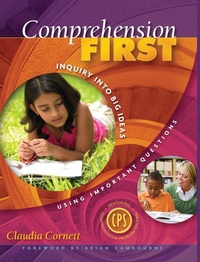
Comprehension First
Inquiry into Big Ideas Using Important Questions
1st Edition
Published on 3. May 2017
Book
Hardback
432 pages
978-1-138-07804-8 (ISBN)
Description
This book is about designing instruction that makes comprehension the priority in reading and in content area study. The comprehension model described responds to calls from literacy experts and professional organizations for inquiry-based instruction that prepares readers to be active meaning makers who are adept at both critical and creative thinking.
Comprehension First introduces a before, during, after Comprehension Problem Solving (CPS) process that helps readers ask key questions so they arrive at a substantial comprehension product-"big ideas" based on themes and conclusions drawn from literary works and expository texts. The book further describes how to orchestrate research-based best practices to build lessons and units around big ideas and important questions.
In this age of multiple literacies, all of us must learn to be more nimble users of Literacy 2.0 communication tools. Mastering problem solving is at the core of this challenge. Comprehension First embraces this challenge by inviting present and future teachers to examine WHY and HOW these tools can be used more purposefully to achieve the pre-eminent literacy goal of deep comprehension.
Comprehension First introduces a before, during, after Comprehension Problem Solving (CPS) process that helps readers ask key questions so they arrive at a substantial comprehension product-"big ideas" based on themes and conclusions drawn from literary works and expository texts. The book further describes how to orchestrate research-based best practices to build lessons and units around big ideas and important questions.
In this age of multiple literacies, all of us must learn to be more nimble users of Literacy 2.0 communication tools. Mastering problem solving is at the core of this challenge. Comprehension First embraces this challenge by inviting present and future teachers to examine WHY and HOW these tools can be used more purposefully to achieve the pre-eminent literacy goal of deep comprehension.
More details
Language
English
Place of publication
London
United Kingdom
Publishing group
Taylor & Francis Ltd
Target group
College/higher education
Dimensions
Height: 260 mm
Width: 208 mm
Thickness: 28 mm
Weight
1147 gr
ISBN-13
978-1-138-07804-8 (9781138078048)
Copyright in bibliographic data and cover images is held by Nielsen Book Services Limited or by the publishers or by their respective licensors: all rights reserved.
Schweitzer Classification
Other editions
Additional editions
E-Book
06/2017
Routledge
€76.49
Available for download
E-Book
06/2017
Routledge
€76.49
Available for download

Book
10/2009
Taylor & Francis
€147.07
Article exhausted; check different version
Book
10/2009
1st Edition
Holcomb Hathaway, Incorporated
€81.60
Shipment within 3-4 weeks
Person
Claudia Comett
Content
Foreword xv
Preface xvii
About the Author xxii
1 Comprehension Definitions, Issues, and Directions
2 Comprehension Problem Solving
Inquiry into Big Ideas Using Important Questions
3 Teachers, Context, and the Comprehension Task
4 Assessing to Differentiate Instruction
5 Explicit Teaching of Comprehension Strategies and Text Characteristics
6 Using Motivation Strategies to Engage Comprehension
7 Using Questioning to Promote Discussion and Conversation
8 Teaching Vocabulary and Fluency for Comprehension
9 Teaching Diverse Response Options to Show Comprehension
10 Organizing Main Events with Embedded Comprehension Practices
Appendices
References
Author Index
Subject Index
Preface xvii
About the Author xxii
1 Comprehension Definitions, Issues, and Directions
2 Comprehension Problem Solving
Inquiry into Big Ideas Using Important Questions
3 Teachers, Context, and the Comprehension Task
4 Assessing to Differentiate Instruction
5 Explicit Teaching of Comprehension Strategies and Text Characteristics
6 Using Motivation Strategies to Engage Comprehension
7 Using Questioning to Promote Discussion and Conversation
8 Teaching Vocabulary and Fluency for Comprehension
9 Teaching Diverse Response Options to Show Comprehension
10 Organizing Main Events with Embedded Comprehension Practices
Appendices
References
Author Index
Subject Index