

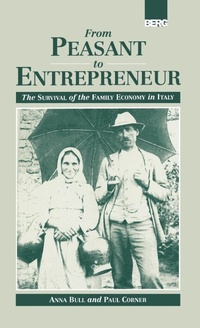
From Peasant to Entrepreneur
The Survival of the Family Economy in Italy
Published on 23. June 1993
Book
Hardback
192 pages
978-0-85496-309-6 (ISBN)
Description
The conspicuous success in Italy of a highly dynamic sector of small, rurally based manufacturing businesses has attracted a considerable amount of attention throughout both Europe and the United States in recent years. This book links this development in Italy to the processes of transformation of certain parts of the Italian countryside over the last hundred years and argues that the involvement of peasant families with both agricultural and industrial employment - a constant of the situation before the First World War - produced an entrepreneurial spirit that was subsequently reflected in the development of rural industries.
Reviews / Votes
'... an important study.'Business History'... this book should prove of interest not just to economists concerned with the somewhat unusual patterns of Italian economic development, but also to political scientists, historians, and sociologists.'Modern Italy'This impressive case study is a welcome addition to the body of literature on the origins and nature of the 'Third Italy' '.ItalyMore details
Language
English
Place of publication
London
United Kingdom
Publishing group
Bloomsbury Publishing PLC
Illustrations
tables, bibliography, index
Dimensions
Height: 222 mm
Width: 145 mm
Thickness: 14 mm
Weight
375 gr
ISBN-13
978-0-85496-309-6 (9780854963096)
Copyright in bibliographic data and cover images is held by Nielsen Book Services Limited or by the publishers or by their respective licensors: all rights reserved.
Schweitzer Classification
Persons
Anna Bull Lecturer in Italian History and Politics,University of Bath Paul Corner Professor of Contemporary Italian History, University of Sienna
Content
Part 1 Introduction. Part 2 Peasant families and rural labour 1815-90: Grain rents, silk, and peasant poverty; Peasant families and rural manufacturing; Woman's labour and peasant survival; Family roles and peasant conservatism; A social form, a pattern of behaviour. Part 3 Agrarian crisis and the end of the equilibrium 1890-1915: The impact of crisis; From peasant-worker to worker-peasant; Family mentalities and resistence to proletarianisation; Peasants and proto-industrialisation. Part 4 War and fascism - peasant independence and new directions: The war as watershed; Postwar independence - family and freedom; The decline of the silk industry; Peasants and small businesses - the interwar experiment; Small firm foundation and "historic breaches" with the past. Part 5 Peasants and entrepreneurship - from fascism to the present: Social and economic trends; The marginalisation of agriculture; The fascist period; Postwar economic development; Como today - entrepreneurship and society; Diffused industry and political culture. Part 6 Beyond silk - Italy's model of diffused industrialisation: Small firms as an independent form of industrial organisation; The Italian model - current debates on its origins and characteristics; A reassessment of current theories - the social variables of small business performance. Part 7 Conclusions.