

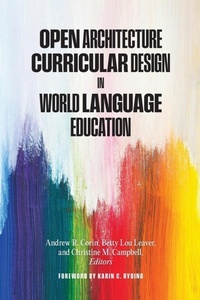
Open Architecture Curricular Design in World Language Education
Published on 1. July 2025
Book
Paperback/Softback
280 pages
978-1-64712-599-8 (ISBN)
Description
A guide to a textbook-free approach to world languages curriculums that will improve learning outcomes
Open architecture curricular design (OACD) is a textbook-free curricular design framework for teaching and learning world languages that integrates all the best practices in world language education to enhance learning efficiency and effectiveness. As editors and pioneers of this method, Corin, Leaver, and Campbell define OACD for world language instructors and second language acquisition researchers from middle school through higher education and beyond.
The book's chapters demonstrate how to use OACD for a wide variety of languages and proficiency levels in government, service academy, and university programs. Topics covered include the use of authentic texts at all levels, learner involvement in the selection of content and activities, and methods of assessment and program evaluation.
Open architecture curricular design (OACD) is a textbook-free curricular design framework for teaching and learning world languages that integrates all the best practices in world language education to enhance learning efficiency and effectiveness. As editors and pioneers of this method, Corin, Leaver, and Campbell define OACD for world language instructors and second language acquisition researchers from middle school through higher education and beyond.
The book's chapters demonstrate how to use OACD for a wide variety of languages and proficiency levels in government, service academy, and university programs. Topics covered include the use of authentic texts at all levels, learner involvement in the selection of content and activities, and methods of assessment and program evaluation.
More details
Language
English
Place of publication
Washington, DC
United States
Target group
Professional and scholarly
US School Grade: College Graduate Student and over
Product notice
Paperback (trade)
Illustrations
Not illustrated
Dimensions
Height: 225 mm
Width: 150 mm
Thickness: 17 mm
Weight
408 gr
ISBN-13
978-1-64712-599-8 (9781647125998)
Copyright in bibliographic data and cover images is held by Nielsen Book Services Limited or by the publishers or by their respective licensors: all rights reserved.
Schweitzer Classification
Other editions
Additional editions
Andrew R. Corin | Betty Lou Leaver | Christine M. Campbell
Open Architecture Curricular Design in World Language Education
E-Book
07/2025
Georgetown University Press
€43.99
Available for download
Persons
Andrew R. Corin is Professor Emeritus at the Defense Language Institute's Foreign Language Center, where he also served as associate provost.
Betty Lou Leaver is the former provost and dean of the Defense Language Institute and has published twenty-one books.
Christine Campbell is president of Campbell Language Consultants and previously served as associate provost of the Defense Language Institute.
Betty Lou Leaver is the former provost and dean of the Defense Language Institute and has published twenty-one books.
Christine Campbell is president of Campbell Language Consultants and previously served as associate provost of the Defense Language Institute.
Content
Foreword by Karin C. Ryding
A Note to the Reader
Acknowledgments
Abbreviations
Part 1. The OACD Framework
1. An Introduction to Open Architecture Curricular Design: Concept, Origins, and Range of Applicability. Andrew Corin, Betty Lou Leaver, and Christine Campbell
Part 2. OACD in U.S. Government Language Institutes: Programs at the Defense Language Institute Foreign Language Center
2. Open Architecture Curricular Design as an Enabler for Transformative Learning in a Korean Course. Jae Sun Lee
3. Preparing Novice Learners for Open Architecture Learning: The Gradual Release of Responsibility Model. Irene Krasner
4. OACD-based Immersion Events Outside the Classroom in an Intensive Chinese Mandarin Program. Kueilan Chen
5. Introducing Open Architecture Curricular Design in an Egyptian Dialect Program. Kassema Jones
6. The Use of Project-based OACD Modules in an Intermediate and Advanced Chinese Mandarin Program. Daniel Wang
Part 3. OACD in U.S. Military Service Academies: Programs at the United States Military Academy (West Point)
7. Emulating Proficiency-Increasing Features of the Semester Abroad Experience through Open Architecture Curricular Design. E. John Gregory
8. Optimizing Flexibility in a Distance Learning Immersion Course at West Point: Three Examples of Open Architecture Curricular Design. Sherry A. Maggin, Zachary F. Miller, Joshua Enslen, John Pendergast, and Olga Dobrunoff
9. Using OACD and Macrostrategies Frameworks to Enable the Practical Application of Sociocultural Theory in a College Russian Course. Jeff R. Watson
Part 4. OACD in Academe
10. Inter-Institutional Collaboration in Curriculum Development: The Design of Flexible Modules in the Less Commonly Taught Languages Partnership. Koen Van Gorp, Emily Heidrich Uebel, and Luca Giupponi
11. From Reading the News to Performing the News: Using Oral Presentations as a Key of an OACD-enabled Course. Rossina Soyan
12. Integrating Open Architecture Curricular Design in a Proficiency-Oriented, Content-Based Instruction Course in Korean. Sang Yee Cheon
13. Spiral-like Design for Teaching Inflectional Languages at Novice Level in an OACD-enabled Content-Based Instruction Course. Maria Bondarenko
Part 5. Learning Assessment, Program Evaluation, and Program Management in an OACD Context
14. Open Architecture Curricular Design as an Enabler of Diagnostic Instruction. Reem Dababneh and Rong Yuan
15. An Open Architecture Approach to Program Evaluation in a Language Learning Setting. Wendy Ashby
16. Implementing Open Architecture Curricular Design at the Classroom and Department Level: Lessons from a Ten-Year Experience. Yaniv Oded and Ilknur Oded
Contributors
Index
A Note to the Reader
Acknowledgments
Abbreviations
Part 1. The OACD Framework
1. An Introduction to Open Architecture Curricular Design: Concept, Origins, and Range of Applicability. Andrew Corin, Betty Lou Leaver, and Christine Campbell
Part 2. OACD in U.S. Government Language Institutes: Programs at the Defense Language Institute Foreign Language Center
2. Open Architecture Curricular Design as an Enabler for Transformative Learning in a Korean Course. Jae Sun Lee
3. Preparing Novice Learners for Open Architecture Learning: The Gradual Release of Responsibility Model. Irene Krasner
4. OACD-based Immersion Events Outside the Classroom in an Intensive Chinese Mandarin Program. Kueilan Chen
5. Introducing Open Architecture Curricular Design in an Egyptian Dialect Program. Kassema Jones
6. The Use of Project-based OACD Modules in an Intermediate and Advanced Chinese Mandarin Program. Daniel Wang
Part 3. OACD in U.S. Military Service Academies: Programs at the United States Military Academy (West Point)
7. Emulating Proficiency-Increasing Features of the Semester Abroad Experience through Open Architecture Curricular Design. E. John Gregory
8. Optimizing Flexibility in a Distance Learning Immersion Course at West Point: Three Examples of Open Architecture Curricular Design. Sherry A. Maggin, Zachary F. Miller, Joshua Enslen, John Pendergast, and Olga Dobrunoff
9. Using OACD and Macrostrategies Frameworks to Enable the Practical Application of Sociocultural Theory in a College Russian Course. Jeff R. Watson
Part 4. OACD in Academe
10. Inter-Institutional Collaboration in Curriculum Development: The Design of Flexible Modules in the Less Commonly Taught Languages Partnership. Koen Van Gorp, Emily Heidrich Uebel, and Luca Giupponi
11. From Reading the News to Performing the News: Using Oral Presentations as a Key of an OACD-enabled Course. Rossina Soyan
12. Integrating Open Architecture Curricular Design in a Proficiency-Oriented, Content-Based Instruction Course in Korean. Sang Yee Cheon
13. Spiral-like Design for Teaching Inflectional Languages at Novice Level in an OACD-enabled Content-Based Instruction Course. Maria Bondarenko
Part 5. Learning Assessment, Program Evaluation, and Program Management in an OACD Context
14. Open Architecture Curricular Design as an Enabler of Diagnostic Instruction. Reem Dababneh and Rong Yuan
15. An Open Architecture Approach to Program Evaluation in a Language Learning Setting. Wendy Ashby
16. Implementing Open Architecture Curricular Design at the Classroom and Department Level: Lessons from a Ten-Year Experience. Yaniv Oded and Ilknur Oded
Contributors
Index