

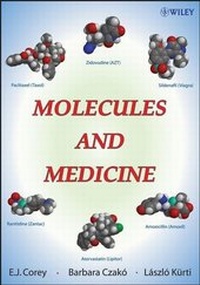
Molecules and Medicine
Published on 14. September 2007
Book
Paperback/Softback
272 pages
978-0-470-22749-7 (ISBN)
Description
Molecules And Medicine
This book is appropriate for a broad readership, starting with curious and thoughtful college undergraduates and reaching beyond to professors and researchers in the life sciences, chemistry, and medicine. This book provides, for the first time ever, a completely integrated look at chemistry, biology, drug discovery, and medicine.
Molecules and Medicine delves into the discovery, application, and mode of action of more than one hundred of the most significant molecules now in use in modern medicine. Molecule structures and shapes are shown for all of these medicines. The opening sections of the book provide a unique, clear, and concise introduction which enables the reader to understand chemical formulas.
Reviews / Votes
"Dieses Werk schließt eine Lücke in der didaktischen Literatur und wird in der Ausbildung von Wissenschaftlern enorm von Nutzen sein." Angewandte Chemie, 2008, 120, 2203-2205More details
Other editions
Additional editions
E. J. Corey | Barbara Czako | László Kürti
Molecules and Medicine
E-Book
02/2012
Wiley
€52.99
Available for download
E. J. Corey | Barbara Czako | László Kürti
Molecules and Medicine
E-Book
02/2012
Wiley
€52.99
Available for download
E. J. Corey | Barbara Czakó | László Kürti
Molecules and Medicine
Book
03/2008
Wiley
€105.00
Shipment within 10-20 days
Persons
E. J. Corey has been a Professor at Harvard University since 1959. He was educated at The Massachusetts Institute of Technology (1945-1950) and served as a faculty member at the University of Illinois from1951 to 1959. He is the 1990 Nobel Laureate in Chemistry, and the recipient of over seventy international awards and honorary degrees, including the U.S. National Medal of Science, the Japan Prize in Science, and the Priestley Medal of the American Chemical Society. He is amember of the U.S. National Academy of Sciences and the U.S. National Institute of Medicine. Professor Corey is the author of more than 1,000 publications and is one of the most cited authors in science.
Barbara Czakó completed undergraduate studies at the University of Debrecen, Hungary, where she worked with Dr. Sándor Berényi. She obtained a Master of Science degree at the University of Missouri-Columbia with Professor Shon R. Pulley. Dr. Czakó received her Ph.D. degree (2006) in synthetic organic chemistry under the guidance of Professor Gary A. Molander at the University of Pennsylvania. Currently she is a postdoctoral fellow with Professor E.J. Corey at Harvard University. In 2005 she published with László Kürti the textbook Strategic Applications of Named Reactions in Organic Synthesis.
László Kürti was born and raised in Hungary. He received his diploma from the University of Debrecen, Hungary, where he conducted research in the laboratory of Professor Sándor Antus. Subsequently he received his Master of Science degree at the University of Missouri-Columbia working with Professor Michael Harmata, and his Ph.D. degree (2006) in synthetic organic chemistry under the supervision of Professor Amos B. Smith III (the University of Pennsylvania). Currently he is a Damon Runyon Cancer Fellow in the group of Professor E.J. Corey at Harvard University. In 2005 he published with Barbara Czakó the textbook Strategic Applications of Named Reactions in Organic Synthesis.
Content
PART I. INTRODUCTION.
UNDERSTANDING STRUCTURAL DIAGRAMS OF ORGANIC MOLECULES.
SOME COMMON MOLECULES.
PROTEINS AND THREE-DIMENSIONAL PROTEIN STRUCTURE.
SOME OF THE PROTEIN STRUCTURES THAT APPEAR IN THIS BOOK.
PART II. INFLAMMATORY, CARDIOVASCULAR AND METABOLIC DISEASES.
ANTI-INFLAMMATORY AGENTS.
Acetylsalicylic acid Aspirin).
Naproxen (Aleve).
How Do Anti-Inflammatory Drugs Work?
Other Eicosanoids in Inflammation.
An Overview of Inflammation.
Celecoxib (Celebrex).
Prednisone (Deltasone).
Methotrexate (Trexall).
Allopurinol (Zyloprim).
ANTIASTHMATIC AND ANTIALLERGIC AGENTS.
Salmeterol (Serevent).
Fluticasone Propionate (Flovent).
Montelukast Sodium (Singulair).
Tiotropium Bromide (Spiriva).
Loratadine (Claritin).
TYPE 2 DIABETES.
An Overview of Metabolic Syndrome.
ANTIDIABETIC AND CHOLESTEROL-LOWERING AGENTS.
Metformin (Glucophage).
Glipizide (Glucotrol).
Pioglitazone (Actos).
Sitagliptin (Januvia).
Atorvastatin (Lipitor).
Ezetimibe (Zetia).
CARDIOVASCULAR AGENTS.
Atenolol (Tenormin).
Enalapril (Vasotec).
Candesartan Cilexetil (Atacand).
Aliskiren (Tekturna).
Amlodipine (Norvasc).
Nitroglycerin.
Clopidogrel Bisulfate (Plavix).
Digoxin (Lanoxin).
RECEPTORS AND SIGNALING.
Information Flow into the Cell by Chemical Signaling.
REFERENCES FOR PART II.
PART III. REPRODUCTIVE MEDICINE.
Oral Contraceptives.
Testosterone.
Mifepristone (Mifeprex).
Oxytocin (Oxytocin).
Sildenafil (Viagra).
OSTEOPOROSIS.
Some Aspects of Osteoporosis.
Alendronate (Fosamax).
Calcitriol (Rocaltrol).
Raloxifene (Evista).
Teriparatide (Forteo).
GLAUCOMA AND ANTIULCER AGENTS.
Latanoprost (Xalatan).
Ranitidine (Zantac).
Omeprazole (Prilosec).
REFERENCES FOR PART III.
PART IV. AUTOIMMUNE DISEASE AND ORGAN TRANSPLANT.
A Brief Survey of the Immune System.
IMMUNOSUPPRESSIVE AGENTS.
Azathioprine (Imuran).
Mycophenolate Mofetil (CellCept).
Cyclosporin (Neoral).
Tacrolimus (Prograf).
FTY720 (Fingolimod).
INFECTIOUS DISEASES.
ANTIBIOTICS.
Amoxicillin (Amoxil).
Cefaclor (Ceclor).
Doxycycline (Vibramycin).
Azithromycin (Zithromax).
Ciprofloxacin (Cipro).
Trimethoprim (Triprim).
Amikacin (Amikin).
Vancomycin (Vancocin).
Linezolid (Zyvox).
Isoniazid (Laniazid).
Ancillary Antibiotics.
Drug Resistance.
ANTIVIRAL AGENTS.
On Viruses and Viral Diseases.
Acyclovir (Zovirax).
Ribavirin (Virazole).
Oseltamivir (Tamiflu).
Zidovudine (Retrovir, AZT).
Zalcitabine (Hivid).
Nevirapine (Viramune).
Efavirenz (Sustiva).
Lopinavir + Ritonavir (Kaletra).
UK427857 (Maraviroc).
ANTIFUNGAL AGENTS.
Amphotericin (Fungizone).
Fluconazole (Diflucan).
Caspofungin (Cancidas).
Terbinafine (Lamisil).
ANTIMALARIAL AND ANTIPARASITIC AGENTS.
Parasitic Diseases: A Focus on Malaria.
Chloroquine (Aralen).
Artemether + Lumefantrine (CoArtem).
Atovaquone + Proguanil (Malarone).
Miltefosine (Impavido).
Nitazoxanide (Alinia).
Ivermectin (Stromectol).
REFERENCES FOR PART IV.
PART V. MALIGNANT DISEASE.
An Overview of Cancer.
Capecitabine (Xeloda).
Carboplatin (Paraplatin).
Vinblastine (Velban).
Paclitaxel (Taxol).
Cyclophosphamide (Cytoxan).
Tamoxifen (Nolvadex).
Irinotecan (Camptosar).
Bleomycin (Blenoxane).
Imatinib (Gleevec).
Sunitinib (Sutent).
Bortezomib (Velcade).
Ancillary Anticancer Agents.
REFERENCES FOR PART V.
PART VI. DRUGS ACTING ON THE NERVOUS SYSTEM.
PAIN AND ANALGESIA.
Lidocaine (Xylocaine).
Morphine (Avinza).
Acetaminophen (Tylenol).
Fentanyl (Duragesic).
Sodium Thiopental (Sodium Pentothal).
Gabapentin (Neurontin).
Diazepam (Valium).
Sumatriptan (Imitrex).
HYPNOTICS (INSOMNIA) AND ANTISMOKING.
Zolpidem (Ambien).
Ramelteon (Rozerem).
Varenicline (Chantix).
The Brain, Neurotransmission and Molecular Neurotransmitters.
NEURODEGENERATIVE AND PSYCHIATRIC DISEASES.
Levodopa (Larodopa).
Donepezil (Aricept).
ANTIEPILEPTIC AGENTS.
ANTIANXIETY AGENTS.
ANTIDEPRESSANTS.
ANTIPSYCHOTICS.
REFERENCES FOR PART VI.
GLOSSARY.
INDEX.