

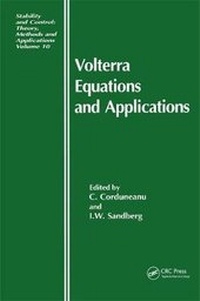
Volterra Equations and Applications
1st Edition
Published on 10. January 2000
Book
Hardback
512 pages
978-90-5699-171-5 (ISBN)
Description
This volume comprises selected papers presented at the Volterra Centennial Symposium and is dedicated to Volterra and the contribution of his work to the study of systems - an important concept in modern engineering. Vito Volterra began his study of integral equations at the end of the nineteenth century and this was a significant development in the theory of integral equations and nonlinear functional analysis. Volterra series are of interest and use in pure and applied mathematics and engineering.
More details
Series
Language
English
Place of publication
Bosa Roca
United States
Publishing group
Taylor & Francis Inc
Target group
College/higher education
Professional and scholarly
Dimensions
Height: 254 mm
Width: 178 mm
Weight
1260 gr
ISBN-13
978-90-5699-171-5 (9789056991715)
Copyright in bibliographic data and cover images is held by Nielsen Book Services Limited or by the publishers or by their respective licensors: all rights reserved.
Schweitzer Classification
Other editions
Additional editions
C. Corduneanu | I. Sandberg
Volterra Equations and Applications
E-Book
01/2000
CRC Press
€324.99
Available for download
C. Corduneanu | I. Sandberg
Volterra Equations and Applications
E-Book
01/2000
1st Edition
CRC Press
€324.99
Available for download
Persons
Corduneanu, C.; Sandberg, I
Content
1. Retrospective of Vito Volterra and His Influence on Nonlinear Systems Theory 2. Volterra Integral Equations at Wisconsin 3. Stability and Asymptotic Behaviour of Solutions of Equations with Aftereffect 4. Generalized Halay Inequalities for Volterra Functional Differential Equations and Discretized Versions 5. Stochastic Convolutions with Kernels Arising in Volterra Equations 6. An Example of Lp-Regularity for Hyperbolic Integrodifferential Equations 7. The Present Status of UAS for Volterra and Delay Equations 8. Myopic Maps and Volterra Series Approximations 9. State Space Theory for Abstract Volterra Operators