

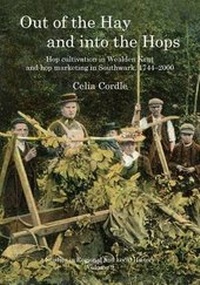
Out of the Hay and into the Hops
Hop Cultivation in Wealden Kent and Hop Marketing in Southwark, 1744-2000
Published on 2. February 2011
Book
Hardback
288 pages
978-1-907396-03-8 (ISBN)
Description
Out of the Hay and into the Hops explores the history and development of hop cultivation in the Weald of Kent together with the marketing of this important crop in the Borough at Southwark (where a significant proportion of Wealden hops were sold). A picture emerges of the relationship between the two activities, as well as of the impact this rural industry had upon the lives of the people engaged in it. Dr Cordle draws extensively on personal accounts of hop work to evoke a way of life now lost for good. Oral history, together with evidence from farm books and other sources, records how the steady routine of hop ploughing and dung spreading, weeding and spraying contrasted with the bustle and excitement of hop picking (bringing in, as it did, many itinerant workers from outside the community to help with the harvest) and the anxious period of drying the crop. For hops, prey to the vagaries of weather and disease, needed much care and attention to bring them to fruition. In early times their cultivation provided work for more people than any other crop.
The diverse processes of hop cultivation are examined within the wider context of events such as the advent of rail and the effects of war, as are changes to the working practices and technologies used, and their reception and implementation in the Weald. Meanwhile, in the Borough, an enclave of hop factors and merchants, whose interests sometimes conflicted with those of the hop growers, arose and then suffered decline. A full account of this trade is presented, including day-to-day working practices, links with the Weald, and the changes in hop marketing following Britain's entry into the European Economic Community. This book provides readers with a fascinating analysis of some three hundred years of hop history in the Weald and the Borough. Hops still grow in the Weald; in the Borough, the Le May facade and the gates of the Hop Exchange are reminders of former trade.
The diverse processes of hop cultivation are examined within the wider context of events such as the advent of rail and the effects of war, as are changes to the working practices and technologies used, and their reception and implementation in the Weald. Meanwhile, in the Borough, an enclave of hop factors and merchants, whose interests sometimes conflicted with those of the hop growers, arose and then suffered decline. A full account of this trade is presented, including day-to-day working practices, links with the Weald, and the changes in hop marketing following Britain's entry into the European Economic Community. This book provides readers with a fascinating analysis of some three hundred years of hop history in the Weald and the Borough. Hops still grow in the Weald; in the Borough, the Le May facade and the gates of the Hop Exchange are reminders of former trade.
More details
Series
Language
English
Place of publication
Hatfield
United Kingdom
Target group
College/higher education
Illustrations
Illustrations, 1 map
Dimensions
Height: 234 mm
Width: 156 mm
Thickness: 10 mm
ISBN-13
978-1-907396-03-8 (9781907396038)
Copyright in bibliographic data and cover images is held by Nielsen Book Services Limited or by the publishers or by their respective licensors: all rights reserved.
Schweitzer Classification
Person
Celia Cordle studied English Local History at the University of Leicester and was awarded her PhD in 2006. Her doctoral thesis won Kent Archaeological Society's inaugural Hasted Prize in 2007.
Content
Introduction: '... into the Hops' Chapter 1 Land and Location Chapter 2 Fringe Farms: the Early Days of Hop cultivation Chapter 3 Continuity and Change: Combourne and Harper's Farms 1897-1899 Chapter 4 The Twentieth Century: Futures Chapter 5 Hop Factors and Hop Merchants: Buying and Selling Hops in the Borough Chapter 6 The Last Hurrah? Tithe Commutation and the Repeal of Hop Duty Conclusion: Gathering Up and Moving On