

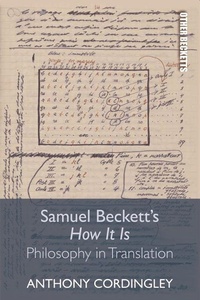
Samuel Beckett's How It Is
Philosophy in Translation
Published on 25. August 2020
Book
Paperback/Softback
304 pages
978-1-4744-4061-5 (ISBN)
Description
The first sustained exegesis of a neglected masterpiece of twentieth-century literature, Samuel Beckett's How It Is
This book maps out the novel's complex network of intertexts, sources and echoes, interprets its highly experimental writing and explains the work's great significance for twentieth-century literature. It offers a clear pathway into this remarkable bilingual novel, identifying Beckett's use of previously unknown sources in the history of Western philosophy, from the ancient and modern periods, and challenging critical orthodoxies. Through careful archival scholarship and attention to the dynamics of self-translation, the book traces Beckett's transformation of his narrator's 'ancient voice', his intellectual heritage, into a mode of aesthetic representation that offers the means to think beyond intractable paradoxes of philosophy. This shift in the work's relation to tradition marks a hiatus in literary modernism, a watershed moment whose deep and enduring significance may now be appreciated.
Key Features
Offers the first comprehensive treatment of Beckett's most poorly understood novel, identifying the breadth of its philosophical and literary sourcesMakes extensive use of manuscript evidence and newly accessible notes from Beckett's reading in philosophyGuides the reader through Beckett's philosophical and theological sources, highlighting his innovative and original dialectics between the pre-Socratics, Plato, Aristotle, the Ancient Stoics, the early Church Fathers and desert mystics, seventeenth-century mystics and Rationalists
This book maps out the novel's complex network of intertexts, sources and echoes, interprets its highly experimental writing and explains the work's great significance for twentieth-century literature. It offers a clear pathway into this remarkable bilingual novel, identifying Beckett's use of previously unknown sources in the history of Western philosophy, from the ancient and modern periods, and challenging critical orthodoxies. Through careful archival scholarship and attention to the dynamics of self-translation, the book traces Beckett's transformation of his narrator's 'ancient voice', his intellectual heritage, into a mode of aesthetic representation that offers the means to think beyond intractable paradoxes of philosophy. This shift in the work's relation to tradition marks a hiatus in literary modernism, a watershed moment whose deep and enduring significance may now be appreciated.
Key Features
Offers the first comprehensive treatment of Beckett's most poorly understood novel, identifying the breadth of its philosophical and literary sourcesMakes extensive use of manuscript evidence and newly accessible notes from Beckett's reading in philosophyGuides the reader through Beckett's philosophical and theological sources, highlighting his innovative and original dialectics between the pre-Socratics, Plato, Aristotle, the Ancient Stoics, the early Church Fathers and desert mystics, seventeenth-century mystics and Rationalists
Reviews / Votes
Samuel Beckett's How It Is: Philosophy in Translation will undoubtedly become another landmark in Beckett studies, one which is particularly relevant to the study of the author's mature prose and his method of extracting material from philosophical sources. * Irish Studies Review * Samuel Beckett's How It Is: Philosophy in Translation will undoubtedly become another landmark in Beckett studies, one which is particularly relevant to the study of the author's mature prose and his method of extracting material from philosophical sources * Irish Studies Review * This is the first guide to Beckett's darkest and most impenetrable novel. This wonderfully informed commentary based on first-hand knowledge of unpublished manuscripts details the numerous philosophical references contained in How It Is. Cordingley makes us grasp how the strength and the beauty of Beckett's unforgettable sentences derive from countless hidden references, all the while sketching a new theory of Beckett's use of philosophy. * Jean-Michel Rabate, University of Pennsylvania * Dans ce livre passionnant, Cordingley souligne comment les allusions de Beckett demeurent melangees, formant des couches successives. Prenant soin d'eviter que l'on puisse identifier une reference unique, Beckett neutralisait les signifiants sedimentes, deployant ses references de maniere discrete. Ainsi, au lieu qu'elles affirment leur sens d'origine, elles deviennent la matiere premiere d'une nouvelle creation. Cordingley nous invite a apprehender la presence effective et dynamique des allusions au sein de l'oeuvre, au lieu de se restreindre a une these derridienne qui conduirait a la dissipation de son objet . En effet, Beckett devait en passer par la construction d'une fiction integrant des motifs tires des traditions humaniste et religieuse dans l'acte meme d'ecrire. [...] Cordingley y fait une oeuvre salutaire, restituant son epaisseur a cette oeuvre majeure de Beckett. Il rend palpable l'immense corps de savoir qui nourrit ce livre, et met en relief le dynamisme a l'oeuvre entre le sujet et ses voix. * La Revue des Lettres modernes, serie << Samuel Beckett * Dans ce livre passionnant, Cordingley souligne comment les allusions de Beckett demeurent melangees, formant des couches successives. Prenant soin d'eviter que l'on puisse identifier une reference unique, Beckett neutralisait les signifiants sedimentes, deployant ses references de maniere discrete. Ainsi, au lieu qu'elles affirment leur sens d'origine, elles deviennent la matiere premiere d'une nouvelle creation. Cordingley nous invite a apprehender la presence effective et dynamique des allusions au sein de l'oeuvre, au lieu de se restreindre a une these derridienne qui conduirait a la dissipation de son objet . En effet, Beckett devait en passer par la construction d'une fiction integrant des motifs tires des traditions humaniste et religieuse dans l'acte meme d'ecrire. [...] Cordingley y fait une oeuvre salutaire, restituant son epaisseur a cette oeuvre majeure de Beckett. Il rend palpable l'immense corps de savoir qui nourrit ce livre, et met en relief le dynamisme a l'oeuvre entre le sujet et ses voix. * La Revue des Lettres modernes, serie Samuel Beckett * There are few critical studies that one can identify as outstanding. This is one of the few. * Professor Chris Ackerley, University of Otago * Samuel Beckett's How It Is. Philosophy in Translation, by Anthony Cordingley [...] is the most comprehensive account of Beckett's impenetrable novel to date, as well as the first book-length monograph devoted to the explanation of its sources. The principal merit of this study is that Cordingley has been able to detect the origin of half-veiled assumptions that are interspersed throughout the text, and at the same time offers a convincing explanation of how Beckett used them poetically and as a means of cultural critique. One of the most remarkable achievements of the study by this Australian scholar is that he has shown that How It Is is, above many other concerns that are also touched upon in the narrative, a novel about education. * The Beckett Circle * Samuel Beckett's How It Is. Philosophy in Translation, by Anthony Cordingley [...] is the most comprehensive account of Beckett's impenetrable novel to date, as well as the first book-length monograph devoted to the explanation of its sources. The principal merit of this study is that Cordingley has been able to detect the origin of half-veiled assumptions that are interspersed throughout the text, and at the same time offers a convincing explanation of how Beckett used them poetically and as a means of cultural critique. One of the most remarkable achievements of the study by this Australian scholar is that he has shown that How It Is is, above many other concerns that are also touched upon in the narrative, a novel about education. * The Beckett Circle *More details
Series
Language
English
Place of publication
Edinburgh
United Kingdom
Target group
Professional and scholarly
Dimensions
Height: 156 mm
Width: 233 mm
Thickness: 22 mm
Weight
484 gr
ISBN-13
978-1-4744-4061-5 (9781474440615)
Copyright in bibliographic data and cover images is held by Nielsen Book Services Limited or by the publishers or by their respective licensors: all rights reserved.
Schweitzer Classification
Person
Anthony Cordingley is ARC Discovery Early Career Research Fellow in the Department of English, University of Sydney, on secondment from the Universite Paris 8 - Vincennes-Saint-Denis, where he is Associate Professor in English and Translation Studies.
Content
List of Illustrations
Series Editor's Preface
List of Abbreviations
Introduction
1. A Poetics of Translation: Dante, Goethe and the Paideia
2. Pythagorean Mysticism / Democritean Wisdom
3. The Physical Cosmos: Aristotelian Dialectics
4. A Comedy of Ethics: From Plato to Christian Asceticism (Via Rembrandt)
5. Mystic Paths, Inward Turns
6. Pascal's Miraculous Tongue
7. Spinoza, Leibniz, or a World "Less Exquisitely Organized"
Acknowledgements
Bibliography
Index
Series Editor's Preface
List of Abbreviations
Introduction
1. A Poetics of Translation: Dante, Goethe and the Paideia
2. Pythagorean Mysticism / Democritean Wisdom
3. The Physical Cosmos: Aristotelian Dialectics
4. A Comedy of Ethics: From Plato to Christian Asceticism (Via Rembrandt)
5. Mystic Paths, Inward Turns
6. Pascal's Miraculous Tongue
7. Spinoza, Leibniz, or a World "Less Exquisitely Organized"
Acknowledgements
Bibliography
Index