

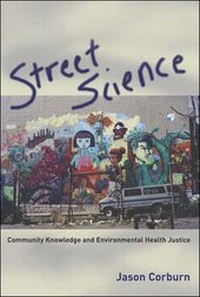
Street Science
Community Knowledge and Environmental Health Justice
Published on 19. August 2005
Book
Hardback
281 pages
978-0-262-03333-6 (ISBN)
Description
When environmental health problems arise in a community, policymakers must be able to reconcile the first-hand experience of local residents with recommendations by scientists. In this highly original look at environmental health policymaking, Jason Corburn shows the ways that local knowledge can be combined with professional techniques to achieve better solutions for environmental health problems. He traces the efforts of a low-income community in Brooklyn to deal with environmental health problems in its midst and offers a framework for understanding "street science" -- decision making that draws on community knowledge and contributes to environmental justice.
Like many other low-income urban communities, the Greenpoint/Williamsburg neighborhood of Brooklyn suffers more than its share of environmental problems, with a concentration of polluting facilities and elevated levels of localized air pollutants. Corburn looks at four instances of street science in Greenpoint/Williamsburg, where community members and professionals combined forces to address the risks from subsistence fishing from the polluted East River, the asthma epidemic in the Latino community, childhood lead poisoning, and local sources of air pollution. These episodes highlight both the successes and the limits of street science and demonstrate ways residents can establish their own credibility when working with scientists. Street science, Corburn argues, does not devalue science; it revalues other kinds of information and democratizes the inquiry and decision making processes.
Like many other low-income urban communities, the Greenpoint/Williamsburg neighborhood of Brooklyn suffers more than its share of environmental problems, with a concentration of polluting facilities and elevated levels of localized air pollutants. Corburn looks at four instances of street science in Greenpoint/Williamsburg, where community members and professionals combined forces to address the risks from subsistence fishing from the polluted East River, the asthma epidemic in the Latino community, childhood lead poisoning, and local sources of air pollution. These episodes highlight both the successes and the limits of street science and demonstrate ways residents can establish their own credibility when working with scientists. Street science, Corburn argues, does not devalue science; it revalues other kinds of information and democratizes the inquiry and decision making processes.
More details
Series
Language
English
Place of publication
Cambridge, Mass.
United States
Publishing group
MIT Press Ltd
Target group
Professional and scholarly
Interest Age: From 18 years
Illustrations
13 illus.
Dimensions
Height: 229 mm
Width: 152 mm
Thickness: 15 mm
Weight
522 gr
ISBN-13
978-0-262-03333-6 (9780262033336)
Copyright in bibliographic data and cover images is held by Nielsen Book Services Limited or by the publishers or by their respective licensors: all rights reserved.
Schweitzer Classification
Person
Jason Corburn is Associate Professor of City & Regional Planning in the College of Environmental Design at UC Berkeley. He is the author of Street Science: Community Knowledge and Environmental Health Justice, winner of the 2007 Paul Davidoff award given by the Association of Collegiate Schools of Planning.