

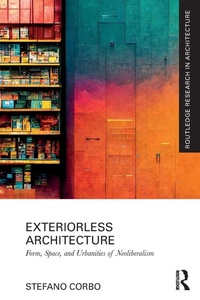
Exteriorless Architecture
Form, Space, and Urbanities of Neoliberalism
1st Edition
Published on 28. November 2024
Book
Paperback/Softback
138 pages
978-1-032-17082-4 (ISBN)
Description
The current phase of capitalist development manifests itself through a very diverse range of spatial byproducts: data centers, warehouses, container terminals, logistics parks, and many others. Generally considered as mediocre and banal examples that sit outside of pre-established disciplinary canons, these architectural episodes are extremely relevant. They are relevant not for their aesthetic or historic qualities but for what they represent - for the system of values these spaces embed. They express specific power relations, exacerbate issues of labor, and generate dramatic processes of subjectivity. Most importantly, these architectures, despite their formal and typological heterogeneity, belong to a common paradigm: the EXTERIORLESS.
How can an architecture of the EXTERIORLESS be defined? How does it differentiate from examples and manifestations of the past? How do notions of legibility, form versus function, typological articulation come into play?
In situating the spatialities of contemporary capitalism within the larger debate on Anthropocene, Post-Anthropocene, and Capitalocene, the book attempts to answer those questions by delineating three main characteristics for an architecture of the EXTERIORLESS: its physical and symbolic role as interface; its ambiguous condition of being at the same time local and global, isolated and connected, compressed and expanded; and, lastly, its contribution to new forms of urbanity in absence of the traditional city. These three defining aspects constitute the main sections of the book. Each section includes two chapters covering a wide spectrum of themes and examples. In its tripartite organization, the book describes the influence that the experimental architecture of the 1960s has exerted on late-capitalist spatial byproducts; it analyzes the impact of logistics on the redesign of the territory; and it introduces the radical processes of urban transformation generated by the EXTERIORLESS.
How can an architecture of the EXTERIORLESS be defined? How does it differentiate from examples and manifestations of the past? How do notions of legibility, form versus function, typological articulation come into play?
In situating the spatialities of contemporary capitalism within the larger debate on Anthropocene, Post-Anthropocene, and Capitalocene, the book attempts to answer those questions by delineating three main characteristics for an architecture of the EXTERIORLESS: its physical and symbolic role as interface; its ambiguous condition of being at the same time local and global, isolated and connected, compressed and expanded; and, lastly, its contribution to new forms of urbanity in absence of the traditional city. These three defining aspects constitute the main sections of the book. Each section includes two chapters covering a wide spectrum of themes and examples. In its tripartite organization, the book describes the influence that the experimental architecture of the 1960s has exerted on late-capitalist spatial byproducts; it analyzes the impact of logistics on the redesign of the territory; and it introduces the radical processes of urban transformation generated by the EXTERIORLESS.
More details
Series
Language
English
Place of publication
London
United Kingdom
Publishing group
Taylor & Francis Ltd
Target group
College/higher education
Professional and scholarly
Academic and Postgraduate
Illustrations
20 s/w Photographien bzw. Rasterbilder, 20 s/w Abbildungen
20 Halftones, black and white; 20 Illustrations, black and white
Dimensions
Height: 234 mm
Width: 156 mm
Thickness: 8 mm
Weight
222 gr
ISBN-13
978-1-032-17082-4 (9781032170824)
Copyright in bibliographic data and cover images is held by Nielsen Book Services Limited or by the publishers or by their respective licensors: all rights reserved.
Schweitzer Classification
Other editions
Additional editions
Book
05/2023
1st Edition
Routledge
€194.80
Shipment within 10-20 days
E-Book
05/2023
1st Edition
Routledge
€55.49
Available for download
E-Book
05/2023
1st Edition
Routledge
€55.49
Available for download
Person
Stefano Corbo is an Italian architect and educator. He holds a Ph.D in Advanced Architectural Design from UPM-ETSAM Madrid. Over the last years, he taught at several academic institutions in the United States, Europe, the Middle East, and China. In 2022, Corbo joined the Faculty of Architecture and the Built Environment at TU Delft.
Content
List of Illustrations. Acknowledgments. Preface. 1) Capitalism, Architecture, Subjectivity. 2) Interface. 3) Expanded Domains. 4) Forms of Urbanity. 5) Afterword. Index.