

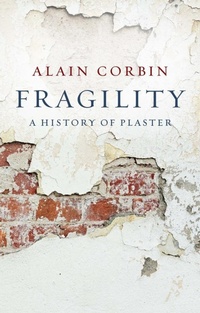
Fragility
A History of Plaster
1st Edition
Published on 25. April 2025
Book
Paperback/Softback
88 pages
978-1-5095-6595-5 (ISBN)
Description
The distant past is commonly characterized in terms of dominant materials of the time - the Stone Age, the Bronze Age, the Iron Age, etc. Since the dawn of writing, however, characterizing eras in terms of materials has fallen by the wayside, and yet materials have continued to exert a powerful influence on our collective imagination.
Viewed from this perspective, France in the period from 1815 to 1855 could be seen as the half-century of plaster. After the French Revolution, plaster was used for a great variety of things: building, moulding, sculpting, decorating. Cheap and easy to use, plaster was everywhere, from Napoleon's death mask to household ornaments, from walls to elaborate mouldings. Plaster was king - but a fragile king that easily crumbled and fell apart. The age of plaster was also the reign of the ephemeral and the transient, the vulgar and the eclectic, and the men and women of the time struggled to maintain stability and continuity with the past. In the space of a few decades, no fewer than seven political regimes succeeded one another. Plaster - symbol of the ephemeral, the flaking and the vulgar - is the material which defines the first half of the nineteenth century.
Written with his characteristic brilliance and eye for unconventional topics, Alain Corbin's highly original exploration of the role of plaster in history will be of interest to a wide readership.
Viewed from this perspective, France in the period from 1815 to 1855 could be seen as the half-century of plaster. After the French Revolution, plaster was used for a great variety of things: building, moulding, sculpting, decorating. Cheap and easy to use, plaster was everywhere, from Napoleon's death mask to household ornaments, from walls to elaborate mouldings. Plaster was king - but a fragile king that easily crumbled and fell apart. The age of plaster was also the reign of the ephemeral and the transient, the vulgar and the eclectic, and the men and women of the time struggled to maintain stability and continuity with the past. In the space of a few decades, no fewer than seven political regimes succeeded one another. Plaster - symbol of the ephemeral, the flaking and the vulgar - is the material which defines the first half of the nineteenth century.
Written with his characteristic brilliance and eye for unconventional topics, Alain Corbin's highly original exploration of the role of plaster in history will be of interest to a wide readership.
Reviews / Votes
"Once again, Alain Corbin has found a topic that no one else had thought of and writes about it in his inimitable way."Peter Burke, University of Cambridge
"Since we name prehistoric periods like the Bronze Age after their signature material, ought we to name the first half of the nineteenth century the Age of Plaster? In this brief but characteristically expansive book, Alain Corbin argues just that."
Robert D. Priest, Royal Holloway, University of London
"Persuasive"
Literary Review
More details
Language
English
Place of publication
Oxford
United Kingdom
Publishing group
John Wiley and Sons Ltd
Dimensions
Height: 210 mm
Width: 132 mm
Thickness: 10 mm
Weight
158 gr
ISBN-13
978-1-5095-6595-5 (9781509565955)
Copyright in bibliographic data and cover images is held by Nielsen Book Services Limited or by the publishers or by their respective licensors: all rights reserved.
Schweitzer Classification
Other editions
Persons
Alain Corbin is Emeritus Professor of History at the University of Paris I, Pantheon-Sorbonne.
Content
Acknowledgements
History - from stone to plastic
1.The half-century of plaster
2. Plaster houses and poverty
3. Restoring ancient monuments
4. Plaster - allegory of a phantom century
5. Plaster casts and the art of the hollow
6. Immortalizing the dead in plaster
7. Ornaments and figurines: plaster within the home
8. The strange case of life-casting
9. Crumbling political regimes
Notes
History - from stone to plastic
1.The half-century of plaster
2. Plaster houses and poverty
3. Restoring ancient monuments
4. Plaster - allegory of a phantom century
5. Plaster casts and the art of the hollow
6. Immortalizing the dead in plaster
7. Ornaments and figurines: plaster within the home
8. The strange case of life-casting
9. Crumbling political regimes
Notes