

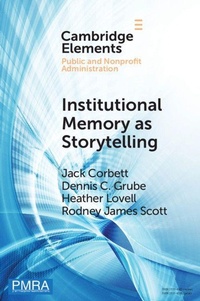
Institutional Memory as Storytelling
How Networked Government Remembers
Published on 24. December 2020
Book
Paperback/Softback
78 pages
978-1-108-74800-1 (ISBN)
Description
How do bureaucracies remember? The conventional view is that institutional memory is static and singular, the sum of recorded files and learned procedures. There is a growing body of scholarship that suggests contemporary bureaucracies are failing at this core task. This Element argues that this diagnosis misses that memories are essentially dynamic stories. They reside with people and are thus dispersed across the array of actors that make up the differentiated polity. Drawing on four policy examples from four sectors (housing, energy, family violence and justice) in three countries (the UK, Australia and New Zealand), this Element argues that treating the way institutions remember as storytelling is both empirically salient and normatively desirable. It is concluded that the current conceptualisation of institutional memory needs to be recalibrated to fit the types of policy learning practices required by modern collaborative governance.
More details
Series
Language
English
Place of publication
Cambridge
United Kingdom
Target group
Professional and scholarly
Product notice
Paperback (trade)
Illustrations
Worked examples or Exercises
Dimensions
Height: 229 mm
Width: 152 mm
Thickness: 4 mm
Weight
118 gr
ISBN-13
978-1-108-74800-1 (9781108748001)
Copyright in bibliographic data and cover images is held by Nielsen Book Services Limited or by the publishers or by their respective licensors: all rights reserved.
Schweitzer Classification
Other editions
Additional editions
E-Book
12/2020
Cambridge University Press
€14.49
Available for download
Jack Corbett | Dennis Christian Grube | Heather Caroline Lovell
Institutional Memory as Storytelling
How Networked Government Remembers
E-Book
12/2020
Cambridge University Press
€15.49
Available for download
Persons
Content
1. Introduction; 2. Whole of government processes and the creation of collective memories: the case of the Tasmanian Family Violence Action Plan; 3. What happens with iterative conversations in cases of policy failure: the State of Victoria's smart metering program, Australia; 4. Differentiated memories: the case of the UK's Zero Carbon Hub; 5. Living Memories: the case of the New Zealand justice sector; 6. Conclusion.