

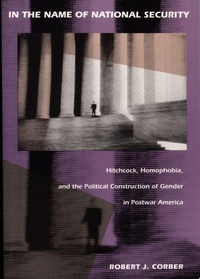
In the Name of National Security
Hitchcock, Homophobia, and the Political Construction of Gender in Postwar America
Will be published approx. on 20. October 1993
Book
Hardback
272 pages
978-0-8223-1380-9 (ISBN)
Description
In the Name of National Security exposes the ways in which the films of Alfred Hitchcock, in conjunction with liberal intellectuals and political figures of the 1950s, fostered homophobia so as to politicize issues of gender in the United States.
As Corber shows, throughout the 1950s a cast of mind known as the Cold War consensus prevailed in the United States. Promoted by Cold War liberals--that is, liberals who wanted to perserve the legacies of the New Deal but also wished to separate liberalism from a Communist-dominated cultural politics--this consensus was grounded in the perceived threat that Communists, lesbians, and homosexuals posed to national security. Through an analysis of the films of Alfred Hitchcock, combined with new research on the historical context in which these films were produced, Corber shows how Cold War liberals tried to contain the increasing heterogeneity of American society by linking questions of gender and sexual identity directly to issues of national security, a strategic move that the films of Hitchcock both legitimated and at times undermined. Drawing on psychoanalytic and Marxist theory, Corber looks at such films as Rear Window, Strangers on a Train, and Psycho to show how Hitchcock manipulated viewers' attachments and identifications to foster and reinforce the relationship between homophobia and national security issues.
A revisionary account of Hitchcock's major works, In the Name of National Security is also of great interest for what it reveals about the construction of political "reality" in American history.
As Corber shows, throughout the 1950s a cast of mind known as the Cold War consensus prevailed in the United States. Promoted by Cold War liberals--that is, liberals who wanted to perserve the legacies of the New Deal but also wished to separate liberalism from a Communist-dominated cultural politics--this consensus was grounded in the perceived threat that Communists, lesbians, and homosexuals posed to national security. Through an analysis of the films of Alfred Hitchcock, combined with new research on the historical context in which these films were produced, Corber shows how Cold War liberals tried to contain the increasing heterogeneity of American society by linking questions of gender and sexual identity directly to issues of national security, a strategic move that the films of Hitchcock both legitimated and at times undermined. Drawing on psychoanalytic and Marxist theory, Corber looks at such films as Rear Window, Strangers on a Train, and Psycho to show how Hitchcock manipulated viewers' attachments and identifications to foster and reinforce the relationship between homophobia and national security issues.
A revisionary account of Hitchcock's major works, In the Name of National Security is also of great interest for what it reveals about the construction of political "reality" in American history.
Reviews / Votes
"Corber's argument is at once clear and rich. He makes clear that Hitchcock's films engage fundamental issues of sexuality and gender identity, and he also makes clear that these issues are in dialogue with the process of ideological struggle, including the mobilization of homophobia, in which Cold War Liberalism won its powerful place in the 1950s. The richness comes in the contexts Corber provides from that struggle and in the lucid imagination with which he reconceptualizes very famous films in relation to those contexts."-Jonathan AracMore details
Series
Language
English
Place of publication
North Carolina
United States
Target group
College/higher education
Product notice
Cloth over boards
Illustrations
1 photograph
Dimensions
Height: 226 mm
Width: 157 mm
Thickness: 25 mm
Weight
680 gr
ISBN-13
978-0-8223-1380-9 (9780822313809)
Copyright in bibliographic data and cover images is held by Nielsen Book Services Limited or by the publishers or by their respective licensors: all rights reserved.
Schweitzer Classification
Other editions
Additional editions
Corber Robert J. Corber
In the Name of National Security
Hitchcock, Homophobia, and the Political Construction of Gender in Postwar America
E-Book
10/1993
1st Edition
Duke University Press Books
€198.99
Available for download
Person
Robert J. Corber
Content
Acknowledgments ix
Introduction 1
1. Draped in the American Flag: Cold War Liberals and the Resistance to Theory 19
2. Reconstructing Homosexuality: Hitchcock and the Homoerotics of Spectatorial Pleasure 56
3. Resisting History: Rear Window and the Limits of the Postwar Settlement 83
4. The Fantasy of the Maternal Voice: The Man Who Knew Too Much and the Eroticization of Motherhood 113
5. "There Are Many Such Stories": Vertigo and the Repression of Historical Knowledge 154
6. Hitchcock Through the Looking Glass: Psycho and the Breakdown of the Social 185
Conclusion 219
Notes 227
Index 257
Introduction 1
1. Draped in the American Flag: Cold War Liberals and the Resistance to Theory 19
2. Reconstructing Homosexuality: Hitchcock and the Homoerotics of Spectatorial Pleasure 56
3. Resisting History: Rear Window and the Limits of the Postwar Settlement 83
4. The Fantasy of the Maternal Voice: The Man Who Knew Too Much and the Eroticization of Motherhood 113
5. "There Are Many Such Stories": Vertigo and the Repression of Historical Knowledge 154
6. Hitchcock Through the Looking Glass: Psycho and the Breakdown of the Social 185
Conclusion 219
Notes 227
Index 257