

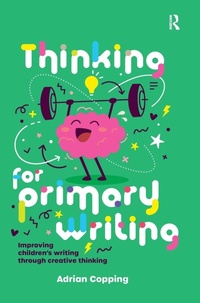
Thinking for Primary Writing
Improving Children's Writing Through Creative Thinking
1st Edition
Published on 31. March 2025
Book
Hardback
178 pages
978-1-041-05768-0 (ISBN)
Description
Drawing on the author's personal experience, this book provides a deeper understanding of how children experience the writing process in primary school. The framework termed 'think for writing' demonstrates that training children in creative writing and providing creative thinking opportunities can develop their writing and improve their confidence in writing.
Aimed at all teachers and trainees, it examines each element of the framework: the thinking environment, task design, training creative thinking, the building blocks of the writing process, and developing children's creative self-efficacy. This range of ideas and approaches across all elements of the writing process that teachers can adapt, adopt and apply to their own practice. This book also demonstrates that a lot of the key work in developing writing is done in between the building blocks of the writing process. This work in the gaps includes process feedback and feedback on the application of ideas.
Ultimately, this book provides a resource for teachers to develop their writing pedagogy and children's outcomes whilst meeting National curriculum for England and Wales requirements and demands of standardised testing. Teachers can feel a lot more assured when designing units of work in primary English with this helpful framework, that provides them with this knowledge and details on how to apply it.
Aimed at all teachers and trainees, it examines each element of the framework: the thinking environment, task design, training creative thinking, the building blocks of the writing process, and developing children's creative self-efficacy. This range of ideas and approaches across all elements of the writing process that teachers can adapt, adopt and apply to their own practice. This book also demonstrates that a lot of the key work in developing writing is done in between the building blocks of the writing process. This work in the gaps includes process feedback and feedback on the application of ideas.
Ultimately, this book provides a resource for teachers to develop their writing pedagogy and children's outcomes whilst meeting National curriculum for England and Wales requirements and demands of standardised testing. Teachers can feel a lot more assured when designing units of work in primary English with this helpful framework, that provides them with this knowledge and details on how to apply it.
Reviews / Votes
...including considerable work in school, this book provides insights into the writing process and ways to develop it....(It) is an excellent addition to texts on children's writing and brings a refreshing and often original perspective which, if taken on board by educators, should improve children's writing and the ways in which it is taught.
Professor David WaughDurham University
...Thinking for primary writing is a thought-provoking and practical guide that successfully bridges the gap between theory and application in the realm of children's writing. It is crafted resource, achieved as a culmination of high-quality research. This book will inspire educators and parents with the tools they need to cultivate creative thinking and enhance the writing skills and writing attainment of our future pupils.
This book is a must-read for anyone committed to fostering a love for writing and imagination in children.
Megan Stephenson, Associate Professor, School of Education, Leeds Trinity University
This professional guidance book presents a powerful framework for developing children's creative thinking during the writing process. The underpinning research project involved the researcher teaching children in a case study primary school and so the whole project is strongly grounded in classroom practice and a real-world context. The guidance provided in each chapter is supported by theory and research and helpfully illustrated by reflecting on concrete classroom examples. The book is a useful research-informed practical guide for teachers and schools determined to develop children as effective and confident writers.
Pete Boyd, Professor Emeritus in Professional Learning University of Cumbria, Visiting Professor of Education University of Hertfordshire
More details
Language
English
Place of publication
London
United Kingdom
Publishing group
Taylor & Francis Ltd
Target group
Professional and scholarly
Professional Practice & Development
Dimensions
Height: 250 mm
Width: 175 mm
Thickness: 14 mm
Weight
497 gr
ISBN-13
978-1-041-05768-0 (9781041057680)
Copyright in bibliographic data and cover images is held by Nielsen Book Services Limited or by the publishers or by their respective licensors: all rights reserved.
Schweitzer Classification
Other editions
Additional editions
E-Book
02/2025
Routledge
€27.49
Available for download
E-Book
02/2025
Routledge
€27.49
Available for download
Book
01/2024
1st Edition
Critical Publishing Ltd
€36.50
Shipment within 3-4 weeks
Person
Adrian Copping has been involved in primary education for over 25 years, as a teacher, subject leader, senior leader, and teacher educator. He taught in two contrasting primary schools and currently leads the University of Cumbria's Primary PGCE where he has been involved in researching and writing on primary English for over ten years. He completed a PhD in creative thinking and children's writing, using the research and framework for this book.
Content
Introduction - 'Think for Writing': What? Where? Why? How? Chapter 1: The architect's brief: What is so hard about writing? Chapter 2: Choosing the tools: Creative thinking skills Chapter 3: Laying the foundations Chapter 4: The building blocks Chapter 5: The importance of cement: Connecting the blocks Chapter 6: Working between the gaps Chapter 7: Call the scaffolders: the role of the task Chapter 8: Here comes the building inspector: Assessment and learning Chapter 9: The big reveal: What they said Chapter 10: Changing the landscape