

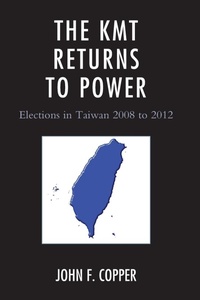
The KMT Returns to Power
Elections in Taiwan, 2008-2012
Published on 14. October 2014
Book
Paperback/Softback
312 pages
978-1-4985-0419-5 (ISBN)
Description
In this book the author examines how the Nationalist Party (Kuomintang or KMT) returned to govern Taiwan after ruling for more than half a century but losing power in 2000 when the opposition Democratic Progressive Party's (DPP) Chen Shui-bian won the presidency and was reelected in 2004.
Out of power and playing the role of opposition party the KMT won legislative and executive elections in 2008. It subsequently won mayoral elections in 2010 and elections again to the legislative and executive branches of government in 2012.
The KMT returned to power by resolving internal differences between older and younger factions in the party, maintaining an alliance with friendly parties and preventing philosophical differences from mattering. It was helped by the debilitating corruption of the DPP's President Chen and good campaigning.
In assessing these KMT election victories the author concludes that the KMT will probably remain the ruling party for some time. Its reputation for good economic management, democratization, honesty and good leaders seen against the DPP's still damaged reputation due to Chen's corruption, internal disagreements, its perorocial base, its inability to deal with China and the United States inhibit it from being able to return to power.
Out of power and playing the role of opposition party the KMT won legislative and executive elections in 2008. It subsequently won mayoral elections in 2010 and elections again to the legislative and executive branches of government in 2012.
The KMT returned to power by resolving internal differences between older and younger factions in the party, maintaining an alliance with friendly parties and preventing philosophical differences from mattering. It was helped by the debilitating corruption of the DPP's President Chen and good campaigning.
In assessing these KMT election victories the author concludes that the KMT will probably remain the ruling party for some time. Its reputation for good economic management, democratization, honesty and good leaders seen against the DPP's still damaged reputation due to Chen's corruption, internal disagreements, its perorocial base, its inability to deal with China and the United States inhibit it from being able to return to power.
Reviews / Votes
Copper frequently and prolifically writes on Taiwan's elections. This volume describes elections in 2008, 2010, and 2012. Reports in chapters 2-4 are abbreviated versions of three monographs published by the University of Maryland series in contemporary Asian studies; because chapters treat the same background information, they are repetitive. In the 2008 presidential election, Kuomintang (KMT) candidate Ma Ying-jeou defeated the Democratic Progressive Party candidate, returning Taiwan's oldest party to power. In the 2010 metropolitan elections of mayors, city council members, and county magistrates, KMT candidates won three of five important mayoral positions. In Taiwan's 2012 presidential/vice presidential and legislative elections, President Ma was reelected, and the legislature remained under KMT control. Copper attributes KMT victories to problems in the opposition movement and to successes of the Nationalist Party in shepherding economic development and political reforms, finding that the KMT is likely "to be the ruling party for some time to come." Copper's casual and colloquial writing style makes the tome accessible to all readers. Summing Up: Recommended. All readership levels. * Choice Reviews * John Copper has produced an excellent book on the last three major elections in Taiwan in 2008, 2010, and 2012 which were won by the Kuomintang (KMT) following eight years of the presidency of Chen Shui-bian of the Democratic Progressive Party. The book provides a very detailed and insightful analysis of the candidates, issues, and major events for these three elections. Furthermore, it also makes a valuable contribution to the study of Taiwan politics by placing them in the context of the nation's development of democracy and elections and by using a variety of theories about elections to explain what happened in Taiwan. -- Cal Clark, Auburn UniversityMore details
Language
English
Place of publication
United States
Publishing group
Bloomsbury Publishing Plc
Target group
Professional and scholarly
Dimensions
Height: 234 mm
Width: 156 mm
Thickness: 14 mm
Weight
404 gr
ISBN-13
978-1-4985-0419-5 (9781498504195)
Copyright in bibliographic data and cover images is held by Nielsen Book Services Limited or by the publishers or by their respective licensors: all rights reserved.
Schweitzer Classification
Other editions
Additional editions
E-Book
11/2012
1st Edition
Bloomsbury eBooks US
€61.99
Available for download
Person
John F. Copper is the Stanley J. Buckman Distinguished Professor of International Studies at Rhodes College in Memphis, Tennessee. He is the author of more than twenty-five books on China, Taiwan and Asian Affairs. Professor Copper's most recent books include Taiwan's Democracy on Trial: Political Change During the Chen Shui-bian Era and Beyond (2010), The A to Z of Taiwan (Republic of China) (2010), Taiwan: Nation-State or Province, fifth edition (2009), Playing with Fire: The Looming War with China over Taiwan (2006). In 1997, Dr. Copper was recipient of the International Communications Award.
Content
Preface
Chapter 1: The Nationalist Party Returns to Power: How and Why?
Chapter 2: Taiwan's 2008 Presidential and Vice Presidential Election
Chapter 3: Taiwan's 2009 Metropolitan City Elections
Chapter 4: Taiwan's 2012 Presidential, Vice Presidential and Parliamentary Elections
Chapter 5: Conclusions
Chapter 1: The Nationalist Party Returns to Power: How and Why?
Chapter 2: Taiwan's 2008 Presidential and Vice Presidential Election
Chapter 3: Taiwan's 2009 Metropolitan City Elections
Chapter 4: Taiwan's 2012 Presidential, Vice Presidential and Parliamentary Elections
Chapter 5: Conclusions