

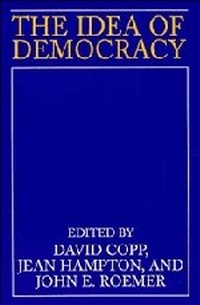
The Idea of Democracy
Published on 26. March 1993
Book
Hardback
461 pages
978-0-521-43254-2 (ISBN)
Description
In the wake of the recent expansion of democratic forms of government around the world, political theorists have begun to rethink the nature and justification of this form of government. The essays in this book address a variety of foundational questions about democracy: How effective is it? How stable can it be in a pluralist society? Does it deserve its current popularity? Can it successfully guide a socialist society?
More details
Language
English
Place of publication
Cambridge
United Kingdom
Target group
College/higher education
Professional and scholarly
Dimensions
Height: 240 mm
Width: 162 mm
Thickness: 29 mm
Weight
740 gr
ISBN-13
978-0-521-43254-2 (9780521432542)
Copyright in bibliographic data and cover images is held by Nielsen Book Services Limited or by the publishers or by their respective licensors: all rights reserved.
Schweitzer Classification
Other editions
New editions
David Copp | Jean Hampton | John E. Roemer
The Idea of Democracy
Book
02/1995
Cambridge University Press
€75.80
Shipment within 15-20 days
Additional editions
David Copp | Jean Hampton | John E. Roemer
The Idea of Democracy
Book
02/1995
Cambridge University Press
€75.80
Shipment within 15-20 days
Content
Introduction; Part I. The Point of Democracy: 1. Tocqueville and democracy Stephen Holmes; 1a. Tocqueville, commerce and democracy Debra Satz; 2. Making truth safe for democracy David Estlund; 2a. Could political truth be a hazard for democracy? David Copp; 3. Democratic rights at national and workplace levels Richard J. Arneson; 3a. Justified to whom? Robert Sugden; Part II. Democracy and Preferences: 4. Public choice versus democracy Russell Hardin; 4a. Social choice and democracy Thomas Christiano; 5. Democracy and shifting preferences Cass R. Sunstein; 5a. Must preferences be respected in a democracy? John Ferejohn; Part III. Democracy and Public Reason: 6. The domain of the political and overlapping consensus John Rawls; 6a. Moral pluralism and political consensus Joshua Cohen; 6b. The moral commitments of liberalism Jean Hampton; 7. Constituting democracy David Gauthier; 7a. On contractarian constitutional democracy Christopher W. Morris; Part IV. Democracy and Economics: 8. The possibility of market socialism John E. Roemer; 8a. Alternative conceptions of feasibility Michael S. McPherson; 9. A political and economic case for the democratic enterprise Samuel Bowles and Herbert Gintis; 9a. Contested power Karl Ove Moene; Part V. Democracy: Case Studies: 10. Capitalist development and democracy: empirical research on the social origins of democracy John D. Stephens; 10a. Comments on John D. Stephens 'Capitalist development and democracy' Pranab Bardhan.