

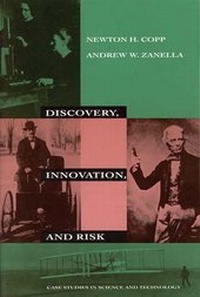
Discovery, Innovation, and Risk
Case Studies in Science and Technology
Published on 22. December 1992
Book
Paperback/Softback
437 pages
978-0-262-53111-5 (ISBN)
Description
How do scientific principles work in the real world? Discovery, Innovation, and Risk presents brief descriptions of selected scientific principles in the context of interesting technological examples to illustrate the complex interplay among science, engineering, and society. An understanding of scientific principles is developed through the technology rather than in isolation from it. Drawn from significant contributions to modern culture that arose during the Second Industrial Revolution, examples depict events in each of the major divisions of engineering, touch on key principles in physics, chemistry, and biology, and introduce the important concept of risk.Case studies in the first section emphasize technological developments growing directly from scientific discoveries. These cases include telegraphy and the origin of telecommunications as an application of discoveries in electromagnetism, hydroelectric power as an outgrowth of Faraday's work in electromagnetic induction, and the airplane as a product of the Wright brothers' scientific approach to an engineering problem. Case studies in the second section show that technological innovation can proceed without a full understanding of the underlying science, as in the development of steam power for use in electric power plants, the production of gasoline from crude oil, and the development of prestressed concrete for use in building bridges. The fact that new technological developments often bring risks is amply illustrated in the third section by case studies on vaccines, the greenhouse effect, and atomic power.
More details
Series
Language
English
Place of publication
Cambridge, Mass.
United States
Publishing group
MIT Press Ltd
Target group
College/higher education
Professional and scholarly
Interest Age: From 18 years
Product notice
Paperback (trade)
Dimensions
Height: 229 mm
Width: 152 mm
Thickness: 23 mm
Weight
748 gr
ISBN-13
978-0-262-53111-5 (9780262531115)
Copyright in bibliographic data and cover images is held by Nielsen Book Services Limited or by the publishers or by their respective licensors: all rights reserved.
Schweitzer Classification
Persons
Newton H. Copp is Associate Professor of Biology in the joint Science Department of Claremont McKenna, Pitzer, and Scripps Colleges of The Claremont Colleges, Claremont, California.
Andrew W. Zanella is Professor of Chemistry in the joint Science Department of Claremont McKenna, Pitzer, and Scripps Colleges of The Claremont Colleges, Claremont, California.
Andrew W. Zanella is Professor of Chemistry in the joint Science Department of Claremont McKenna, Pitzer, and Scripps Colleges of The Claremont Colleges, Claremont, California.