

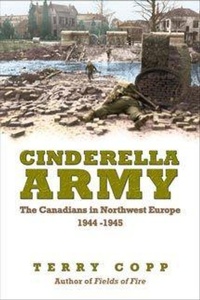
Cinderella Army
The Canadians in Northwest Europe, 1944-1945
Published on 20. October 2007
Book
Paperback/Softback
392 pages
978-0-8020-9522-0 (ISBN)
Description
In his controversial and award-winning 2003 book Fields of Fire, Terry Copp offered a stunning reversal of accepted military history, challenging the conventional view that the Canadian contribution to the Battle of Normandy was a failure. Cinderella Army continues the story of the operations carried out by the First Canadian Army in the last nine months of the war, and extends the argument developed in Fields of Fire that "the achievement of the Allied and especially the Canadian armies... has been greatly underrated while the effectiveness of the German army has been greatly exaggerated." Copp supports this argument with research conducted on numerous trips to the battlefields of France, Belgium, Holland and Germany. His detailed knowledge of the battlefield terrain, along with contemporary maps and air photos, allows Copp to explore the defensive positions that Canadian soldiers were required to overcome, and to illustrate how impressive their achievements truly were.
Except for a brief period during the Rhineland battle, the First Canadian Army was the smallest to serve under Eisenhower's command. The Canadian component of that Army never totalled more that 185,000 of the four million Allied troops serving in Northwest Europe. It is, however, evident that the divisions of 2nd Canadian Corps played a role disproportionate to their numbers. Their contribution to operations designed to secure the Channel Ports and open the approaches to Antwerp together with the battles in the Rhineland place them among the most heavily committed and sorely tried divisions in the Allied armies. By the end of 1944 3rd Canadian Division had suffered the highest number of casualties in 21 Army Group with 2nd Canadian Division ranking a close second. Among armoured divisions, 4th Canadian was at the top of the list as was 2nd Canadian Armoured Brigade among the independent tank brigades. Overall Canadian casualties were twenty percent higher than in comparable British formations. This was a direct result of the much greater number of days that Canadian units were involved in close combat.
As passionately written and compellingly argued as its precursor, Cinderella Army is both an important bookend to Copp's earlier work, and stands on its own as a significant contribution to Canadian military history.
Except for a brief period during the Rhineland battle, the First Canadian Army was the smallest to serve under Eisenhower's command. The Canadian component of that Army never totalled more that 185,000 of the four million Allied troops serving in Northwest Europe. It is, however, evident that the divisions of 2nd Canadian Corps played a role disproportionate to their numbers. Their contribution to operations designed to secure the Channel Ports and open the approaches to Antwerp together with the battles in the Rhineland place them among the most heavily committed and sorely tried divisions in the Allied armies. By the end of 1944 3rd Canadian Division had suffered the highest number of casualties in 21 Army Group with 2nd Canadian Division ranking a close second. Among armoured divisions, 4th Canadian was at the top of the list as was 2nd Canadian Armoured Brigade among the independent tank brigades. Overall Canadian casualties were twenty percent higher than in comparable British formations. This was a direct result of the much greater number of days that Canadian units were involved in close combat.
As passionately written and compellingly argued as its precursor, Cinderella Army is both an important bookend to Copp's earlier work, and stands on its own as a significant contribution to Canadian military history.
Reviews / Votes
'Terry Copp has become the pre-eminent historian of the Canadian army in northwest Europe during the Second World War.'- Peter Behrens (The Globe and Mail - September 30, 2006)
More details
Language
English
Place of publication
Toronto
Canada
Target group
College/higher education
Professional and scholarly
Product notice
Paperback (trade)
Dimensions
Height: 227 mm
Width: 155 mm
Thickness: 29 mm
Weight
703 gr
ISBN-13
978-0-8020-9522-0 (9780802095220)
Copyright in bibliographic data and cover images is held by Nielsen Book Services Limited or by the publishers or by their respective licensors: all rights reserved.
Schweitzer Classification
Person
Terry Copp is a Canadian military historian, director emeritus of the Laurier Centre for Military Strategic and Disarmament Studies, and a professor emeritus at Wilfrid Laurier University. He is an award-winning author of more than twenty books on Canada's role in the World Wars and an influential advocate for military history in both military and civilian education.
Content
LIST OF MAPS PREFACE Introduction Normandy to the Scheldt Siege Warfare: Boulogne and Calais The Breskens Pocket North from Antwerp Walcheren Regeneration Veritable Blockbuster and the Rhine The Liberation of Holland Conclusion APPENDIX A. DEFICIENCIES AND HOLDINGS OF CANADIAN INFANTRY APPENDIX B. CANADIAN ARMY FATAL CASUALTIES, NORTHWEST EUROPE