

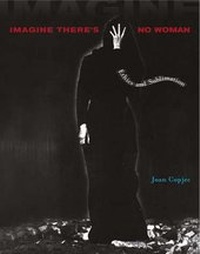
Imagine There's No Woman
Ethics and Sublimation
Published on 17. January 2003
Book
Hardback
269 pages
978-0-262-03299-5 (ISBN)
Description
Jacques Lacan claimed that his theory of feminine sexuality, including the infamous
proposition, "the Woman does not exist," constituted a revision of his earlier work on "the ethics
of psychoanalysis." In Imagine There's No Woman, Joan Copjec shows how Freud's ragtag, nearly
incoherent notion of sublimation was refashioned by Lacan to become the key term in his ethics. To
trace the link between feminine being and Lacan's ethics of sublimation, Copjec argues, one must
take the negative proposition about the woman's existence not as just another nominalist
denunciation of thought's illusions about the existence of universals, but as recognition of the
power of thought, which posits and gives birth to the difference of objects from themselves. While
the relativist position currently dominant insists on the difference between my views and another's,
Lacan insists on this difference within the object I see. The popular position fuels the
disaffection with which we regard a world in a state of decomposition, whereas the Lacanian
alternative urges our investment in a world that awaits our invention.In the book's first part,
Copjec explores positive acts of invention/sublimation: Antigone's burial of her brother, the
silhouettes by the young black artist Kara Walker, Cindy Sherman's Untitled Film Stills, and Stella
Dallas's final gesture toward her daughter in the well-known melodrama. In the second part, the
focus shifts to sublimation's adversary, the cruelly uncreative superego, as Copjec analyzes Kant's
concept of radical evil, envy's corruption of liberal demands for equality and justice, and the
difference between sublimation and perversion. Maintaining her focus on artistic texts, she weaves
her arguments through discussions of Pasolini's Salo, the film noir classic Laura, and the Zapruder
film of the Kennedy assassination.
proposition, "the Woman does not exist," constituted a revision of his earlier work on "the ethics
of psychoanalysis." In Imagine There's No Woman, Joan Copjec shows how Freud's ragtag, nearly
incoherent notion of sublimation was refashioned by Lacan to become the key term in his ethics. To
trace the link between feminine being and Lacan's ethics of sublimation, Copjec argues, one must
take the negative proposition about the woman's existence not as just another nominalist
denunciation of thought's illusions about the existence of universals, but as recognition of the
power of thought, which posits and gives birth to the difference of objects from themselves. While
the relativist position currently dominant insists on the difference between my views and another's,
Lacan insists on this difference within the object I see. The popular position fuels the
disaffection with which we regard a world in a state of decomposition, whereas the Lacanian
alternative urges our investment in a world that awaits our invention.In the book's first part,
Copjec explores positive acts of invention/sublimation: Antigone's burial of her brother, the
silhouettes by the young black artist Kara Walker, Cindy Sherman's Untitled Film Stills, and Stella
Dallas's final gesture toward her daughter in the well-known melodrama. In the second part, the
focus shifts to sublimation's adversary, the cruelly uncreative superego, as Copjec analyzes Kant's
concept of radical evil, envy's corruption of liberal demands for equality and justice, and the
difference between sublimation and perversion. Maintaining her focus on artistic texts, she weaves
her arguments through discussions of Pasolini's Salo, the film noir classic Laura, and the Zapruder
film of the Kennedy assassination.
More details
Language
English
Place of publication
Cambridge, Mass.
United States
Publishing group
MIT Press Ltd
Target group
Professional and scholarly
US School Grade: College Graduate Student and over
Illustrations
14 s/w Abbildungen
14 b&w illus.
Dimensions
Height: 229 mm
Width: 178 mm
Thickness: 0 mm
Weight
454 gr
ISBN-13
978-0-262-03299-5 (9780262032995)
Copyright in bibliographic data and cover images is held by Nielsen Book Services Limited or by the publishers or by their respective licensors: all rights reserved.
Schweitzer Classification
Person
Joan Copjec is Professor of English, Comparative Literature, and Media Study at the University at Buffalo, where she is also Director of the Center for the Study of Psychoanalysis and Culture.